How Do Farmers Store Potatoes to Prevent Rot & Sprouting?
This post contains affiliate links. As an Amazon Associate, we earn from qualifying purchases.
Farmers store potatoes by precisely controlling three environmental factors: temperature, humidity, and ventilation. The process follows three distinct phases, curing, cooling, and holding, with specific targets for each. For long-term storage, holding temperatures range from 3°C (37°F) for seed potatoes to 10–13°C (50–55°F) for processing potatoes, with relative humidity maintained at 90–95% to prevent weight loss and suppress sprouting.
That precision isn’t academic. It’s the difference between a crop that ships in spring and one that rots by New Year’s.
The rest of this guide breaks down the exact protocols from university extensions and international standards. You’ll see the numbers behind the ventilation rates, the physics of condensation that ruins entire bins, and the specific salvage operations for when things go wrong.
Key Takeaways
- Cure first, always. A minimum of two weeks at 10–13°C (50–55°F) and >95% RH heals harvest wounds and toughens skins, creating a biological barrier against rot.
- Ventilation is for drying and uniformity, not just cooling. The target airflow is 0.02–0.04 m³/s per tonne of potatoes to remove field heat and equalize pile temperature, preventing deadly condensation.
- Condensation kills through wet rot. It happens when air warmer than the potatoes holds more moisture than the cooler tuber skin can support. The water that beads up is an open invitation for bacterial soft rot.
- Different potatoes have different endgames. Seed tubers are held near freezing (3°C), fresh market potatoes around 7°C (45°F), and chipping potatoes warmer (10–13°C) to prevent starch from converting to sugar (cold sweetening).
- Loading speed is a silent deadline. Aim to fill a storage within 7 days, absolutely within 14. Slower loading creates multiple temperature zones in the pile, making uniform ventilation impossible and stressing the crop.
The Three-Phase Storage Process
Farmers don’t just cool potatoes and walk away. They manage a physiological transition with distinct goals for each stage.
Phase 1: Curing (The Healing Period)
This isn’t passive waiting. It’s active wound healing.
Newly harvested tubers have micro-abrasions and cuts. The curing phase, detailed in resources like the University of California resource, holds potatoes at 10–13°C (50–55°F) with relative humidity above 95% for at least two weeks. Under these warm, humid conditions, the potatoes form a corky layer of suberin over any damage. This layer, called periderm, is the potato’s primary defense against pathogens and water loss.
Skip curing, and you skip the shield. Any bruise becomes a highway for bacteria.
Common mistake: Rushing the cool-down after harvest. Dropping temperature before suberization is complete locks in wounds and guarantees higher shrinkage and disease loss.
Phase 2: Active Cooling (The Controlled Descent)
After curing, the temperature is lowered slowly, by no more than 0.5°C (1°F) per day. This gradual decline prevents thermal shock, which can cause internal stress cracks.
The goal is to bring the entire pile to its final “holding temperature” uniformly. This is where ventilation strategy is everything. The air used for cooling must be within 2–3°C of the potato pile temperature. Using much colder air, even if it’s foggy and saturated, will dry out the potatoes from the inside out.
Phase 3: Long-Term Holding (The Dormancy Watch)
Now the potatoes are dormant. The job is to keep them that way.
| Potato End-Use | Typical Holding Temperature | Primary Risk if Temperature Drifts |
|---|---|---|
| Seed | 3–4°C (37–40°F) | Freezing damage; excessive sprouting if too warm. |
| Fresh Market | 7–10°C (45–50°F) | Sprouting, weight loss, and texture changes. |
| Processing (Chips/Fries) | 10–13°C (50–55°F) | Cold sweetening (starch→sugar) leading to off-color fried products. |
The UC IPM potato storage page notes that some chipping cultivars bred for cold tolerance can be held as low as 7°C. Knowing your variety is non-negotiable.
Humidity stays locked at 90–95% in this phase. Lower humidity leads to direct weight loss, water evaporating from the tuber. Higher humidity, without sufficient air movement, invites condensation.
Ventilation: More Than Just a Fan
Ventilation has three jobs: remove field heat, dry the crop surface, and maintain uniform temperature throughout the pile. It is the circulatory system of the storage.
How Much Air?
The old standard was 0.02 cubic meters per second per tonne of potatoes (0.02 m³/s/t). Modern systems now push toward 0.04 m³/s/t for more effective drying and temperature control, as noted in industry guides.
This airflow is delivered through a plenum floor, a space beneath a perforated floor or through ducts laid directly on the storage floor, as seen in farm videos. The air must be distributed evenly. “Short-circuiting,” where air takes the path of least resistance through channels in the pile, leaves dead zones of stagnant, humid air perfect for disease.
Recirculation vs. Fresh Air
The control system constantly decides: recirculate indoor air or pull in fresh outside air?
The rule from the BC Ministry potato ventilation guide is simple. Only introduce outside air if its temperature is within 4°C of the potato pile temperature. If it’s colder, you risk drying the potatoes. If it’s warmer, you risk condensation.
Otherwise, the fans recirculate the internal air, passing it through the pile to pick up heat and moisture, then often through cooling coils or a humidifier to re-condition it. This maintains the environment without introducing new risks.
Condensation: The Silent Storage Killer
Condensation is public enemy number one. It’s not “a little dampness.” It’s liquid water coating a tuber, and it dissolves the tuber’s natural defenses, allowing bacteria to swim right in.
The physics are straightforward. Warm air can hold more water vapor than cold air. When warm, humid air contacts a cooler potato, the air right at the tuber skin chills. If it cools past its “dew point,” the air can’t hold all that moisture anymore, and it deposits it as liquid water on the potato.
Where this goes sideways: Loading warm, freshly harvested potatoes (16°C) on top of a cooler, settled pile (10°C). The warm crop’s respiration creates a plume of humid air that condenses on the cooler potatoes below, starting a wet rot outbreak in an otherwise healthy batch.
The solution is aggressive, targeted ventilation during the first 24-48 hours after harvest or loading to strip away surface moisture and equalize temperatures fast. Sensors that measure dew point, not just temperature and RH, are critical for automating this.
When Storage Goes Wrong: Disease and Salvage
 Even with perfect protocol, disease happens. How farmers respond depends on the pathogen.
Soft Rot & Late Blight: These are “hot” rots. The response is to “pull the bottom out of the temperature”, cool the pile rapidly with maximum continuous airflow to slow the bacteria. Infected lots may need to be shipped immediately; they often won’t last 60 days in storage.
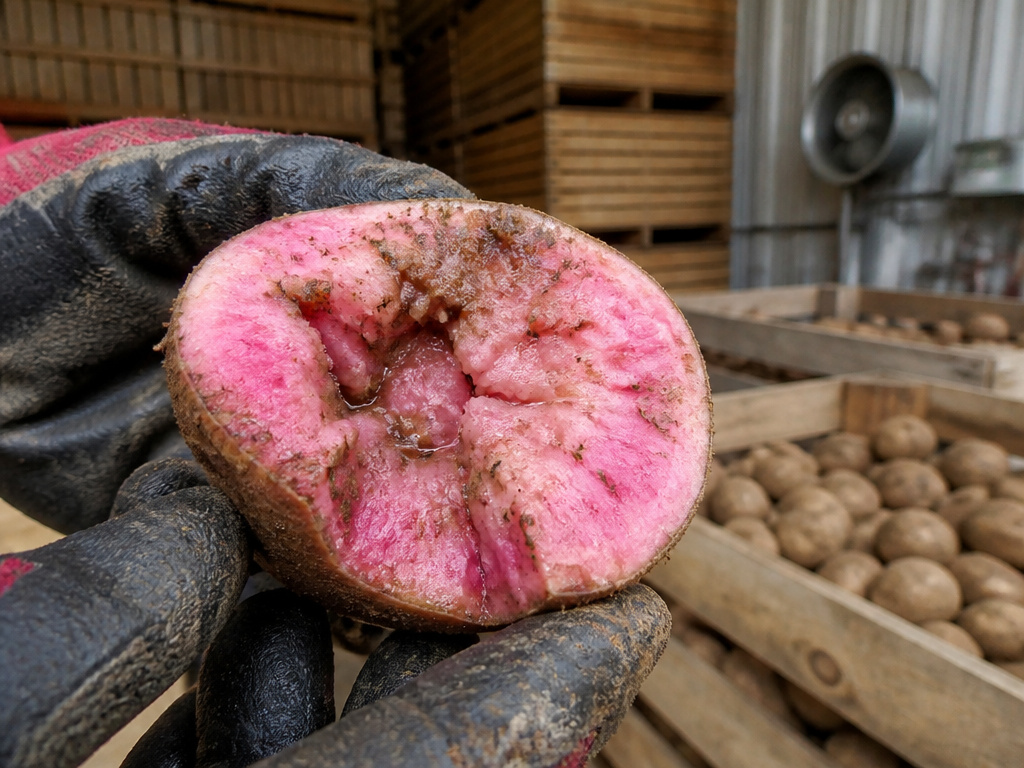
Pink Rot: This is a special case. Caused by Phytophthora erythroseptica, it’s a wet rot that can spread tuber-to-tuber. The University of Maine potato storage guide states modern storages can handle about 1% pink rot at intake, but even that’s tough. If levels are high, it becomes a salvage operation: cool quickly (but not to freezing), then warm the lot for a day or two before shipping to let breakdown occur where it can be culled.
For home gardeners facing similar issues on a smaller scale, the principles of preserving potatoes like curing and cool, humid storage still apply.
From Bulk Piles to Box Stores
 Not all potatoes are stored in million-pound bulk piles. The system adapts to the scale and market.
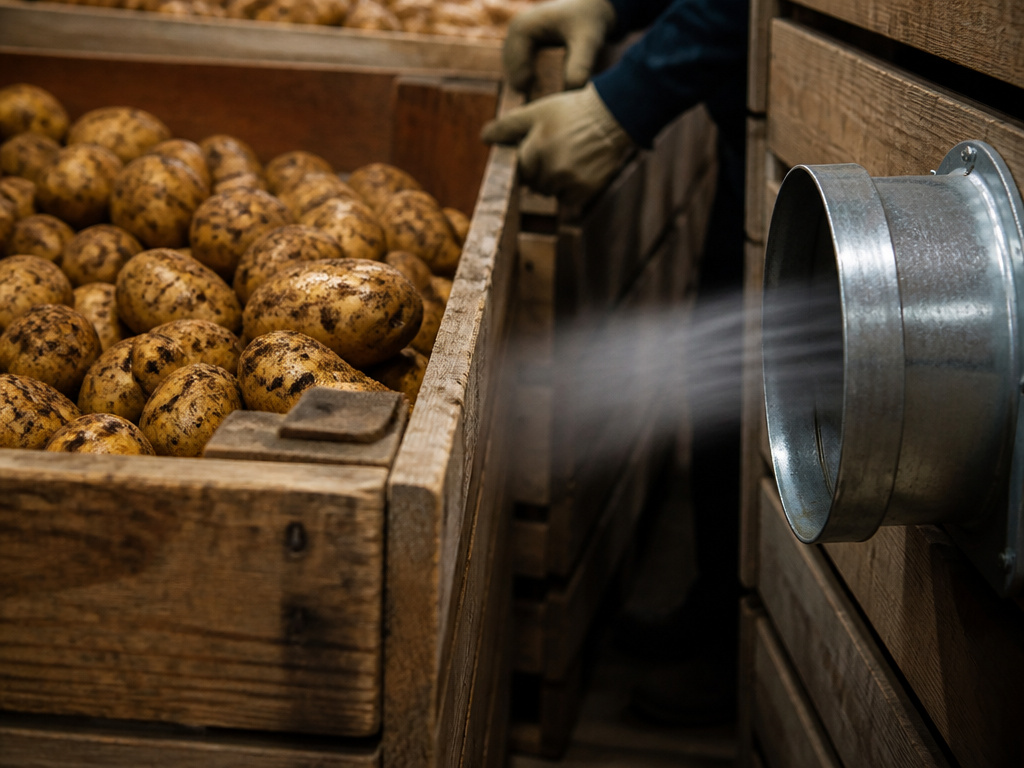
Box Storage (Bin Storage): Potatoes are stored in large wooden or plastic bins. This reduces pile pressure and bruising, allows for easier lot separation, and improves air circulation around each bin. It’s preferred for seed potatoes or high-value tablestock varieties. The same air rules apply, but the path of the air is around and through the slotted bins.
Clamp Storage: This is traditional, low-tech storage, often used in fields. Potatoes are piled in a long, low mound (the clamp), covered with straw for insulation, and then with soil. It’s governed by its own ISO standard for clamp storage. Control is passive, relying on soil temperature and breathable covers. It’s riskier but low-cost.
The choice between a high-tech ventilated warehouse and a simple root cellar follows the same logic: manage temperature, humidity, and air movement by whatever means you have. Whether you’re storing onions and potatoes together in a basement or a farmer managing separate climate zones, the goals are identical.
The Tools of the Trade
You can’t manage what you don’t measure. The modern potato store is a sensor network.
Temperature Probes: Placed at multiple depths and locations in the pile, these track the differential. The goal is a gradient of less than 1–1.5°C from top to bottom.
Relative Humidity Sensors: These monitor the air’s moisture-holding capacity. They must be accurate and calibrated.
Carbon Dioxide Monitors: Potatoes respire, producing CO₂. Levels above 1% can stress the tubers, affect fry color, and are a safety risk for staff entering the store. High CO₂ can also be an early indicator of a hot spot or disease outbreak.
Automated Control Systems: These tie it all together. They read the sensor data, compare outside conditions, and automatically decide whether to run fans, open vents, activate coolers, or recirculate air. They execute the rules so the manager can focus on exceptions.
Frequently Asked Questions
How long can farmers store potatoes?
With optimal conditions, most processing and fresh market potato varieties can be stored for 6–10 months. Seed potatoes are often stored through the winter and spring for summer planting. Success depends entirely on initial quality, precise disease control, and maintaining dormancy through temperature management.
Why can’t you store potatoes in the refrigerator at home?
Home refrigerators are typically set around 4°C (39°F). For many potato varieties, especially those destined for frying, this is too cold and induces “cold sweetening,” where starch converts to sugars. This leads to uneven browning and off-flavors when cooked. A cool, dark basement or pantry at 10–13°C (50–55°F) is better for storing potatoes at home.
What is the white powder on stored potatoes?
This is often dried condensation or residual soil. If it brushes off easily, it’s generally harmless. However, a white, powdery fungal growth could be a sign of disease like powdery scab. Proper initial cleaning and ventilation during curing should prevent most superficial moisture issues.
Can you store different potato varieties together?
It’s not ideal. Different varieties may have slightly different optimal storage temperatures and dormancy periods. Storing a long-dormancy variety with one prone to early sprouting can complicate management. Furthermore, if one variety carries a latent disease, it can spread. Farmers typically store by variety and lot for maximum control, a principle that also helps when storing sweet potatoes separately from other root crops.
How do farmers prevent potatoes from sprouting in storage?
Sprouting is controlled primarily by maintaining the correct low temperature for the potato type, which keeps them dormant. Humidity around 90-95% also helps suppress sprout initiation. In some commercial operations, a sprout inhibitor may be applied as a fog or gas before long-term storage, but temperature management is the primary and most natural tool.
The Bottom Line
Farmers store potatoes by manipulating the crop’s environment to keep it in a state of suspended animation. The magic isn’t a secret; it’s a published set of numbers: 10–13°C for curing, 90–95% RH for weight loss, 0.04 m³/s/t for ventilation.
The hard part is the relentless consistency. A single warm, humid air leak, one clogged fan, or a load of stressed tubers can unravel months of work. It’s a practice built on sensor data, mechanical systems, and the acknowledgment that the potato is still alive, breathing, and waiting. Whether the scale is a backyard clamp or a controlled-atmosphere warehouse, the principles of long-term carrot storage and other roots remain anchored in the same science of temperature, humidity, and air.
