
Where Do Pantry Moths Come From? How They Invade Your Food
This post contains affiliate links. As an Amazon Associate, we earn from qualifying purchases.
Pantry moths come from eggs laid inside or on packages of dry food at warehouses, stores, or in your home. The most common culprit, the Indian meal moth, can chew through thin plastic and cardboard, so an unopened box isn’t safe. An infestation starts when you bring home contaminated cereal, flour, nuts, pet food, or birdseed.
That fact about chewing changes everything. It means the standard advice of “check for holes” misses the early-stage infestation where larvae are still inside a sealed-looking package. By the time you see a moth, its offspring have often already tunneled into neighboring items.
What follows: the exact entry points, how to identify the invaders, the specific health risks most guides skip, and the cleanup timeline that actually works. This isn’t about scare stories. It’s about the mechanics of a small problem that becomes a big one, and how to shut it down for good.
Key Takeaways
- Pantry moths usually hitchhike into your home inside infested dry goods from the store; they don’t spontaneously generate from poor hygiene.
- Larvae of the Indian meal moth can chew through plastic bags and thin cardboard, contaminating “sealed” packages nearby.
- Beyond food spoilage, some pantry pests can introduce carcinogenic mycotoxins or cause physical irritation if ingested.
- Seeing moths for up to three weeks after cleaning is normal; persistence beyond that means you missed an infested item.
- Insecticide sprays near food are dangerous and ineffective; control relies on removal, sealing, and trapping.
The Unseen Cargo: How Infestations Really Begin
You don’t get pantry moths from a dirty kitchen. You buy them.
The UC Statewide IPM Program states it plainly: Pantry pests usually enter your home in an infested package of food. The eggs or tiny larvae are already present in that bag of flour, box of cereal, or sack of birdseed when you place it in your cart. They escaped detection at the milling, packaging, or warehouse level. This is the primary source, the patient zero of most home infestations.
Once inside, the lifecycle kicks off. A single female Indian meal moth can lay hundreds of eggs directly on or near a food source. The damage is done by the larvae—tiny, hungry caterpillars that spin silken threads as they feed, creating the telltale webbing and leaving behind frass (excrement). They attack a staggering range: cereal, grains, beans, nuts, flour, dried fruit, spices, chocolate, and dry pet food.
Common mistake: Assuming an unopened package is safe. The National Pesticide Information Center notes that larvae can chew through plastic bags and thin cardboard, so even unopened packages may become infested.
This chewing capability is the stealth bomber of pantry pests. A larvae-infested bag of rice can serve as a base camp, sending scouts into the neighboring box of crackers and bag of almonds, all without a visible hole until the population booms. This is why a single source can rapidly become a whole-cabinet problem.
Moth vs. Beetle: Knowing What You’re Fighting
Not every flying insect in your pantry is a moth. Beetles are equally common, and while the cleanup is similar, identification helps target your monitoring.
The Indian meal moth (Plodia interpunctella) is the most frequent offender. Adults are about 5/8 inch in wingspan. The base of the front wing is pale gray or tan, and the outer two-thirds are a distinctive reddish-brown with a coppery sheen. You’ll see them fluttering in a zigzag pattern near dusk or when disturbed.
Pantry beetles, like the red flour beetle or warehouse beetle, are smaller, hard-shelled, and crawl more than fly (though some can). The confusion often happens with the larvae: both moth and beetle larvae are small, off-white, and worm-like.
Here’s the quick visual diagnostic a professional would use:
| Pest Type | Adult Form | Key Identifying Feature | Primary Damage |
|---|---|---|---|
| Indian Meal Moth | 5/8″ wingspan, copper & grey wings | Flutters weakly; larvae spin dense webbing | Larvae consume food, leave frass & webbing |
| Flour Beetles | Tiny red-brown beetles, ~1/8″ long | Crawl in flour; give infested food a grayish hue & unpleasant odor | Adults & larvae consume; contaminate with odor |
| Warehouse Beetle | Small, mottled brown/black beetle | Larvae covered in fine hairs that can irritate mouth & throat | Larvae feed; hairs pose a physical health risk |
Why does the difference matter? The warehouse beetle introduces a specific risk most people miss. As noted in the UC IPM guide, setae (hairs) from the warehouse beetle larva can irritate the mouth, throat, and stomach of people who eat infested products. It’s not just about spoiled food; it’s about a direct physical irritant in your meal.
The Real Stakes: More Than Just Spoiled Food
Throwing out a bag of moth-ridden flour is annoying. The hidden risks are worse.
Pantry pests are vectors for microbes. In warm, humid conditions, they can introduce organisms that rot food. More critically, as the UC IPM guide points out, these pests might introduce microbes into the food that could produce mycotoxins. Mycotoxins are highly carcinogenic compounds. This moves the problem from the domain of nuisance into the realm of genuine food safety.
Then there’s the physical contamination. Beyond the beetle hairs, think about the entire ecosystem in an infested bag: larvae, shed skins, frass, and webbing. It’s all there, often ground into flour or mixed with cereal. The “disagreeable odor and taste” mentioned in the guides is your warning signal. If something smells off or has a sour, metallic scent, it’s already a loss.
Where this goes sideways: Using insecticide sprays on pantry shelves or near food. The California DPR pantry pests PDF and UC IPM are unequivocal: spraying pesticides on or near food may cause greater harm to you and your family than the pests would. The chemicals can contaminate food surfaces and packaging, posing a direct poisoning risk. Control relies on physical, non-chemical methods.
The Elimination Playbook: Clean, Contain, Monitor
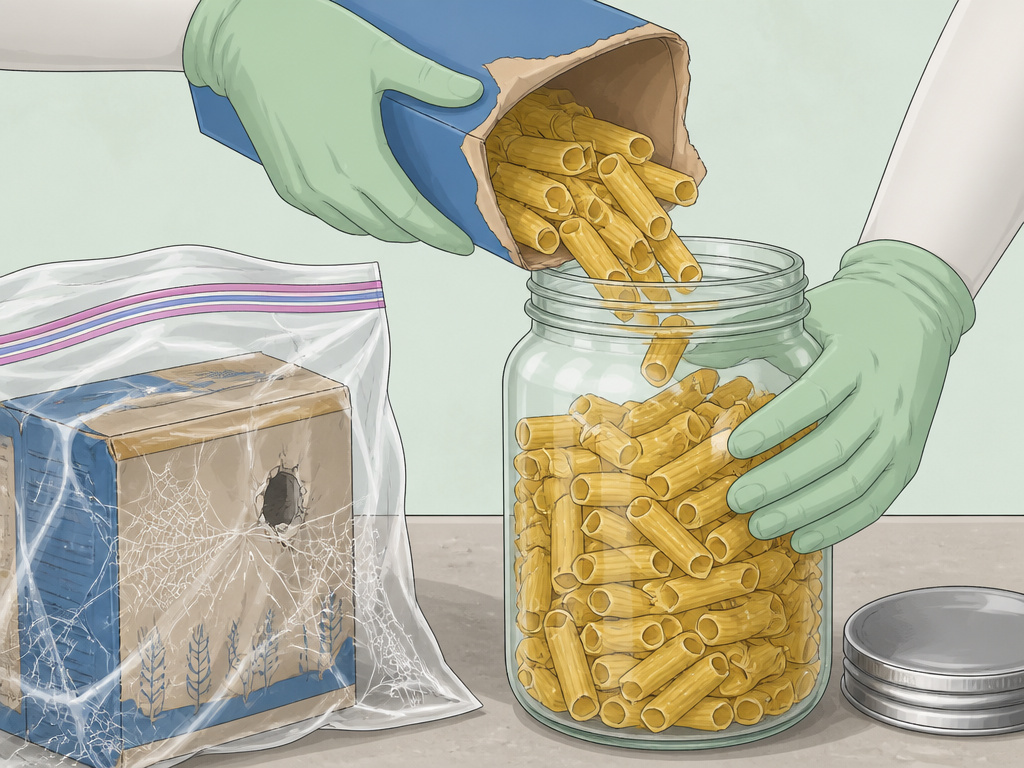
Getting rid of pantry moths is a three-act process: removal, isolation, and vigilance. Half-measures guarantee a comeback.
Step 1: The Total Clear-Out.
Empty every shelf, drawer, and cupboard that holds dry goods. This isn’t a spot-check. Inspect each item individually under bright light. Look for: * Silken webbing (like fine cobwebs) in box seams or bag folds. * Tiny holes in packaging. * Larvae crawling on the outside or clumped inside. * A dusty residue (frass) at the bottom of a container. When in doubt, throw it out. Place suspect items in a sealed plastic bag and dispose of it outside immediately.
Step 2: The Deep Clean.
Vacuum every corner, crevice, and shelf support with a crevice attachment. This sucks up wandering larvae, pupae, and eggs. Follow by washing all surfaces with warm, soapy water, then dry thoroughly. This removes any remaining food residue and sticky egg patches.
Step 3: The Quarantine & Storage Shift.
Any surviving food that passed inspection needs protection. Transfer all dry goods—flour, sugar, pasta, cereals—into airtight containers. Glass jars with sealing lids or thick, locking plastic containers are best. This creates a physical barrier that larvae cannot penetrate. It also makes your next inspection infinitely easier.
Step 4: Deploy Intelligence.
Install pheromone traps. These sticky traps contain a scent that attracts male Indian meal moths. They don’t eliminate an infestation, but they provide crucial intelligence. A trap catching moths tells you activity remains. Catching none means your clean-up likely succeeded.
The 3-Week Rule That Tells You If You’ve Won
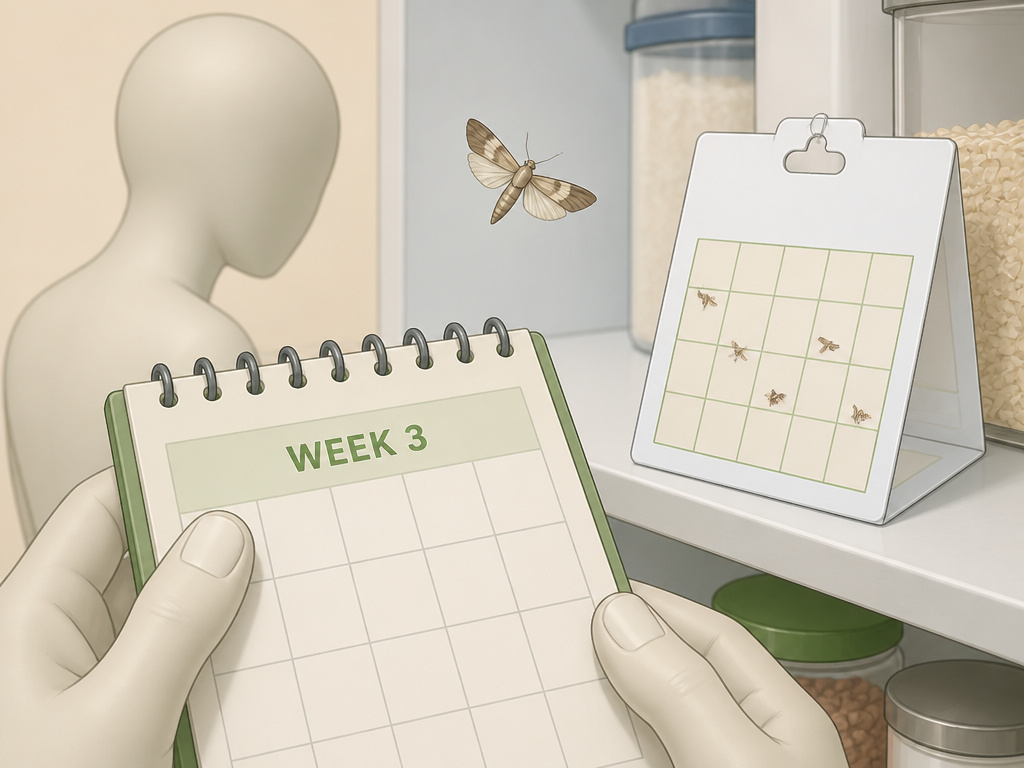
Here is the most frustrating, non-commodity fact about pantry moths: victory is not immediate.
The University of Minnesota Extension provides the critical timeline: It is not unusual to see an Indian meal moth flying for up to three weeks after the infested food has been thrown out. Adults that had already pupated before your cleanup will still emerge. Seeing them doesn’t mean you failed.
The part nobody mentions: If you continue to see Indianmeal moths after three weeks, that means there is an infested food source that you haven’t found yet. It’s still in your home.
This timeline is your benchmark. It resets the expectation from “clean once and done” to “clean once and monitor.” The pheromone traps are your gauge during this period. Pantry pests can live for many weeks without food, so persistence is key. Continue trapping for at least two months after the last sighting.
Freezing: Your Secret Weapon for Incoming Goods
You can’t control what happens at the warehouse, but you can create a dead-end for any stowaways.
For high-risk items like bulk flours, grains, nuts, or pet food, implement a freezer quarantine. Place the entire, unopened package in your freezer for a minimum of one week (four days is the absolute minimum, seven is better). The sustained cold kills all life stages—eggs, larvae, and pupae. After the freeze, you can transfer the contents to your airtight containers for shelf storage.
This is especially useful if you’ve had an infestation before and want to prevent a recurrence. Think of it as a mandatory customs inspection for all dry good imports. It’s a simple, non-chemical step that extends flour shelf life and nips problems in the bud.
Frequently Asked Questions
Can pantry moths get into sealed jars?
True, sealed glass jars with rubber gaskets or metal lids with tight seals are generally safe. However, moths can infest the lid threads or outer surface if there’s spillage. Always wipe jar rims clean before sealing.
Are pantry moths the same as clothes moths?
No. Clothes moths are smaller, more uniformly golden, and shyer. They eat keratin in wool, silk, and fur, not food. Pantry moths have the distinct copper-and-grey wing pattern and are found near foodstuffs.
I only see beetles, not moths. Is the process different?
The cleanup procedure is identical: remove infested food, clean thoroughly, and store in airtight containers. The monitoring tool changes; use pantry beetle traps (which often use food-oil lures) instead of moth pheromone traps.
Can an infestation spread to other rooms?
Yes. Mature larvae often crawl away from the food source to pupate in dark, undisturbed areas like ceiling corners, behind pictures, or in furniture joints. This is why vacuuming beyond the pantry is crucial.
What’s the best container to prevent future problems?
Glass is impervious. For plastic, look for containers with locking, silicone-gasket lids like those from OXO or Rubbermaid Brilliance. The seal must be physical and airtight; a simple snap lid isn’t enough.
The Bottom Line
Pantry moths come from the store, not from a lack of cleaning. They win by chewing through weak packaging and breeding faster than you can spot them. You win by breaking their lifecycle: find and remove every infested item, clean to remove every stray egg, and lock down everything else in fortress-grade containers. The three-week countdown starts the moment you finish cleaning. If moths are still flying after that, you missed a base. Go back, find it, and remember the freezer is your best friend for every new bag of flour that comes through the door.
