The ISO Standard for Storing Onions for 6 Months at Home
This post contains affiliate links. As an Amazon Associate, we earn from qualifying purchases.
Store onions for six months by holding them at 32–34°F (0–1°C) with 70–75% relative humidity and constant air circulation. This trio, temperature, humidity, airflow, comes straight from the ISO 1673:1991 international storage standard and commercial cold-chain protocols. Most home methods fail by missing just one.
The gap between a home pantry and a seven-million-pound cold store involves three specific, measurable variables. Get one wrong and the clock starts: sprouting, mold, or a disorder called translucent scale that turns the outer layers to mush.
What follows is the commercial playbook adapted for a basement, garage, or spare fridge. We’ll cover the ISO standard’s numbers, the one mistake that ruins onions next to potatoes, and how to spot an onion that’s already too far gone to store.
Key Takeaways
- The ISO 1673:1991 standard calls for 70–75% relative humidity, not the 65% often cited, the extra 5-10% prevents excessive moisture loss without encouraging mold.
- Translucent scale, a storage disorder resembling freezing injury, is triggered by delaying the move to cold storage after curing by just 3–4 weeks.
- Air circulation is measured: you need 1 cubic meter of air per minute for every cubic meter of onions to prevent gas buildup and even cooling.
- Never store onions near potatoes. Potatoes release moisture and ethylene gas, forcing onions to sprout and rot weeks ahead of schedule.
- Pungent, thick-skinned varieties like Yellow Globe or Spanish onions can last 6–9 months at 32°F; sweet, thin-skinned varieties (Vidalia, Walla Walla) last a month at best.
The 3 Pillars of Six-Month Onion Storage
Forget “cool, dark, and dry.” That’s a starting point for a few weeks, not half a year. Long-term storage is an engineering problem with three controlled inputs. Miss one and the timeline collapses.
ISO 1673:1991, the international standard for onion storage, specifies a temperature range of -1°C to +1°C (30–34°F) for artificially refrigerated storage, a relative humidity of 70% to 75%, and an air-circulation ratio of 20 to 30 room-volume changes per hour to manage respiration gases and ensure uniform conditions.
The goal is to put the onion to sleep. You’re mimicking the dormant period it would experience in the ground over winter. This stops sprouting from the center and slows the respiration that turns sugars into off-flavors.
Pillar 1: Temperature. It’s Not Just “Cold”
32°F (0°C) is the bullseye. The WFLO Commodity Storage Manual for onions lists this as the temperature for maximum quality and shelf life. Why not colder?
Go below 30°F and you risk internal freezing. The water inside the cells expands, rupturing walls. The damage might not show up for months, manifesting as translucent scale, a water-soaked, glassy appearance in the outer rings. The manual notes this disorder “occurs usually after 4 to 6 months of storage” and is often a sign of borderline freezing injury.
Your home options are a dedicated refrigerator drawer, a cold cellar that stays reliably in the low 30s, or an insulated garage in a cold climate. A regular kitchen cupboard won’t cut it.
| Storage Location | Typical Temperature Range | Suitability for 6-Month Storage |
|---|---|---|
| Kitchen Counter/Pantry | 65–75°F (18–24°C) | Poor – 1 month max for pungent onions |
| Basement (unheated) | 50–60°F (10–16°C) | Moderate – 2-3 months with perfect humidity |
| Refrigerator Crisper | 35–40°F (2–4°C) | Good – 4+ months for pungent varieties |
| Dedicated Fridge/Colt Room | 32–34°F (0–1°C) | Excellent – 6-9 months for proper cultivars |
Pillar 2: Humidity. The 70–75% Sweet Spot
This is where most home advice gets it backwards. You’ll read “keep onions dry” and aim for 60% humidity. That’s a mistake. At 60% RH, onions lose moisture too quickly through their papery skins. They shrink, wrinkle, and the inner layers become tough.
The ISO 1673 onion storage guide explicitly recommends 70% to 75% relative humidity. The goal is equilibrium: the air holds enough moisture that the onion doesn’t desiccate, but not so much that free water condenses on the surface and invites mold.
In a fridge, the crisper drawer with the humidity vent closed creates this environment. In a basement, you might need a humidistat and a small humidifier if your air is very dry. The opposite problem, too damp, is more common. If you see condensation on your onions or their bag, you’ve lost. Mold follows within days.
Pillar 3: Air Flow. It’s About Gas Exchange
An onion is alive. It breathes, taking in oxygen and releasing carbon dioxide and water vapor. In a sealed bag or a crowded bin, that gas builds up. High CO2 concentrations accelerate spoilage and create off-flavors.
Commercial facilities use massive fans to move air. The standard calls for 1 cubic meter of air per minute per cubic meter of bulbs. At home, this means never using sealed plastic. Your tools are mesh bags, open baskets, or slotted wooden crates. Hang them or space them so air can move on all sides.
This constant, gentle breeze also prevents “hot spots.” An onion pile generates its own heat from respiration. Without airflow, the center of the pile can be 10 degrees warmer than the edges, creating a perfect pocket for rot to start.
Selecting and Preparing Onions for the Long Haul
Not every onion is built for a six-month nap. The variety, its maturity at harvest, and how you handle it post-harvest decide everything.
Start with the right cultivar. Pungent, storage-type onions are your only option. Look for Yellow Globe, Copra, Patterson, or Redwing. These have high solids content, tight skins, and small necks. Sweet onions like Vidalia or Walla Walla have thinner skins and higher water content. They’re a treat in season but will turn to mush by month two, regardless of your perfect setup. The University of California Davis notes pungent onions can last 6–9 months at 32°F, while mild onions last only 0.5 to 1 month.
Inspect each bulb. Your six-month stockpile is only as strong as its weakest link. Reject any onion with: – A thick, green, or soft neck (it didn’t cure properly and will rot from the top down). – Bruises, cuts, or punctures (these are entry points for rot). – Visible mold or soft spots. – Signs of sprouting (a small green tip emerging from the neck).
Cure them if they aren’t already. True curing happens in the field over two weeks of dry, warm weather. If you bought onions still damp or with dirt-clogged skins, you must replicate this. Spread them in a single layer in a warm (75–80°F), dry, airy place for 7–10 days. The outer skins should turn papery and rustle when touched. The neck will tighten and shrink. This process seals the onion, locking in moisture and sealing out pathogens.
Where this goes sideways: Skipping the cure on marginally mature onions. The neck stays open, acting as a wick for moisture and bacteria. A soft rot will develop in storage, often undetected until you squeeze the bulb and a foul liquid oozes from the neck.
Step-by-Step: Setting Up a Six-Month Storage Zone
You don’t need a seven-million-pound cold store. You need to apply the three pillars to whatever space you have.
1. Choose and Prep Your Space.
A spare refrigerator is ideal. Empty the crisper drawer, wipe it with a vinegar solution, and let it dry. Adjust the thermostat to its coldest setting (usually around 34°F). If using a basement or garage, monitor the temperature for a week with a digital hygrometer/thermometer. It must stay between 32–40°F. Install a small, battery-powered fan for air movement if the space is dead still.
2. Package for Air Flow.
Dump the plastic produce bag. Transfer your cured, inspected onions into a mesh produce bag, a nylon stocking (one onion per leg, tied between bulbs), or a wide, shallow wooden or plastic crate. The container must have openings on all sides.
3. Load and Monitor.
Place the container in your cold space. Do not stack onions more than two layers deep. If using a fridge crisper, leave the humidity control closed (this raises RH). Place your hygrometer inside the drawer or next to the crate.
4. The Monthly Check.
Every 4–5 weeks, do a two-minute inspection. Feel each onion for soft spots. Sniff for any sour or moldy odors. Remove any suspect bulbs immediately, one rotting onion releases ethylene gas that speeds spoilage in its neighbors. This simple culling is the single biggest factor in making a batch last.
Why Onions and Potatoes Are Enemies
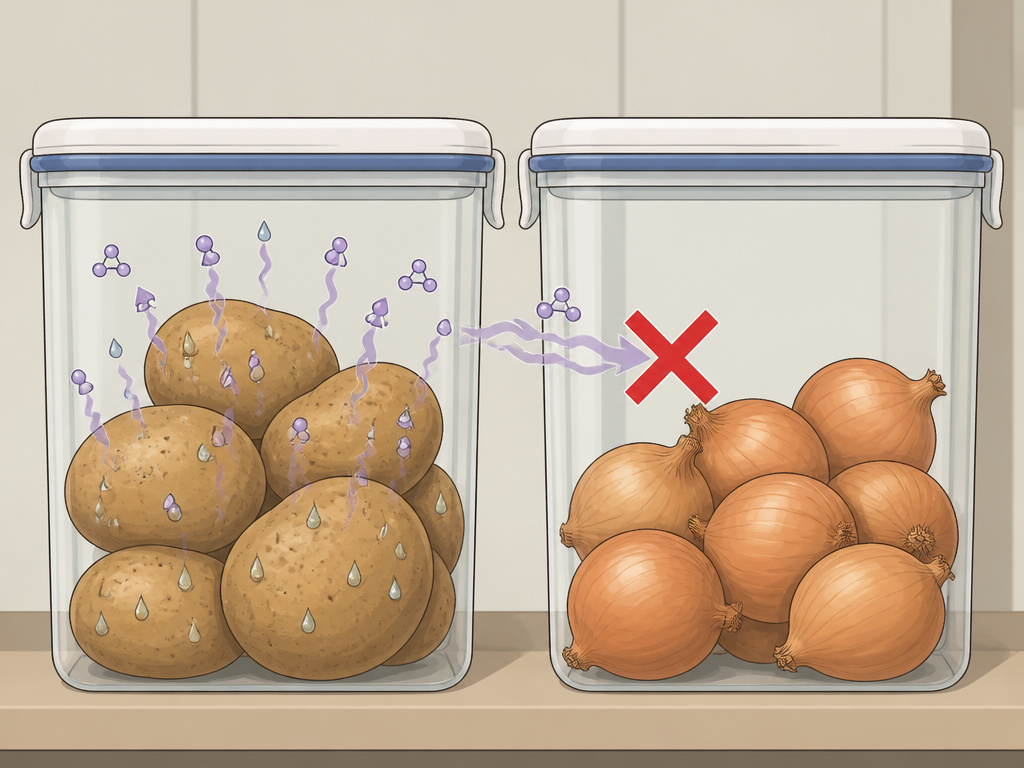
This is a matter of plant physiology.
Potatoes release moisture and ethylene gas, a plant hormone that triggers ripening and sprouting. An onion stored next to a potato is bathed in this gas. The onion interprets it as a signal to break dormancy and grow. It mobilizes its stored sugars to send up a green shoot, hollowing itself out and becoming bitter and soft in the process.
The Oregon State University onion storage guidelines treat them as separate commodities for a reason. Their ideal storage climates are also different. Potatoes want colder (38–40°F) and more humid (90-95% RH) conditions. For practical food storage at home, this means dedicating separate, sealed containers if they must share a fridge drawer. Better yet, use a different space entirely.
The same rule applies to storing onions and potatoes in a root cellar. Keep them on opposite sides of the room, or better, in separate, ventilated bins.
Troubleshooting: What Went Wrong and How to Fix It
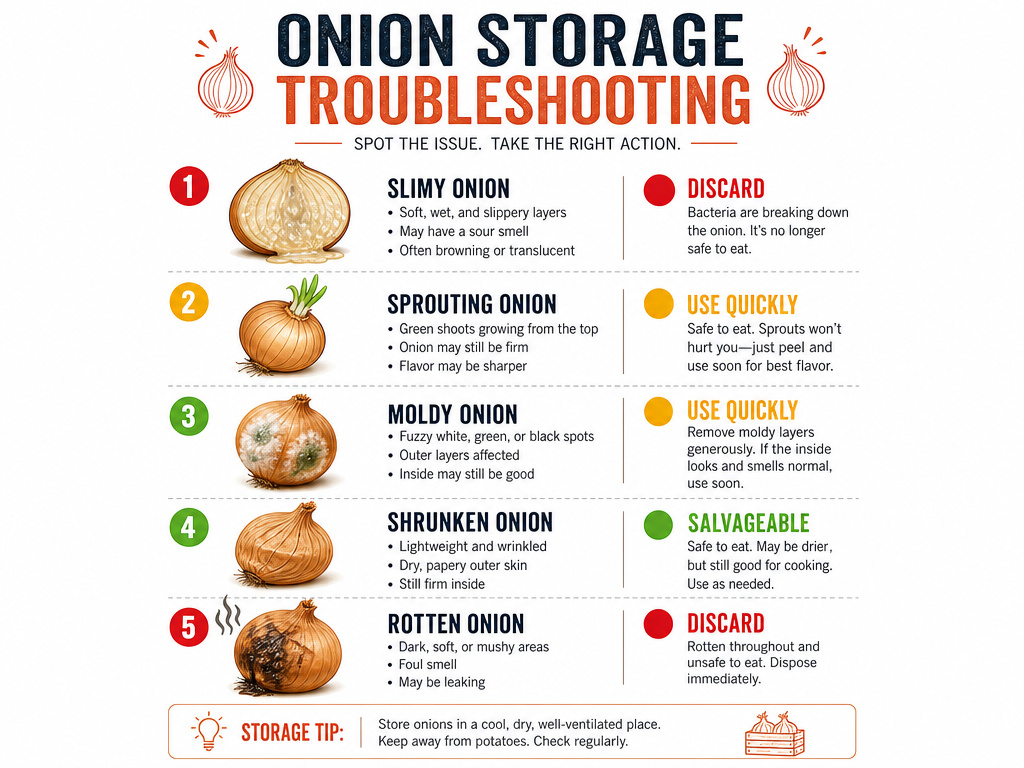
Even with perfect setup, things can degrade. Here’s how to diagnose the most common failures.
| Symptom | Likely Cause | Fix & Salvage |
|---|---|---|
| Outer scales are soft, translucent, slimy | Temperature too low (freezing injury) or humidity far too high. | Cannot reverse. Peel away affected layers. Use the firm inner bulb immediately; do not return to storage. |
| Green sprout emerging from neck | Storage temperature too warm, or exposure to ethylene gas (from potatoes). | Sprout can be cut off. Onion is still usable but will be less pungent and may have a hollow center. Use within a week. |
| Black or grey mold on skins | Condensation formed on bulbs, or one rotten onion contaminated others. | Isolate all onions. Wipe unaffected bulbs with dry cloth. Increase air circulation dramatically. Use within days. |
| Onion feels light, skins are shrunken and brittle | Humidity too low; excessive moisture loss. | Too late to rehydrate. Use in cooked dishes where texture loss matters less (soups, stews). |
| Foul smell, especially from the neck | Bacterial soft rot entered through an uncured neck or bruise. | Discard immediately. Check neighboring onions for softness. |
Translucent Scale: The Silent Storage Killer
This disorder deserves its own warning. It looks like the onion was soaked in water, the outer scales turn glassy and greyish-yellow. It’s often mistaken for freezing damage, and the mechanism is similar.
The part nobody mentions: Translucent scale is triggered by a delay. If you cure onions at room temperature but then wait 3–4 weeks before moving them to proper cold storage (32°F), the risk skyrockets. The cells at the edge of the bulb have already begun to break down in the warmth. When they finally hit the cold, they can’t handle the stress and leak cell sap into the spaces between scales.
The damage is internal and progressive. You might not see it until you peel the onion months later. Prevention is the only cure: cure quickly and get them cold promptly. If you buy onions, ask when they were harvested. If it’s been over a month and they’ve been warm, plan to use them within a few weeks, not months.
Frequently Asked Questions
Can I store cut onions for six months?
No. A cut onion’s protective layers are breached. It will lose moisture, absorb fridge odors, and grow bacteria long before six months. For storing cut onions, wrap the cut face tightly in plastic and use within 2-3 days. For longer preservation, chop and freeze them.
Is basement storage good enough for six months?
It depends entirely on your basement’s climate. An unheated, dry basement that stays between 32–40°F with 70% RH can work. Most home basements are warmer (50–60°F) and damper. In that case, basement storage might get you 2-3 months for pungent onions, not six. You’ll need to monitor humidity and add fan-forced air circulation.
How do I store sweet onions for a long time?
You don’t. Sweet onions (Vidalia, Maui, Walla Walla) are a short-season delicacy. Their genetics and high water content make them poor candidates for long-term storage. The best methods for storing whole onions of this type involve a perforated bag in the fridge, where they might last 4-6 weeks. Enjoy them fresh.
Can I store onions and garlic together?
Yes. Garlic and onions share nearly identical storage needs: cool, dry, ventilated, and dark. You can keep them in the same mesh bag or basket. Their scents might mingle slightly, but they won’t hasten each other’s spoilage like potatoes do.
What’s the best container for long-term onion storage?
Mesh bag is the gold standard. It provides maximum air flow, lets you see inside, and allows for easy inspection. Avoid solid plastic bins, sealed buckets, or closed cardboard boxes, they trap humidity and respiration gases.
The Bottom Line
Six-month onion storage requires a checklist: a pungent variety, cured, flawless, and held at 32°F with 70% RH and constant air movement. The moment you compromise on one element, a warm spot, a sealed bag, a bruised bulb, the timer shortens.
The commercial world runs on these numbers from the ISO and GCCA manuals for a reason. They work. At home, your target is the humble spare fridge crisper and a mesh bag. Nail those three pillars and you’ll pull firm, pungent onions from the same bag next March. Miss one, and you’ll be buying them by New Year’s.
