How to Store Seeds Long Term | The 3–8% Moisture Rule
This post contains affiliate links. As an Amazon Associate, we earn from qualifying purchases.
Store seeds long term by drying them to 3–8% moisture and sealing them in an airtight container with a desiccant, then placing that container in the back of a freezer set at 0 to –5°F (–18 to –21°C). This cold-dry-dark method slows biological decay to a crawl, preserving viability for a decade or more.
That 3–8% moisture target is the threshold the Minnesota Department of Agriculture sets for moving from short-term fridge storage to genuine long-term archiving. Most kitchen jar storage misses it by half because a fridge’s humidity sits around 90% inside an unsealed container.Your seeds are slowly drowning.
What follows is the breakdown of why moisture, temperature, and light are the only three variables that matter, how to hit the right numbers with household tools, and which seeds break the rules entirely.
Key Takeaways
- Long-term means 3–8% moisture. Seeds stored at ~12% moisture (typical fridge humidity) lose viability in 2–5 years. Dropping below 8% pushes their lifespan past a decade.
- Your fridge is a humid cave. Domestic refrigerators often exceed 90% relative humidity. Storing seeds there in a paper envelope is a fast track to mold and early death.
- Freezers demand perfect dryness. Never freeze seeds with high moisture content. Ice crystal formation shreds cell structures, killing the embryo.
- Orthodox vs. Recalcitrant changes everything. Beans, tomatoes, and peppers are orthodox and love dry-cold storage. Tropical seeds like mango or lychee are recalcitrant and will die if dried.
- Silica gel is the shortcut. A packet in a sealed jar creates a 2–3% RH microclimate, passively drying seeds to the target range without an oven.
The 3 Targets: Moisture, Temperature, and Light
Forget complicated formulas. Seed longevity hinges on three physical conditions: low moisture, low temperature, and the absence of light. Get these right and the calendar matters less.
Seeds stored at 15% relative humidity will dry to about 6% moisture content, a level that supports viability for many years. At 90% relative humidity, seeds only dry to 19% moisture, and germination fails within one year. This relationship between ambient humidity and seed moisture is non-negotiable.
Moisture is the primary killer. Seeds are hygroscopic. They constantly exchange water vapor with the air around them. High moisture wakes the embryo’s metabolism, burning through its finite stored energy until nothing is left for germination. The official University of Hawaii seed storage guidelines frame dehydration as the first and most critical conservation step.
Temperature dictates speed. Chemical reactions, including decay, slow by roughly half for every 10°C (18°F) drop in temperature. A seed that lasts one year at 70°F will last two years at 60°F, four years at 50°F, and so on. This is why freezing is so powerful. The UC Davis seed harvest factsheet notes that storage at -20°C can extend life by decades.
Light, specifically UV, damages DNA. It’s a slower, cumulative attack. Storing seeds in amber glass or opaque containers in a dark freezer corner addresses this completely.
| Storage Factor | Ideal Long-Term Target | Common Mistake & Consequence |
|---|---|---|
| Moisture Content | 3–8% (per MDA guidelines) | Storing at ~12% (fridge humidity). Seeds last 2–5 years, not 10+. |
| Temperature | 0 to –5°F (–18 to –21°C) | Using the fridge (32–41°F). Decay rate is 4–8 times faster. |
| Light Exposure | Zero UV / minimal light | Clear glass jars on a shelf. UV damage accumulates, reducing vigor. |
| Container | Airtight seal (glass jar with gasket) | Paper envelope or breathable bag. Seeds absorb ambient humidity daily. |
Why a freezer beats a refrigerator every time. A fridge’s job is to keep food moist. Its defrost cycle creates humidity spikes. Even at 32–41°F, the relative humidity inside can hit 90%. That’s a death sentence for seeds aiming for 6% moisture. A freezer is not only colder but its air is drier. The CSU Extension seed storage resource confirms that below-freezing temperatures are essential for storage life measured in decades, not years.
Orthodox vs. Recalcitrant: The Seed Storage Divide
Not all seeds follow the same rules. Your storage plan collapses if you don’t know which category your seeds belong to.
Orthodox seeds are the majority of garden vegetables: tomatoes, peppers, beans, lettuce, kale. They tolerate extreme drying and cold. Their metabolism switches off completely below a certain moisture threshold. These are the only seeds the long-term freezer method is designed for.
Recalcitrant seeds include many tropical fruits (mango, lychee, avocado), some nuts, and certain temperate trees like oak. They cannot survive drying below a high moisture content (often 20-70%). Dehydration irreversibly damages their cellular structure. Cold is also tricky—too cold and ice crystals form; too warm and they sprout or rot. They require specific, often professional, seed preservation techniques like cryopreservation.
Intermediate seeds, like some beans and brassicas, tolerate drying but then die during long dry storage at low temperatures. They’re a frustrating middle ground.
Where this goes sideways: Treating all seeds the same. Putting recalcitrant mango seeds in a jar with silica gel guarantees failure within weeks. They’ll dehydrate, crack internally, and never germinate.
If you’re saving garden seeds, you’re almost certainly dealing with orthodox seeds. That’s the assumption for the rest of this guide. If you’ve foraged something unusual, look up its storage category first.
Step-by-Step: Drying and Seeding Your Long-Term Vault
The process isn’t hard, but it is precise. Skip a step and you’re just postponing failure.
1. Dry to the Correct Moisture Level
You cannot store what isn’t dry. The goal is 3–8% moisture. You have two reliable paths.
Air drying works in low-humidity climates (RH under 50%). Spread seeds in a single layer on a screen or plate in a shaded, breezy spot indoors. This can take 1-2 weeks. Don’t use direct sunlight—temperatures can soar past 100°F and damage seeds.
Desiccant drying is the surefire method for any climate. Place seeds in a sealed container with a larger quantity of silica gel beads. The gel will pull moisture from the seeds until equilibrium is reached at 2-3% RH, which correlates to ~5% seed moisture. This takes 7-10 days.
Do not use a microwave or conventional oven unless you can precisely control the temperature. The CSU Extension guide mentions oven drying at 100°F with the door open, but 10 degrees too hot and you cook the embryo.
2. Choose and Prepare Your Container
Your container must provide an airtight seal and block light. The common advice to use paper envelopes inside a shoebox fails the humidity test.
Glass Mason jars with two-piece metal lids are the default. The rubbery compound on the underside of the lid creates the seal. For light blocking, use amber-colored jars or store clear jars inside an opaque box.
Add a desiccant. Even if seeds are dry, a silica gel packet inside the jar acts as a humidity monitor and guardian. If the jar is ever opened in humid air, the gel absorbs that moisture first, sparing the seeds. Use indicator gel that changes color when saturated.
Label meticulously. Include the seed variety and the date of storage. Viability declines over time even under perfect conditions; you need to know how old your stash is.
3. The Freezer Transition
This is the most delicate step. Never put a warm or damp jar into a freezer.
- Seal your dry seeds and desiccant in the jar at room temperature.
- Place the sealed jar in the refrigerator for one week. This allows the entire contents to reach a uniformly cold temperature slowly, preventing condensation.
- After a week, move the jar to the back of the freezer. Choose a spot against the rear wall where the temperature is most stable and light never reaches.
The one step nobody skips: Letting the jar come fully to room temperature before opening it after removal from the freezer. Opening a cold jar in warm, humid air causes immediate condensation to soak your seeds. Plan your seed retrieval a day ahead.
What Not to Do: Common Mistakes That Kill Viability
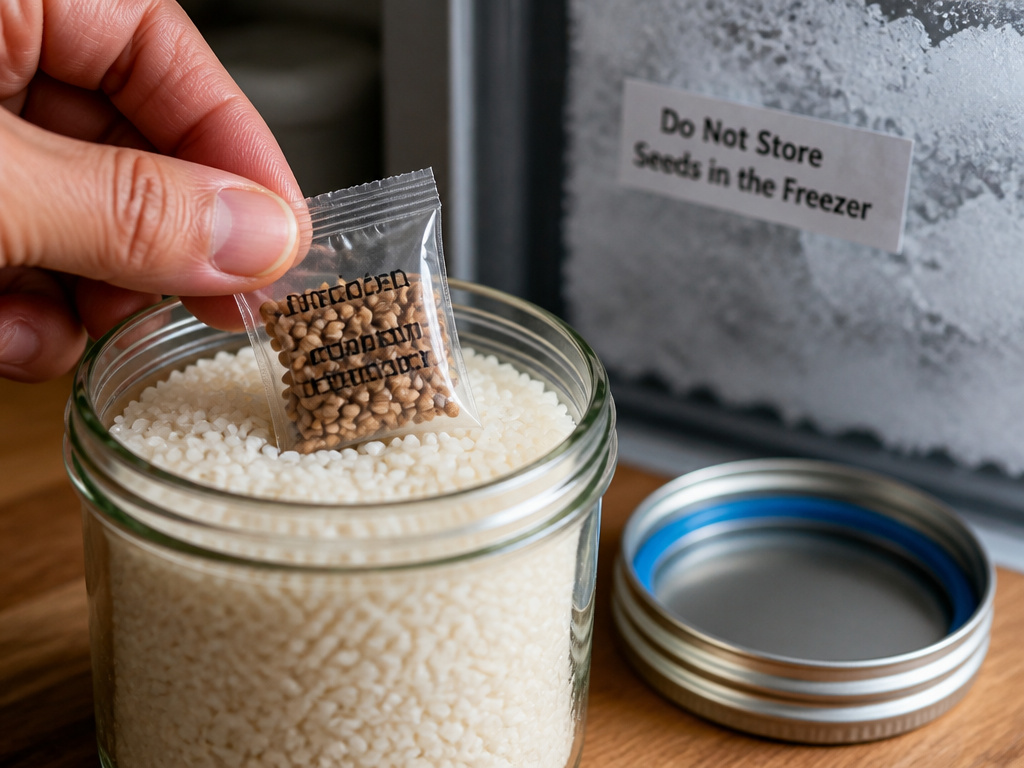 These are the reasons most home-saved seed batches fail.
Storing in a refrigerator without an airtight seal. This is the #1 error. That plastic tub or paper bag is letting in 90% RH air. Your seeds are in a tropical swamp, not a stable archive.
Freezing seeds that are too moist. Ice is sharper than any blade at a cellular level. If you haven’t positively dried your seeds to at least below 12% moisture, the freezer will destroy them.
Using plastic bags long-term. Most plastics are slightly permeable to water vapor over months. They also accumulate static, which can physically damage tiny seeds. They’re fine for a single season, not for a decade.
Ignoring seed type. Trying to save squash seeds when you grew multiple varieties close together will give you unpredictable crosses. You might get a monster, but not what you planted.
Forgetting about pelleted or primed seeds. These are commercially pre-germinated or coated seeds. Their shelf life is often less than one year, and freezing can damage them. Use them the season you buy them.
How to Store Specific Seed Types Long-Term
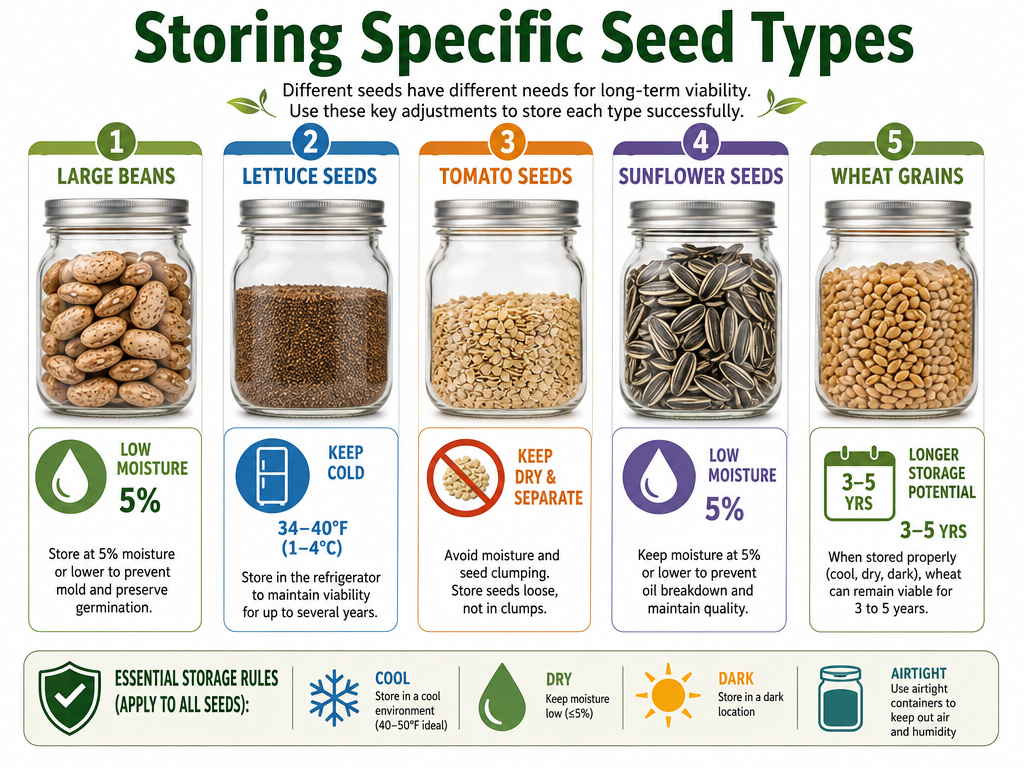 The core cold-dry-dark method applies, but some categories need tweaks.
Beans and Peas: These are large and easy. Let pods dry on the plant until they rattle. Shell them, then do a final desiccant dry to ensure internal moisture is low. Some beans are intermediate seeds, so don’t push them below 8% moisture—aim for 10-12% and store in the fridge, not freezer. This aligns with the same careful approach needed for long-term bean storage.
Tomatoes and Peppers: Fermenting tomato seeds removes germination inhibitors and disease. For both, ensure seeds are thoroughly dry after washing or scraping. Their small size means they can clump; break up clumps before storage.
Lettuce and Small Seeds: Their tiny size makes them prone to static and hard to handle. Dry thoroughly, consider mixing with a bit of dry rice or silica sand in the jar to prevent clumping, and use fine mesh or a sieve when planting.
Grains and Cereals (Wheat, Corn): These are typically stored at 13–14% moisture for food purposes, but that’s too high for long-term seed saving. For viability, dry them to the 8-10% range. They are orthodox and handle freezing well.
Oilseeds (Sunflower, Canola): High oil content makes them spoil faster. They require stricter drying to 7–8% moisture and excellent sealing to prevent rancidity. Use them within 5 years even under ideal conditions.
| Seed Type | Special Consideration | Recommended Storage Adjustments |
|---|---|---|
| Beans (Intermediate) | Can be damaged by over-drying. | Target 10-12% moisture. Use refrigerator, not freezer. |
| Tomatoes | Benefit from fermentation cleaning. | Ensure no clumps after drying. Standard freezer protocol. |
| Lettuce | Very small, prone to static. | Add inert desiccant (dry rice) to jar to prevent clumping. |
| Oilseeds (Sunflower) | High oil content goes rancid. | Dry to 7–8%. Plan for shorter storage lifespan (3-5 years). |
| Pelleted/Primed Seeds | Commercially pre-germinated. | Do not store long-term. Use within the growing season. |
The Role of Desiccants and Oxygen Absorbers
These tools aren’t magic, but they are force multipliers.
Silica gel is a desiccant. It controls humidity. In a sealed jar, it creates and maintains a bone-dry environment (2-3% RH). This passively dries seeds to their ideal moisture level and protects against minor seal leaks. It’s the single best upgrade for any home seed bank.
Oxygen absorbers are different. They remove oxygen from the sealed environment. For food storage, this prevents oxidation and insect growth. For seeds, the science is less clear. Low temperature and moisture are the dominant factors for longevity; an oxygen-free environment might offer a slight additional benefit, but it’s not essential. If you use them, add them after drying is complete—they need moisture to activate.
Don’t use rice. Dry rice is a poor desiccant compared to silica gel. It can introduce dust, fragments, and even weevil eggs into your seed jar.
A simple setup that works for 90% of gardeners: a quart-sized amber Mason jar, a cup of indicating silica gel beads at the bottom, and your paper seed packets placed on top. Seal it. That jar, kept frozen, is a time capsule.
Frequently Asked Questions
Can you store seeds in a freezer?
Yes, a freezer is ideal for long-term storage of orthodox seeds, but only after they have been dried to 3–8% moisture and sealed in an airtight container. Freezing wet seeds causes lethal ice crystal damage.
How long can seeds last in long-term storage?
With proper drying (3–8% moisture) and storage at 0 to –5°F (–18 to –21°C), many orthodox vegetable seeds can remain viable for 10 years or more. Some, like tomatoes and peppers, may last 15+ years under these conditions.
Is it better to store seeds in paper or plastic?
For long-term storage, neither alone is sufficient. Seeds should be placed in paper envelopes (which allow moisture transfer during drying) and then those envelopes should be sealed inside an airtight glass or metal container with a desiccant. This combines the breathability of paper with the humidity lock of a sealed vault.
Do seeds need light to stay viable?
No. Light, especially UV light, damages seed DNA and reduces viability over time. Seeds should always be stored in darkness. Amber glass jars or opaque containers stored in a freezer’s dark interior are perfect.
Can you store all types of seeds this way?
No. This method is only for orthodox seeds (most common vegetables and flowers). Recalcitrant seeds (e.g., mango, avocado) and intermediate seeds (some beans) have different requirements and may be killed by the drying and freezing process.
What is the biggest mistake in home seed storage?
Storing seeds in a standard refrigerator without an airtight moisture barrier. The humidity inside a fridge is often 90% or higher, which slowly raises seed moisture content and leads to mold, premature germination, or loss of viability within a few years.
Before You Go
Long-term seed storage is about controlling three physical conditions: moisture, temperature, and light. Hit the numbers—3–8% moisture, below 0°F, in total darkness—and time becomes your ally.
Dry your seeds thoroughly with silica gel. Seal them in a glass jar. Put that jar in the back of your freezer. That’s the entire system. It protects your gardening future and turns seed saving from an annual chore into a one-time investment. Start with your favorite tomato and pepper varieties this season. In a decade, you’ll still be planting from your own stash.
