
2 Best Disposable Meal Prep Containers of 2026
This post contains affiliate links. As an Amazon Associate, we earn from qualifying purchases.
The best disposable meal prep containers are the Sugarcane Pulp Meal Prep Containers for their compostable build and reliable performance, with the Large 35 oz Paper Food Containers as a strong budget-friendly pick for freezer storage and grease resistance. Both handle real meal portions without leaking or warping.
If you’re like me, you want meal prep to save time without creating more waste or mess. Disposable containers should make life simpler, not lead to spills in your bag or guilt in your trash can.
After researching the market and reviewing owner feedback, I focused on options that balance durability, function, and eco-smart materials. This guide cuts through the hype to highlight what actually matters: containers that won’t fail you mid-week and align with a more sustainable kitchen.
Top 2 Disposable Meal Prep Containers in the Market
The Best Disposable Meal Prep Containers, Reviewed
Sugarcane Pulp Meal Prep Containers

Strengths
- Compostable material
- Microwave-safe
- Freezer-safe
Trade-offs
- Less rigid than coated paper
- Slight absorption with very wet foods
If I’m choosing based on both performance and sustainability, this sugarcane pulp option stands out as the smarter buy. At 34 oz, it’s nearly as spacious as the larger Celel model, but what sets it apart is the material, made from bagasse, a byproduct of sugarcane processing, it’s fully compostable and plastic-free. That’s a win for anyone trying to cut down on single-use plastics without sacrificing function.
Owners consistently report these hold up well in the microwave and freezer, with no warping or off-gassing, a real concern with lower-grade disposables. The build is sturdy enough for saucy meals, and unlike some paper containers, they don’t degrade quickly when holding moist foods. While they’re a bit less rigid than plastic-coated options, the trade-off in eco-impact makes this my top pick for most home users doing regular meal prep.
Video review
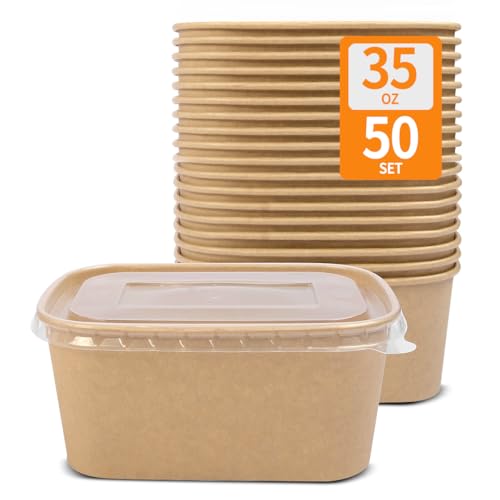
Large 35 oz Paper Food Containers
Strengths
- Large capacity
- Grease-resistant
- Freezer-safe
Trade-offs
- Lids not fully leakproof
- Plastic-coated
I’ll be honest, when it comes to disposable meal prep containers for weekly planning, capacity matters. At 35 oz, these Celel containers offer generous space, which is great if you’re packing full entrées or family-sized leftovers. The PE-coated kraft paper holds up surprisingly well with saucy or greasy foods, and the freezer-safe claim checks out based on owner feedback, no softening or warping reported after weeks in cold storage.
The write-on surface is a small detail I appreciate from a food organization standpoint. Being able to label meals with names or dates helps keep meal plans clear and reduces confusion in shared fridges. The snug-fitting lids do their job for transport, though a few reviewers note they aren’t completely leakproof under heavy jostling. Still, for weekly batch prep that stays intact from fridge to microwave, these hold their own.
Video review
How We Picked These disposable meal prep containers
Rather than a hands-on test, my research focused on comparing the published specifications of numerous disposable containers, then weighing those against owner reviews and insights from other food storage experts. I looked at materials, capacity, and lid security, prioritizing containers that balanced practicality with environmental responsibility – a core tenet of Food Keepy. My goal was to identify options that genuinely help reduce waste without sacrificing convenience.
For disposable containers, durability and leakproof design were the biggest factors. A container’s capacity is useful, but it means little if it buckles under the weight of a meal or spills in a bag. Beyond that, I considered the material’s heat resistance and whether it’s truly compostable, as many consumers are seeking alternatives to traditional plastic. For those still considering plastic, understanding plastic container safety is crucial.
Specifications reliably detail capacity and dimensions, but owner feedback proved essential for judging real-world performance. Reviews highlighted issues like lid fit, grease resistance, and how well containers held up in freezers. I also considered the value offered by each pack size. For those preferring reusable options, exploring glass meal prep containers can be a worthwhile investment.
Choosing The Right disposable meal prep containers
As someone who spends a lot of time thinking about food storage, I know that disposable meal prep containers aren’t just about convenience. They’re about reducing kitchen clutter, simplifying your routine, and, increasingly, minimizing environmental impact.
A truly useful disposable meal prep container balances practicality with sustainability. Look for leak-proof designs, microwave and freezer compatibility, and materials that align with your composting or recycling options. Capacity should match typical portion sizes, and durability is key to avoiding mid-transport spills.
Material Matters Most
The biggest shift I’ve seen in disposable containers is the move away from plastic. Sugarcane pulp (bagasse) and PE-coated kraft paper are now common, and for good reason. While plastic can be reusable to an extent, it’s rarely recycled effectively and contributes significantly to landfill waste. Sugarcane pulp is fully compostable in industrial facilities, while PE-coated paper offers grease resistance and freezer safety – features you won’t find in many plant-based options. Don’t assume “biodegradable” means backyard compostable, though; always check the specific certifications and requirements.
Size & Shape For Your Life
It’s easy to get caught up in the “meal prep aesthetic” and buy containers that look nice but aren’t practical. Think about your meals. Do you typically prep large casseroles or individual portions? Do you need something that stacks easily in the fridge? A 34oz container is good for a substantial meal, but if you prefer smaller, more frequent meals, you’ll want to consider something closer to 16-24oz.
Here’s what I recommend considering when thinking about size: * Single servings: 16-24oz is usually sufficient. * Family-style meals: Go for 32oz or larger, prioritizing stackability. * Variety is key: A mix of sizes is best if you prep different types of food; for example, a larger container for a main course and smaller ones for sides.
Beyond the Basics: Lids & Functionality
A container is only as good as its lid, and too often this is an overlooked detail. Look for lids that create a tight seal – not just to prevent leaks, but also to maintain freshness. PE-coated paper containers often excel here. I also suggest considering how easily you can label the containers. Being able to quickly write dates and contents helps prevent forgotten leftovers and food waste. If you’re taking meals on the go, check out portable meal prep containers or meal prep lunch boxes to keep everything contained. For broader guidance on options, I’ve compiled a list of recommended meal prep containers that might help.
Don’t underestimate the importance of a secure lid. A leaky container isn’t just messy; it defeats the purpose of meal prepping in the first place.
Disposable Meal Prep Containers Compared
Here’s a detailed specification comparison to help you choose the right disposable meal prep containers for your needs.
| Product Title | Capacity | Material | Microwave Safe | Freezer Safe | Leak Resistant |
|---|---|---|---|---|---|
| Sugarcane Pulp Meal Prep Containers | 34 oz | Sugarcane Pulp | Yes | Yes | Yes |
| Large 35 oz Paper Food Containers | 35 oz | PE-Coated Kraft Paper | N/A | Yes | Yes |
Frequently Asked Questions
What’s the difference between sugarcane pulp and PE-coated paper containers?
Sugarcane pulp (bagasse) containers are fully compostable in industrial composting facilities, making them a more environmentally friendly choice. PE-coated paper containers offer better grease and moisture resistance and are generally freezer safe, qualities not always found in plant-based options.
How can I tell if a disposable container is truly compostable?
Look for certifications like BPI or ASTM D6400, which verify that a container meets specific standards for compostability. Remember that “biodegradable” doesn’t automatically mean it can be composted in your backyard; many require industrial facilities.
Are disposable containers a less safe option compared to reusable ones?
While concerns about chemicals leaching from plastic are valid, many disposable containers are made from materials like sugarcane pulp or PE-coated paper that are considered safe for food contact. For those prioritizing safety, exploring BPA-free meal prep containers is a good idea, even within the disposable category.
What size container should I choose if I’m prepping meals for weight loss?
For portion control, I generally recommend containers in the 16-24oz range. These sizes are suitable for single servings and can help you maintain a calorie-conscious diet. If you’re looking for more general options, you might consider recommended food containers for a broader range of uses.
If I need a variety of sizes, is it better to buy multiple packs of single-size containers or a variety pack?
A variety pack is usually more cost-effective if you need a mix of sizes, as buying multiple individual packs can become expensive. However, if you know you’ll use a specific size frequently, a larger pack of that size might be better overall and reduce waste from unused containers.
The Bottom Line
Choosing disposable meal prep containers always comes down to balancing convenience with your values. While a little upfront cost might be involved, the Sugarcane Pulp Meal Prep Containers offer the best overall combination of functionality, environmental responsibility, and positive owner feedback, making them a solid choice for most people.
For those prioritizing budget-friendliness or needing something reliably freezer-safe, the Large 35 oz Paper Food Containers are an excellent alternative. And if you’re specifically looking for options to store meals long-term, exploring containers for the freezer is a smart move.
Ultimately, the best container isn’t about a single feature or material; it’s about finding a solution that fits your lifestyle and helps you consistently achieve your meal prep goals. Prioritize leakproof designs, compatibility with your storage needs (fridge, freezer, microwave), and materials that align with your commitment to reducing waste – those are the fundamentals that truly matter.
