Learn How to Preserve Plums in Freezer with Simple Steps
This post contains affiliate links. As an Amazon Associate, we earn from qualifying purchases.
To preserve plums in the freezer, you need to halt enzyme activity that causes browning and texture loss. The most effective method is a cold 40-50% syrup pack with 1/2 teaspoon (1500 mg) of ascorbic acid per quart. This combination protects color and flavor for 8-12 months at 0°F.
That ascorbic acid figure isn’t a suggestion. It’s the exact quantity cited by the National Center for Home Food Preservation, Clemson University, and Michigan State University Extension. Skip it, and even a perfect syrup won’t stop the flesh from turning a dull, murky brown within a couple of months. The acid is the guard against oxidation, not the sugar.
What follows: three packing methods (syrup, sugar, dry), the physics of why rapid freezing matters more than your container choice, and the one storage mistake that degrades quality as fast as a warm freezer.
Key Takeaways
- Use ascorbic acid (1/2 tsp per quart of syrup) to prevent browning. Lemon juice isn’t concentrated enough.
- Syrup pack (40-50%) is best for plums served uncooked; dry sugar pack is better for baking.
- Never overload your freezer. Adding more than 2-3 pounds per cubic foot at once slows freezing and ruins texture.
- Headspace is non-negotiable. Pint containers need 1/2 inch for syrup packs; narrow-top jars need 3/4 inch.
- Label with the date. Frozen plums in syrup are best within 8-12 months at 0°F.
Why Freezing Works (And Where It Fails)
Freezing doesn’t kill microbes. It puts them to sleep. The real enemy for fruit is its own enzyme activity, which continues slowly even at zero degrees Fahrenheit and leads to off-colors and mushy textures over time. Sugar and ascorbic acid are your two tools to slow that decay.
The quality of frozen beans stored at 0°F for one year degrades at the same rate as those stored at 10°F for three months, 20°F for three weeks, and 30°F for five days. Your freezer’s steady temperature is the first variable in the shelf-life equation.
If your freezer fluctuates or sits above 0°F, you’re compressing that timeline. A frost-free freezer’s defrost cycle causes minor temperature swings, which is why the 8-12 month guideline has a buffer. An old freezer that can’t hold zero will turn your plums icy and dull in half that time.
Step-by-Step: Preparing Plums for the Freezer
Wash the plums in cool water. Pat them dry. Halve them and remove the pit. You can slice them further, but halves hold up better long-term. Some varieties have skins that toughen when frozen. For a smoother texture in sauces or compotes, you can dip the halves in boiling water for 30 seconds (blanch) and then slip the skins off before freezing. Most dessert plums, like Santa Rosa or Black Amber, freeze fine with the skin on.
Decide now how you’ll use them. Syrup-packed plums thaw into a ready-to-eat fruit salad. Sugar-packed plums go straight into pie fillings. An unsweetened pack is for cooks who will add sweetener later during cooking. Your end use dictates the pack type.
The 3 Methods Compared: Syrup, Sugar, and Unsweetened Packs
Each method serves a different purpose. Syrup protects color and shape best. Sugar delivers a ready-to-bake product. Going unsweetened saves sugar but sacrifices quality speed.
| Pack Method | Best For | Quality Timeline | Key Risk If Skipped |
|---|---|---|---|
| Syrup (40-50%) | Eating uncooked, fruit salads | 8-12 months at 0°F | Without ascorbic acid, browning starts at 3 months. |
| Dry Sugar | Pies, crisps, baked desserts | 8-12 months at 0°F | Uneven sugar coating leads to icy spots and texture loss. |
| Unsweetened | Cooking into sauces, jams, smoothies | 4-6 months at 0°F | Faster quality loss; fruit becomes flabby and can darken. |
Common mistake: Using lemon juice instead of pure ascorbic acid. The vitamin C concentration in bottled juice is too variable. A 1/2 teaspoon of crystalline ascorbic acid delivers a guaranteed 1500 mg, which is the dose proven to work in university tests.
Syrup Pack: The Gold Standard for Color
This is the method detailed in the National Center for Home Food Preservation guide. Make a cold syrup by dissolving sugar in water. For a 40% syrup, use 3 cups sugar to 4 cups water. For 50%, use 4 cups sugar to 4 cups water. Use the lighter syrup for sweeter plums, the heavier for tart varieties.
Critical step: Add 1/2 teaspoon (1500 mg) of pure ascorbic acid crystals to each quart of cold syrup and stir to dissolve. Put plums directly into the syrup-filled container. Start with about 1/2 cup syrup in a pint container, add fruit, press down, then add more syrup to cover. Leave the required headspace.
Dry Sugar Pack: The Baker’s Friend
Toss the plum halves with granulated sugar. The standard ratio is about 1/2 cup sugar per quart (about 1 1/4 pounds) of prepared fruit. Stir gently until the sugar is dissolved and a light syrup forms on the fruit. Pack the sugary fruit and any accumulated syrup into your container. This method is excellent for freezer jam style preservation where you want a concentrated fruit flavor.
Unsweetened Pack: The Flexible (But Fragile) Option
Pack the plain, untreated plum halves directly into containers. You can also use a water pack (covering with water) or a juice pack. The NDSU Food Freezing Guide notes that unsweetened fruits lose quality faster. They freeze harder, thaw slower, and are best used within 4-6 months. This approach works if you’re planning to cook the plums into a sauce or freezing soup where you’ll control sweetness later.
Containers, Headspace, and the Physics of Freezing
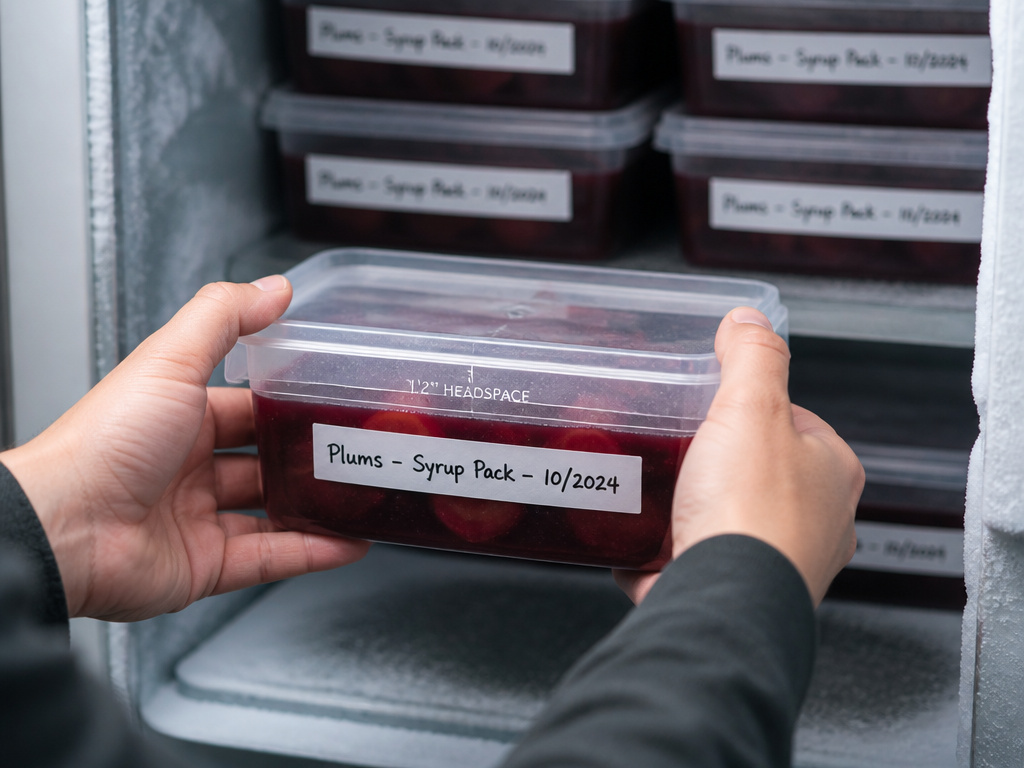 Your container has one job: keep air out and moisture in. Rigid plastic freezer-safe containers with tight lids work. So do heavy-duty freezer bags. Glass canning jars are risky for liquid packs unless they have straight sides and you leave ample headspace—ice expansion is relentless.
Headspace isn’t a suggestion. It’s a physical requirement for expansion.
| Container Type | Syrup Pack (Pint) | Dry Sugar Pack (Pint) |
|---|---|---|
| Wide Top (plastic container) | 1/2 inch headspace | 1/2 inch headspace |
| Narrow Top (glass jar) | 3/4 inch headspace | 1/2 inch headspace |
Where this goes sideways: Overloading the freezer. The NDSU Food Freezing Guide states you should add only 2-3 pounds of food per cubic foot of capacity to freeze solid within 24 hours. Slower freezing forms larger ice crystals that puncture cell walls. Your plums will weep every drop of juice when thawed, leaving a soggy mess.
Label every container with the contents, pack type, and date. Write “Plums – Syrup Pack – 10/2024”. In six months, you won’t remember.
How to Thaw and Use Frozen Plums
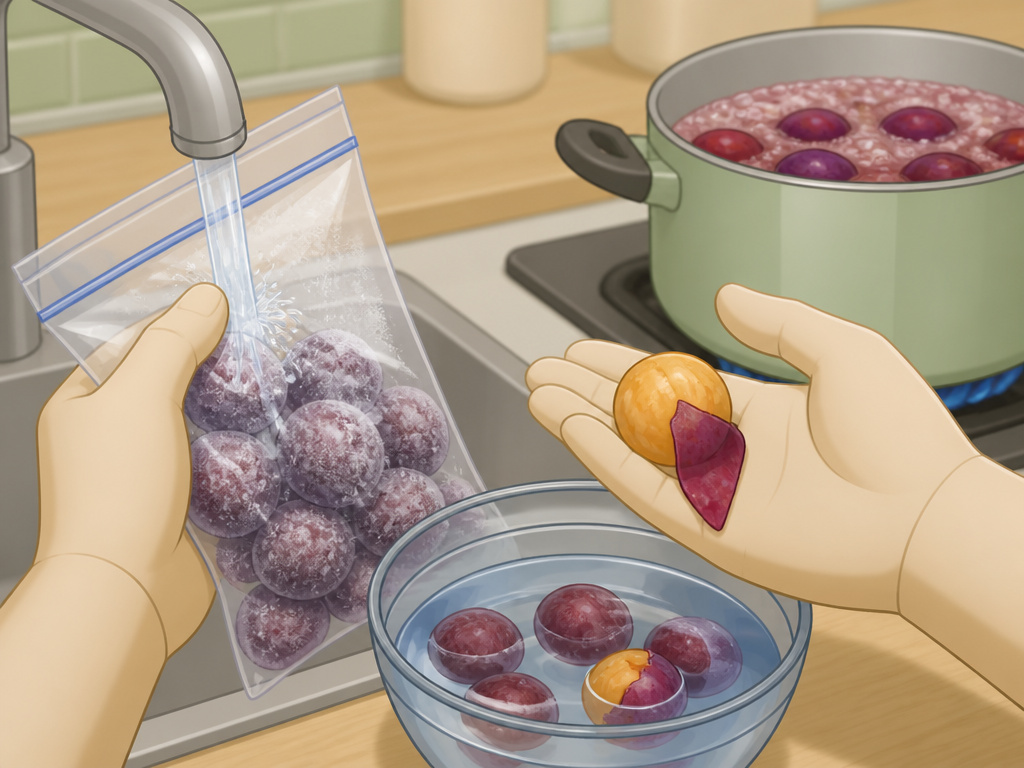 Thaw plums in their sealed container in the refrigerator overnight. For a quicker method, you can place the sealed bag under cold running water. Never thaw at room temperature—the outer layer becomes mushy while the core is still frozen.
- For uncooked use: Syrup-packed plums are ready to eat as-is. You can also dip frozen fruit in cold water for 5-10 seconds to slip the skins off before thawing.
- For baking: Use sugar-packed plums partially thawed, just until you can separate the pieces. If they thaw completely, they’ll be too soft to hold shape in a pie.
- For cooking: Toss still-frozen plums directly into a pot for jam, sauce, or compote. They break down faster and release more pectin.
Think of your frozen plums as a versatile ingredient. A bag of sugar-packed plums becomes a crisp filling. Syrup-packed plumps over yogurt. Unsweetened plums can be blended straight from the freezer into a smoothie.
Freezer Management: Avoiding the Big Three Pitfalls
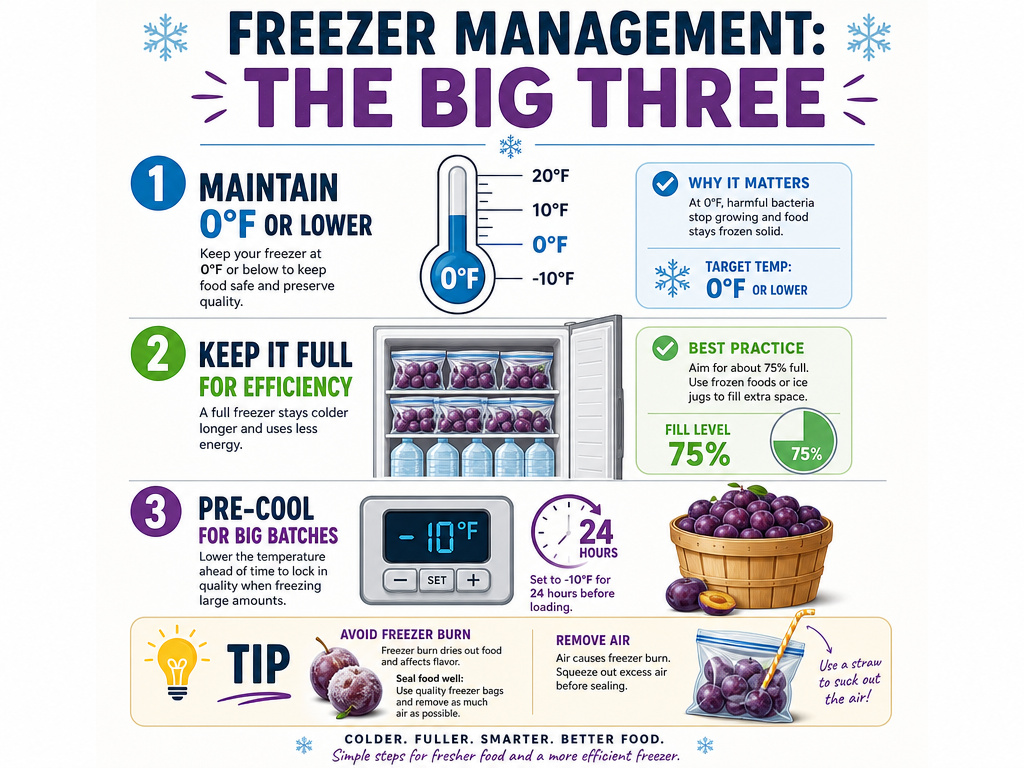 Quality loss in the freezer comes from temperature, air, and time. You’ve controlled for time with your 12-month guideline. Air exposure is managed by good packaging and headspace. Temperature is the ongoing battle.
- Maintain 0°F or lower. Use a standalone freezer thermometer. The fridge’s built-in freezer often runs warmer.
- Keep it full. A freezer that’s at least three-quarters full runs more efficiently and maintains temperature better during door openings. If you’re low on food, fill milk jugs with water and freeze them.
- Pre-cool for big batches. If you’re processing a bushel of plums, set the freezer to -10°F for 24 hours beforehand. This gives you a thermal buffer to freeze the new load rapidly.
Worth knowing before you start: Freezer burn is dehydration, not spoilage. It shows up as greyish-white leathery spots. It happens when air reaches the fruit’s surface. While not unsafe, it ruins texture and flavor. The best tips to prevent freezer burn are eliminating air (use a straw to suck excess air from bags) and using a double wrap like freezer paper inside a bag for long-term storage.
These principles apply to freezing avocados or freezing corn as much as they do to plums. The mechanics are universal.
Frequently Asked Questions
Can you freeze whole plums with the pit?
You can, but don’t. The pit takes up valuable space, slows freezing, and can impart a bitter flavor over long storage. Halving and pitting is the standard for a reason.
Do I have to add sugar or syrup to freeze plums?
No, but your results will be different. The Michigan Fresh plum preservation guide and other extensions state that unsweetened fruits lose quality faster. Sugar and syrup protect color, flavor, and texture by slowing oxidation and forming a protective glaze.
How long do frozen plums last?
For best quality, use syrup- or sugar-packed plums within 8-12 months at a steady 0°F. Unsweetened packs are best within 4-6 months. They remain safe indefinitely, but texture and flavor deteriorate.
Can I freeze plum puree or jam?
Absolutely. Plum puree freezes well in rigid containers. Freezer jam—jam made with no-cook methods and extra sugar—is designed for the freezer and is a fantastic way to preserve flavor. Follow a tested freezer jam recipe for safety.
What’s the best way to prevent browning before packing?
The ascorbic acid in the syrup is your primary guard. You can also give the plum halves a quick dunk in a commercial anti-darkening solution (like Fruit-Fresh) or a water-and-ascorbic-acid bath before packing. The syrup method is generally sufficient.
Before You Go
Preserving plums in the freezer comes down to a simple trade-off. Syrup with ascorbic acid gives you the longest-lasting, best-looking fruit for eating fresh. Dry sugar packing is the shortcut for bakers. Going unsweetened saves sugar but costs you in texture and shelf life. Whichever path you choose, control what you can: use airtight packaging, leave headspace, don’t overload your freezer, and label with the date. That discipline is what turns a bag of frozen fruit into a pie in January that tastes like it was made in September.
