Learn Where in the Refrigerator You Should Store Raw Meat
This post contains affiliate links. As an Amazon Associate, we earn from qualifying purchases.
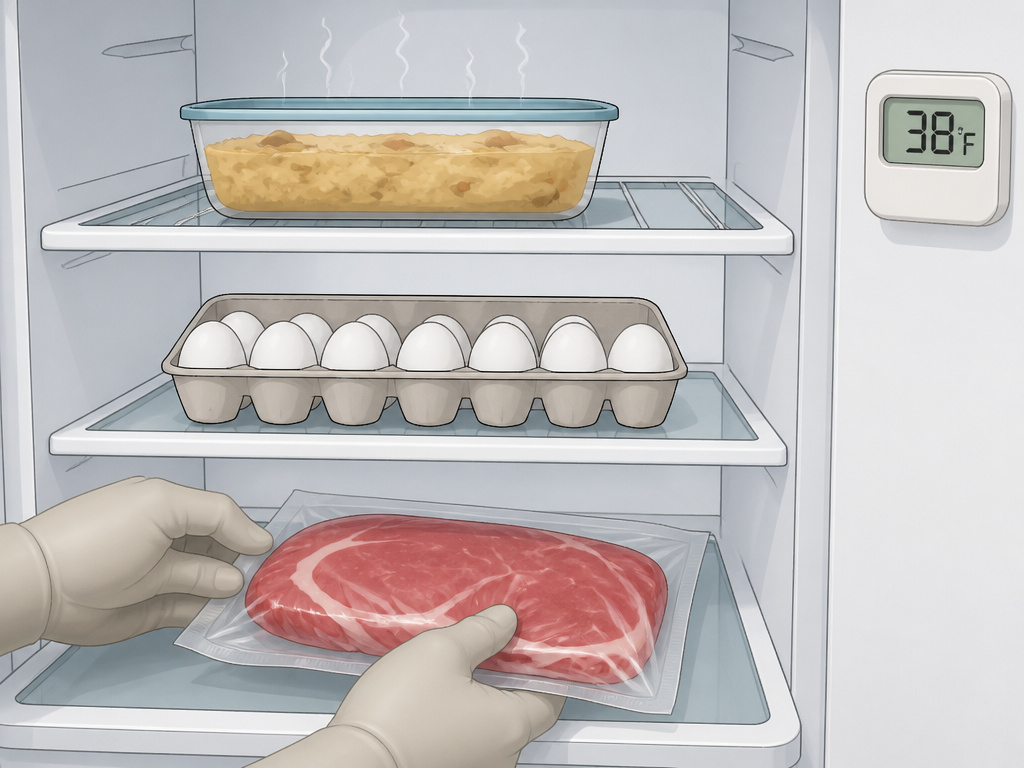
Store raw meat on the bottom shelf of your refrigerator, but organize it by cooking temperature. Raw poultry (165°F) goes on the very bottom, raw ground meats (155°F) go above it, and raw steaks or seafood (145°F) go on a shelf above those. This order ensures any dripping juices contaminate only items that will be cooked to a higher, safer temperature.
That temperature hierarchy is the professional standard used by food inspectors. Most home guides stop at “bottom shelf,” but health department charts don’t. They sort by the internal temperature needed to kill bacteria, poultry at the bottom, then ground meat, then whole cuts.
What follows: the two proven systems (simple and professional), the exact shelf-life numbers from university extensions, and the one mistake that turns a fridge into a contamination zone within 48 hours.
Key Takeaways
- Use the cooking temperature rule: store raw meat from highest required cooking temperature (poultry, 165°F) at the very bottom to lowest (steaks, 145°F) above it.
- Raw ground meat and poultry last only 1–2 days in the fridge; whole muscle cuts like steaks last 3–5 days.
- Your refrigerator must be at 40°F (4.4°C) or below; use a standalone thermometer to verify, as built-in displays are often wrong.
- Never store ready-to-eat foods like cheese, fruit, or leftovers below raw meat. Juices drip down, not up.
- Overcrowding blocks air circulation and creates warm spots where bacteria like Listeria can grow even at cold temperatures.
The Shelf-by-Shelf Science (and the Two Systems)
You have two frameworks: the simple home-kitchen method and the commercial kitchen code. The first is easy to remember. The second is what prevents actual illness.
The simple rule is from the Illinois Extension refrigerator storage guide: raw meat, poultry, and seafood go on the bottom shelf so juices don’t drip. Ready-to-eat foods claim the top shelf. It works. It’s also incomplete.
The Wisconsin Department of Agriculture states that ready-to-eat foods should always be on the top shelf. Other shelves should be arranged by cooking temperatures, with the highest cooking temperature items on the bottom.
The professional system is about kill steps. If raw chicken juice drips onto a package of ground beef, you’ll cook that beef to 155°F, a temperature that kills salmonella. If that same chicken juice drips onto a block of cheddar cheese you plan to eat raw, there is no kill step. The bacteria survive.
This is why the Virginia Department of Agriculture and other regulators publish charts based on minimum internal cooking temperatures. Your storage order becomes a safety backup.
| Storage Shelf (Top to Bottom) | Food Category | Minimum Safe Cooking Temp | Why This Order |
|---|---|---|---|
| Top Shelf | Ready-to-eat foods (dairy, leftovers, washed produce) | N/A | No further cooking; must stay clean. |
| Middle Shelf(s) | Raw whole muscle meat (steak, pork chops), raw seafood, raw shell eggs | 145°F (63°C) | Lower cooking temp than items below. |
| Above Bottom Shelf | Raw ground meats (beef, pork, lamb) | 155°F (68°C) | Higher cooking temp than whole cuts; contains more surface area for bacteria. |
| Bottom Shelf | Raw poultry (chicken, turkey, duck) | 165°F (74°C) | Highest required cooking temp; if it drips, it only contaminates items that will be heated enough to kill pathogens. |
Do you need to follow the professional chart at home? For a single package of chicken breasts, no. For a fridge packed after a big grocery run or before a holiday meal, absolutely. It’s the difference between guessing and having a verified containment plan.
Raw Meat Storage Times: The 48-Hour Clock for Ground Meat
Location matters, but so does timing. Bacteria grow on a schedule, and your refrigerator only slows them down. The shelf life printed on a package is a “best by” guess for quality. The safety clock is stricter.
According to the same Illinois Extension data, the clock starts ticking fastest on ground meat and poultry.
- Raw ground meat (beef, turkey, pork): 1 to 2 days at 35–40°F.
- Raw poultry (chicken, turkey parts): 1 to 2 days.
- Raw steaks, chops, roasts: 3 to 5 days.
- Raw bacon: Up to 7 days (it’s cured).
- Raw fish and seafood: 1 to 2 days.
Where this goes sideways: Treating a “sell by” date as a “use by” date for safety. Ground meat that looks and smells fine on day three can already harbor dangerous levels of bacteria. The 1–2 day rule isn’t a suggestion, it’s the documented safety window at proper fridge temps.
The mechanism is surface area. A steak has bacteria mostly on its exterior. Grinding distributes those bacteria throughout every particle, giving them exponentially more space to multiply. That’s why its safe window is half as long. The same logic applies to marinated or tenderized meats.
If you won’t cook ground meat or poultry within two days, freeze it the day you buy it. A proper raw chicken storage routine in the freezer buys you months, not days.
Setting Up Your Fridge Correctly
A perfect storage plan fails if the environment is wrong. Your fridge’s temperature is the single most important variable. The goal is a steady 40°F (4.4°C) or below throughout the cabinet.
Most refrigerator digital displays are inaccurate. They measure air near a sensor, not the temperature inside your meat drawer. You need a standalone appliance thermometer. Place it in the center of the middle shelf, wait overnight, and read it. Adjust the fridge’s thermostat until the thermometer reads 37–38°F. That gives you a buffer for when the door opens.
Airflow is the second variable. An overloaded fridge can’t circulate cold air evenly. Warm spots develop, often in the back corners or in crammed produce drawers. This is where Listeria monocytogenes, a pathogen that can grow slowly even at cold temperatures, gets a foothold.
- Leave space between items.
- Don’t block the rear vents with gallon milk jugs.
- Use crisper drawers for produce, but don’t pack them solid.
- Designate a drawer or bin for raw fish and other raw meats if your fridge has one, and always place it below ready-to-eat items.
Finally, the door. It’s the warmest part of the fridge, with temperatures fluctuating every time you open it. This is the place for condiments, jams, and butter, items with high sugar, salt, or acid that inhibit bacterial growth. It is not the place for milk or eggs, despite what the built-in racks suggest.
What Happens If You Get It Wrong?
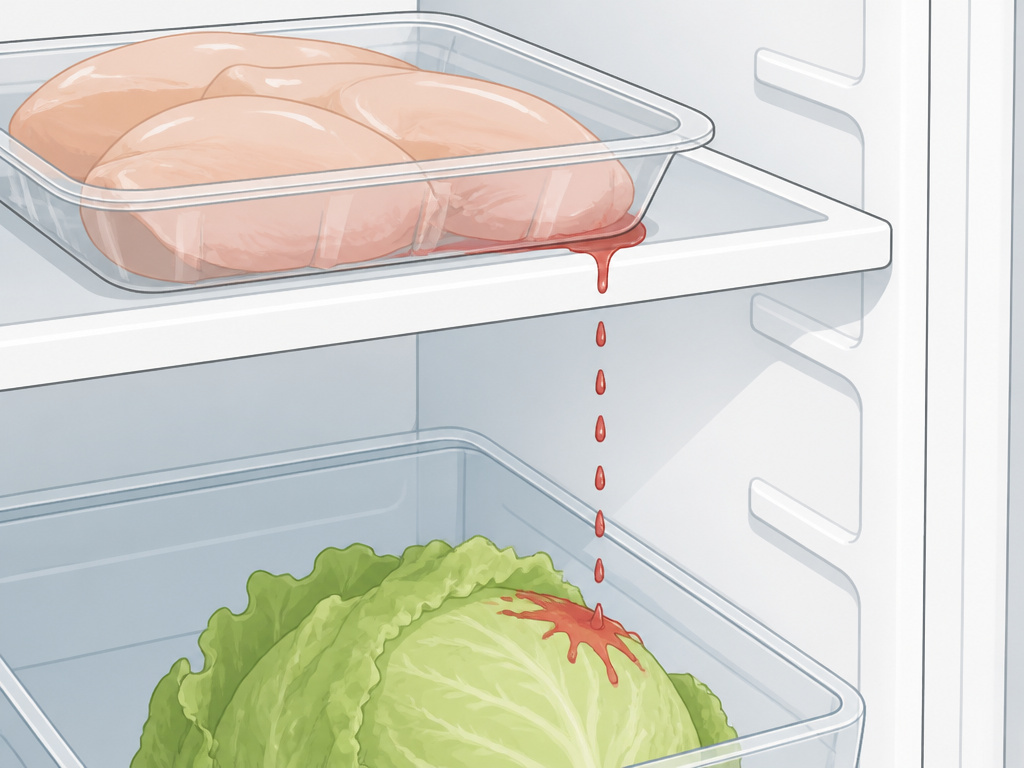 Cross-contamination is a process, not an event. It doesn’t mean immediate sickness. It means transferring bacteria from a raw product to a surface or food that won’t be cooked. The bacteria then multiply until they reach an infectious dose.
The most common home-kitchen failure is storing a leaking package of chicken above a drawer of salad greens or a block of cheese. The juice drips down, often along the back wall or shelf edge, unseen. Salmonella or Campylobacter from the poultry is now on the lettuce. Washing might remove some, but it’s not a reliable kill step.
Another mistake is using the same cutting board and knife for raw meat and vegetables without a proper sanitizing break in between. But fridge contamination is more insidious because it happens passively, over hours or days, while you’re not looking.
The consequence timeline is specific. For high-risk foods left in the “danger zone” (above 40°F), bacteria can double every 20 minutes. In a fridge that’s crept up to 45°F, growth is slower but still steady. A few hundred bacteria on Monday can become hundreds of thousands by Wednesday, enough to cause a foodborne illness when that contaminated cheese is eaten.
The part nobody mentions: A fridge contaminated with Listeria can harbor the pathogen for months, repeatedly re-contaminating cleaned surfaces and foods. This is why regular cleaning fridge shelves with a sanitizing solution is a safety step, not just a chore.
Special Cases and Edge Conditions
 The rules bend for real life. Here’s how to handle exceptions without breaking the safety principles.
What about eggs? Store raw shell eggs in their original carton on a shelf suitable for 145°F foods, often the same shelf as your steaks. The carton prevents absorption of strong odors and protects the eggs from temperature swings. Do not store them in the door.
Dealing with leftovers (storing hot food is a separate challenge). Cooked foods that will be reheated should go on a shelf above raw meats but below ready-to-eat items. Always cool them rapidly (shallow containers) before refrigerating to avoid raising the fridge’s overall temperature.
Power outages. If the power is out, keep the door closed. A full, unopened freezer holds safe temperatures for about 48 hours; a fridge for about 4 hours. If the power returns and the fridge is still at or below 40°F, the food is safe per USDA raw meat storage rules. If it rose above 40°F for more than two hours, discard all potentially hazardous foods like meat, dairy, and cooked leftovers.
Freezer storage. For long-term storage, proper wrapping is key to prevent freezer burn. While freezer-burned meat is safe to eat, its quality is poor. Use freezer-grade bags or vacuum sealers. Remember, freezing pauses bacterial growth but doesn’t kill all bacteria. Always thaw in the fridge, not on the counter.
Frequently Asked Questions
Can I store raw meat on the top shelf if it’s in a sealed container?
Sealed, leak-proof container significantly reduces the risk of drips, but it’s not foolproof. You still risk contaminating the exterior of the container, your hands, and surrounding surfaces when you move it. The bottom-shelf-by-temperature rule is the safest default. If you must use the top shelf, double-bag the meat and place it on a rimmed tray.
Does the “bottom shelf” rule apply to steaks and fish, or just poultry?
It applies to all raw meat, poultry, and seafood. However, within the “raw zone,” you should still stratify: poultry (165°F) very bottom, ground meat (155°F) above it, then steaks and fish (145°F) on a higher shelf. This is the core of the TCS food safety guidelines.
How often should I clean my refrigerator to prevent contamination?
Full cleaning with a sanitizer (like a diluted bleach solution or a commercial kitchen sanitizer) should happen monthly. Wipe up spills from raw meat immediately. The goal is to eliminate environments where bacteria like Listeria can persist.
Is it safe to store raw meat in the refrigerator door?
Never. The door is the warmest, most temperature-fluctuating part of the fridge. It’s unsuitable for any time-temperature control for safety food, especially raw meat. This area is for condiments only.
What’s the best way to thaw frozen meat?
The only safe methods are in the refrigerator, in cold water (changing the water every 30 minutes), or in the microwave followed by immediate cooking. Never thaw at room temperature. Thawing in the fridge requires planning, a whole chicken can take 24 hours or more, but it keeps the meat within a safe temperature range throughout.
Before You Go
Store raw meat low, organized by how hot it needs to be cooked. Keep your fridge at 40°F or below with a real thermometer. Respect the 48-hour limit for ground meat and poultry. This isn’t just organization, it’s a functional barrier between your family and preventable illness. Start with the thermometer check tonight. That one action tells you more about your fridge’s safety than any storage chart ever could.
