How to Store Coffee Beans to Keep Fresh | The 20°C Mistake
This post contains affiliate links. As an Amazon Associate, we earn from qualifying purchases.
Store coffee beans in an airtight, opaque container at a stable temperature below 20°C, away from light and moisture. The ISO 8455 standard and peer-reviewed studies show that 20°C storage drops quality within three months, while 10°C or lower preserves specialty-grade scores for nine months. After opening, an integrated screw cap outperforms clips, tape, or transferring to a separate canister.
That temperature threshold changes the entire game. Most advice stops at “cool, dark place,” which leaves you guessing between a pantry at 18°C and a basement at 12°C. The difference is a full point on a cupping score by month six, the line between a very good coffee and one that’s just okay.
What follows: the sourced number that decides your container, the post-opening method that actually works, and the one fridge debate that splits roasters down the middle. By the end, you’ll read any bag’s roast date and know exactly where it belongs in your home.
Key Takeaways
- Storage at 20°C (68°F) causes a measurable drop in coffee quality within three months. Aim for a stable spot at 10°C (50°F) or lower to preserve flavor for up to nine months.
- After opening a bag, an integrated screw cap is the most effective closure. Transferring beans to a separate canister or re-sealing with tape allows oxygen back in within a week.
- Maintain green bean water activity (WA) below 0.45 to prevent quality loss. Two samples in a controlled study failed this threshold after six months at 20°C.
- Freezing is viable for 3–4 months but requires a truly airtight container to prevent condensation and odor absorption. Refrigeration is riskier due to humidity.
- Never store beans in a grinder hopper. It is not airtight, accelerates staling, and causes oil buildup that affects grind consistency.
The 20°C Mistake That Destroys Flavor in 3 Months
Head to your pantry right now. Is it near an oven, a dishwasher, or a sun-facing wall? If the answer is yes, you’re probably storing coffee above 20°C (68°F). That’s the breaking point.
A peer-reviewed study in Scientific Reports stored green and roasted beans at -10°C, 10°C, and 20°C for twelve months. The results weren’t subtle. Beans kept at 20°C showed “the greatest decrease in quality parameters after the first three months.” Their cupping scores, the professional measure of aroma, flavor, and balance, dropped steadily. Beans in the -10°C and 10°C chambers, however, held scores above 7 points (very good quality) until the ninth month. The Scientific Reports coffee storage study details the clear downward trend.
Beans stored at 20°C lose their specialty coffee qualification (a score above 80 points) by the sixth month. Beans stored at 10°C or -10°C maintain that qualification for at least six months, and several samples were still close to 80 points at nine months.
This isn’t about a slightly stale cup. It’s about a documented, measurable decline that starts sooner than you think. The study also tracked water activity (WA), a measure of moisture available for chemical reactions. For green beans, a WA above 0.45 signals trouble. Two samples stored at 20°C crossed that threshold after six months. Once that happens, the degradation compounds form faster.
So what does 10°C feel like? It’s a cool basement, a dedicated beverage fridge, or a closet on an interior wall away from appliances. If you don’t have a spot that cool, the next best thing is the most stable temperature you can find, avoid daily swings from a heating vent or afternoon sun.
Your Container is Probably Wrong
The classic advice is an airtight container in a dark cupboard. That’s correct, but it’s incomplete. The type of airtight matters, and what you do after opening the bag matters more.
Most coffee bags have a one-way valve. It lets carbon dioxide out but doesn’t let oxygen in, as long as the bag is sealed. The second you break that seal, the game changes. Research from the University of Oregon tested four common re-closing methods after opening: an integrated screw cap, a clip, tape, and transferring beans to a separate airtight canister. They measured oxygen levels inside the package each week.
| Re-Closing Method | Oxygen Level After 1 Week | Why It Fails |
|---|---|---|
| Integrated Screw Cap | Lowest increase | Best seal, minimal air exchange |
| Metal Airtight Canister | Rises to near ambient | Each opening introduces a full volume of new air |
| Clip | Rises quickly | Poor seal at the bag’s folded opening |
| Tape | Rises to ambient (21%) | Adhesive doesn’t create an airtight bond |
The screw cap won. The canister, the very thing most guides recommend, came in second because every time you open it, you replace the whole interior atmosphere with fresh, oxygen-rich air. Tape and clips failed completely.
Common mistake: Transferring beans to a separate canister after opening. Each opening floods the container with new oxygen, accelerating staling. The original bag with a good integrated closure is often better.
This is why your storage containers choice is critical. If your coffee bag has a built-in screw cap or a sturdy zipper, use it. If it’s a flimsy bag you tear open, your priority is a container with the smallest possible interior volume. A tiny airtight container that’s nearly full exposes less bean surface to air than a half-empty gallon jar.
Opaque is non-negotiable. Light, especially UV, breaks down oils. A clear container in a cupboard is better than on a counter, but an opaque one is best. Stainless steel or ceramic airtight containers block all light.
To Freeze or Not to Freeze? The Split Decision
The debate is loud. The National Coffee Association (NCA) says freezing for 3–4 months is fine if you use a “truly airtight container.” Michael Phillips of Blue Bottle Coffee calls refrigeration a “definite no-no” because of fridge odors and moisture.
Who’s right? Both, for different parts of the claim.
Freezing dramatically slows molecular movement and oxidation. It works. The risk isn’t the cold; it’s the transition. Moving beans from freezer to room temperature causes condensation on the beans if you don’t let the sealed container fully acclimate. That moisture is damaging.
Where this goes sideways: Taking beans directly from the freezer, opening the container, and scooping out a dose. Condensation forms on the cold beans, introducing moisture that accelerates staling and can promote mold.
The safe method: freeze your coffee in the exact portion you’ll use. Seal a week’s worth in a small, airtight bag or jar. Thaw that entire portion in its sealed container on the counter for a few hours before opening. Never refreeze.
Refrigeration is the riskier move. Fridges are humid environments designed to keep food moist. Coffee is hygroscopic, it pulls that moisture right out of the air. The constant minor temperature cycles from the door opening and closing can also promote condensation inside the container. If you store coffee in the refrigerator, the container must be flawless and you must remove coffee in bulk, not daily.
For most home setups, freezing whole beans in single-use portions is a viable long-term strategy for 3–4 months. Daily refrigeration is not worth the hassle or risk.
Ground Coffee vs. Whole Bean: The Two-Week Clock
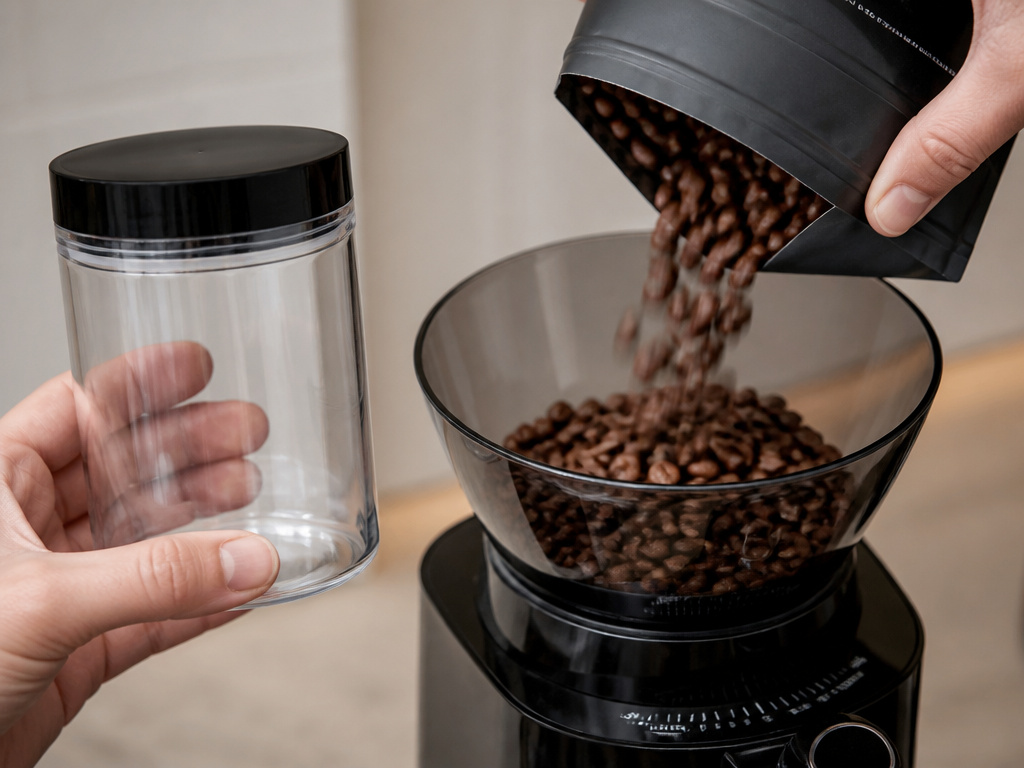
Everything discussed so far applies to whole beans. The moment you grind, you multiply the surface area exposed to air by about 10,000 times. The staling clock accelerates from months to weeks.
That built-in grinder hopper on your counter? It’s the worst possible place for beans. It’s not airtight. It exposes beans to light. It lets oils from the beans coat the grinding mechanism, which then goes rancid and taints future batches. Professionals empty and clean hoppers nightly for a reason.
If you must buy pre-ground, treat it like a perishable. Transfer it immediately to a small, opaque, airtight container. Use it within two weeks. After that, the 2-butanone/2-methylfuran index, a chemical marker for staling identified in research, will show significant degradation. The cup will taste flat, papery, or woody.
Whole beans give you control. Grind immediately before brewing. This is the single most effective freshness step you can take, far outweighing any container or temperature trick for ground coffee.
The Professional’s Checklist for Home Storage
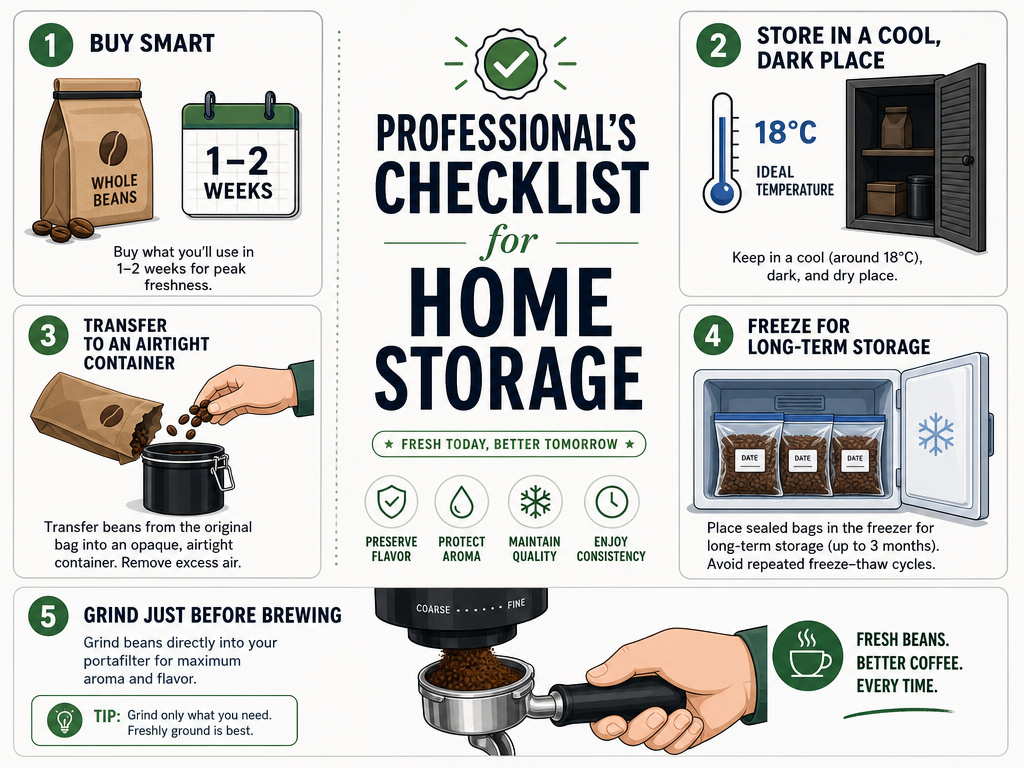
Follow this sequence. Each step builds on the last.
- Buy less, more often. Only buy what you’ll drink in 1-2 weeks. No storage method beats freshness at the source.
- Find a sub-20°C home. Use a basement, interior closet, or dedicated cooler. Measure the spot with a thermometer if you can. Stability is key.
- Keep beans in their original bag if it reseals well. If it has a good zipper or screw cap, use it. If not, move them to a small, opaque, airtight container. Fill it as full as possible.
- If freezing, pre-portion. Divide beans into weekly amounts, seal in airtight bags or jars, and freeze. Thaw each portion sealed before opening.
- Grind at the last second. Never store beans in the grinder hopper. Dose, grind, brew.
This checklist aligns with the ISO green coffee storage standard, which emphasizes stable, cool conditions to minimize quality deterioration from farm to cup.
How Other Dry Goods Compare
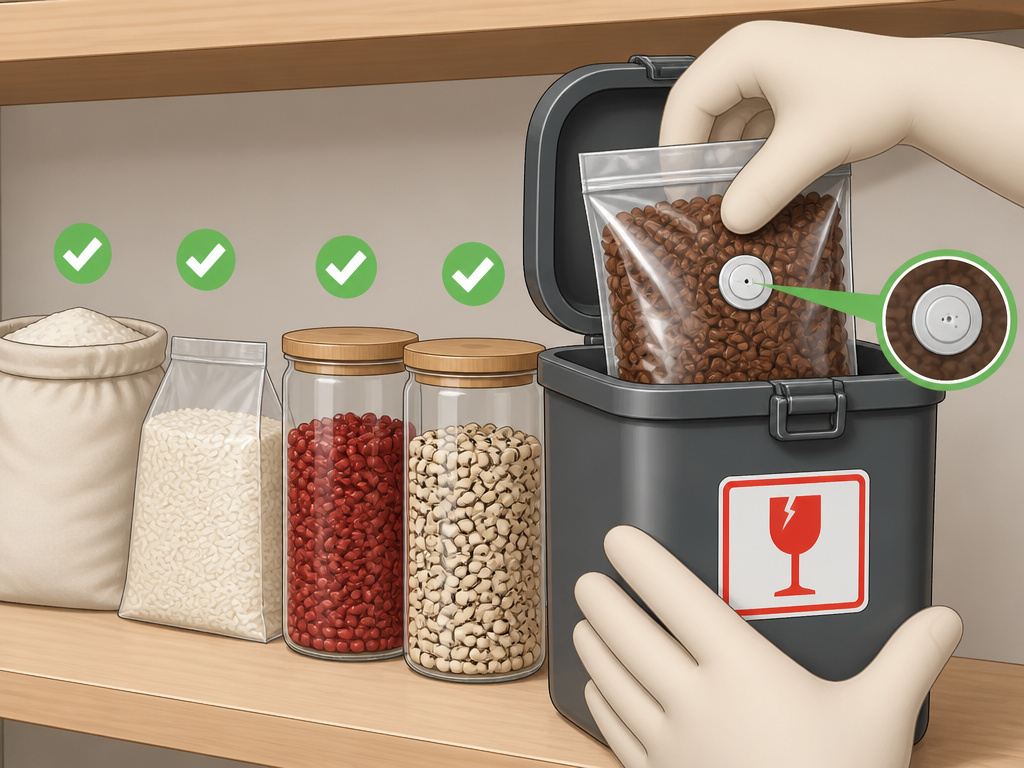
Coffee is uniquely fragile because its prized flavors are volatile aromatic compounds. Other pantry staples have different enemies.
Flour and oatmeal fight moisture and pests, not oxygen. Airtight containers in a cool pantry work well. Rice shares coffee’s aversion to moisture and heat, but its shelf life is years, not weeks. Dried beans and other dry beans need protection from humidity and bugs for long-term storage, but they don’t stale in the same aromatic way.
Coffee’s requirements are stricter. It’s the canary in the coal mine for your pantry’s environment.
Frequently Asked Questions
Can I store coffee beans in the original bag?
Yes, but only if the bag has an effective re-sealable closure like a sturdy zipper or integrated screw cap. If you tear it open, the one-way valve becomes an oxygen-in valve. Transfer the beans to an airtight container immediately.
How long do coffee beans last after opening?
Whole beans stored correctly (airtight, cool, dark) retain peak freshness for 1-3 weeks. They remain safe to drink for months, but quality declines noticeably after the first month. Ground coffee lasts 1-2 weeks.
Does freezing coffee beans ruin them?
No, if done correctly. Freezing in an airtight, portioned container can preserve beans for 3-4 months. The ruin comes from condensation when moving beans in and out of the freezer. Thaw the sealed portion completely before opening.
What is the best container for coffee beans?
An opaque, airtight container with a minimal internal volume. Stainless steel or ceramic with a silicone-gasket lid is ideal. The best coffee storage balances a perfect seal with convenience.
Why does coffee go stale?
Staling is primarily oxidation, oxygen molecules reacting with the coffee’s oils and aromatic compounds. Heat, light, and moisture accelerate these reactions. Grinding exponentially increases the surface area for oxidation to occur.
Before You Go
Your coffee’s fate is decided by three numbers: storage temperature (keep it below 20°C), water activity (keep it below 0.45 for green beans), and time after grinding (keep it under 15 minutes). The container is just a tool to defend those numbers.
Chase stability, not perfection. A constant 18°C in a dark cupboard is better than a perfect 10°C that swings to 15°C every afternoon. Your nose knows, if the beans don’t smell richly aromatic when you open the bag, the staling process is already winning.
Start with the thermometer. Find your home’s cool, stable spot. Then match the container to the bag you buy. That’s how you store coffee beans to keep fresh.
