Is Freezer Paper the Same as Wax Paper? Coatings Explained
This post contains affiliate links. As an Amazon Associate, we earn from qualifying purchases.
No, freezer paper is not the same as wax paper. The difference is in the coating and its purpose. Freezer paper has a low-density polyethylene plastic coating laminated on one side for long-term moisture and vapor resistance in freezing. Wax paper is coated with wax on both sides for short-term moisture resistance and non-stick properties at room temperature. Using wax paper in the freezer leads to freezer burn within weeks.
That plastic coating is what separates a year of safe storage from a ruined cut of meat. It’s a physical barrier, not a marketing term. The polyethylene lamination on freezer paper is engineered to block water vapor migration, which is the precise mechanism of freezer burn.
What follows is a breakdown of the two coatings, the science of why they fail when swapped, and the one rule that decides which paper you should reach for.
Key Takeaways
- Freezer paper uses a polyethylene plastic coating; wax paper uses a paraffin or soybean wax coating. They are chemically different.
- Wax paper is not moisture-vapor-proof. University extensions like Clemson’s explicitly list it as unsuitable for long-term freezer storage.
- The wax coating melts at low oven temperatures, while the polyethylene coating on freezer paper can release chemicals when heated. Neither belongs in the oven.
- For freezing, the packaging must say “freezer” on it. If it doesn’t, assume it’s for room-temperature or refrigerator use only.
- Parchment paper, with its silicone coating, is the only one of the three designed for oven heat.
The Coating Is the Whole Game
Look at the side of the paper. Freezer paper has a dull, plastic-feeling side, that’s the polyethylene. Wax paper feels slick and slightly greasy, that’s the wax. This minor detail is actually the entire functional difference between a paper that preserves and one that merely wraps.
Polyethylene is a plastic polymer that forms a continuous, flexible barrier. When laminated to heavy kraft paper, it creates a sheet that is highly resistant to moisture vapor transmission. This is the technical property that matters for freezing. According to the K-State freezing FAQ, materials for freezing must be “moisture-vapor-proof” or at least “moisture-vapor-resistant.” Freezer paper falls into the latter category.
Freezer paper is a coarse, sturdy paper that features low-density polyethylene laminated on one side for strength, leak resistance, and the prevention of freezer burn for up to a year. . WebstaurantStore product guide
Wax paper, in contrast, is impregnated or coated with wax. Wax repels liquid water beautifully, which is why it’s great for wrapping a sandwich. But it is not a perfect vapor barrier. Over time in the dry, cold freezer environment, water vapor can still pass through microscopic gaps in the wax coating.
Freezer burn is caused by sublimation, where ice crystals on the surface of your food turn directly into water vapor and leave the food. A proper barrier slows this process to a crawl.A weak barrier, like wax paper, lets it happen relatively quickly, leaving behind those dry, grayish, tough patches.
When You Absolutely Must Not Use Wax Paper
The Clemson HGIC freezing basics guide is blunt: “Lightweight (household) aluminum foil, wax paper, and bread wrappers are not sufficiently moisture- and vapor-resistant to be suitable for long-term freezer storage.”
This is a sourced, non-commodity fact. It’s not a suggestion. If you wrap a steak in wax paper and toss it in the back of the freezer, you are conducting an experiment with a known outcome.
The Failure Timeline: With wax paper, you might get away with it for a few weeks, especially if the item is also inside a secondary container. But for anything you plan to store beyond a month, a side of salmon, a batch of homemade burgers, summer berries, the protection fails. You’ll see the telltale signs of freezer burn within 6 to 8 weeks. The texture becomes grainy. The flavor dulls.
Common mistake: Using wax paper for freezing meat. The wax coating cannot stop vapor migration, leading to surface dehydration and flavor loss in as little as two months.
The other hard ban is heat. Never put wax paper in the oven, toaster oven, or air fryer. The wax melts at a low temperature, which can both ruin your food and create a smoky, potentially flammable mess. The melted wax will also fuse to your baking sheet.
| Scenario | Use Freezer Paper? | Use Wax Paper? | What Happens If Wrong |
|---|---|---|---|
| Wrapping meat for freezer | Yes | No | Wax paper: Freezer burn within 2 months. Freezer paper: Protection for up to 12 months. |
| Lining a baking sheet | No | No | Both melt. Freezer paper’s plastic may release chemicals; wax paper smokes and burns. |
| Separating burger patties | Yes (if freezing) | Yes (if immediate cook) | For freezing, wax paper sticks as patties freeze. Freezer paper releases easier. |
| Wrapping a sandwich | Overkill | Yes | Freezer paper’s plastic side isn’t food-safe for direct contact at room temp in some grades. |
So, What Is Freezer Paper For?
Freezer paper has one primary job: to be a flexible, moisture-resistant wrapper for long-term frozen storage. Its best use is for irregularly shaped items that don’t fit well in bags or containers, think whole chickens, racks of ribs, or large cuts of fish.
The process for using freezer paper is specific. You always wrap with the plastic-coated side facing inward, touching the food. This puts the vapor barrier directly against the surface you’re protecting. Then, you wrap it tightly, pressing out as much air as possible, and seal it with freezer tape. The dull paper side on the outside gives you a surface to label with the contents and date.
Where this goes sideways: Wrapping with the paper side in. The plastic coating must contact the food to form the barrier. If you wrap it backwards, you might as well be using butcher paper.
For home use, a roll of generic freezer paper is sufficient. In commercial settings, you’ll find specific grades. For example, Norpak Freezer Wrap comes in 35-pound and 40-pound weights (referring to paper density), each with 5 pounds of polyethylene laminated on one side. That heavier lamination is for high-moisture products and longer shelf-life expectations.
The Parchment Paper Wild Card
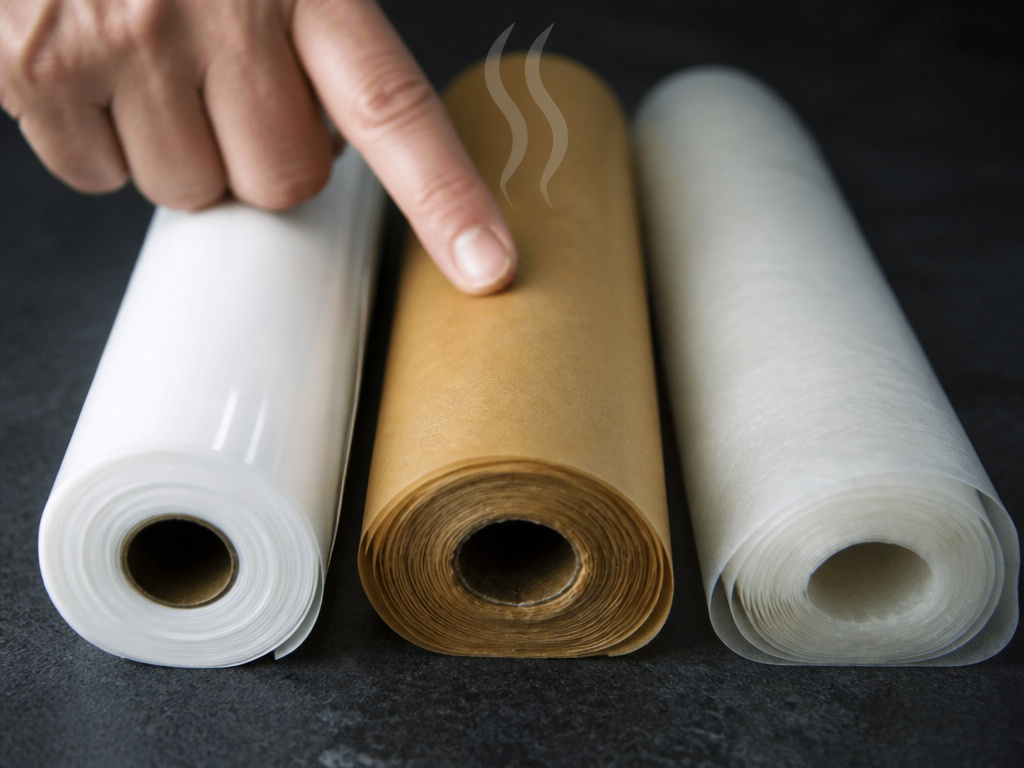
People often lump parchment into this comparison, but it belongs to a different category altogether. Parchment paper is coated with silicone, not wax or plastic. Silicone is non-stick and heat-stable, which makes parchment the only paper in this trio that is designed for oven use.
You cannot use parchment paper for long-term freezing. While it is moisture-resistant, it is not a rated vapor barrier. Its purpose is to provide a release surface during baking, not to lock moisture in for months.
This is the core of the freezer paper vs parchment paper confusion. They look similar on the shelf, both are on rolls, often near each other. But silicone (heat) and polyethylene (cold) are opposites in function. Memorize this: parchment for the oven, freezer paper for the freezer, wax paper for the counter.
How to Choose and What to Buy
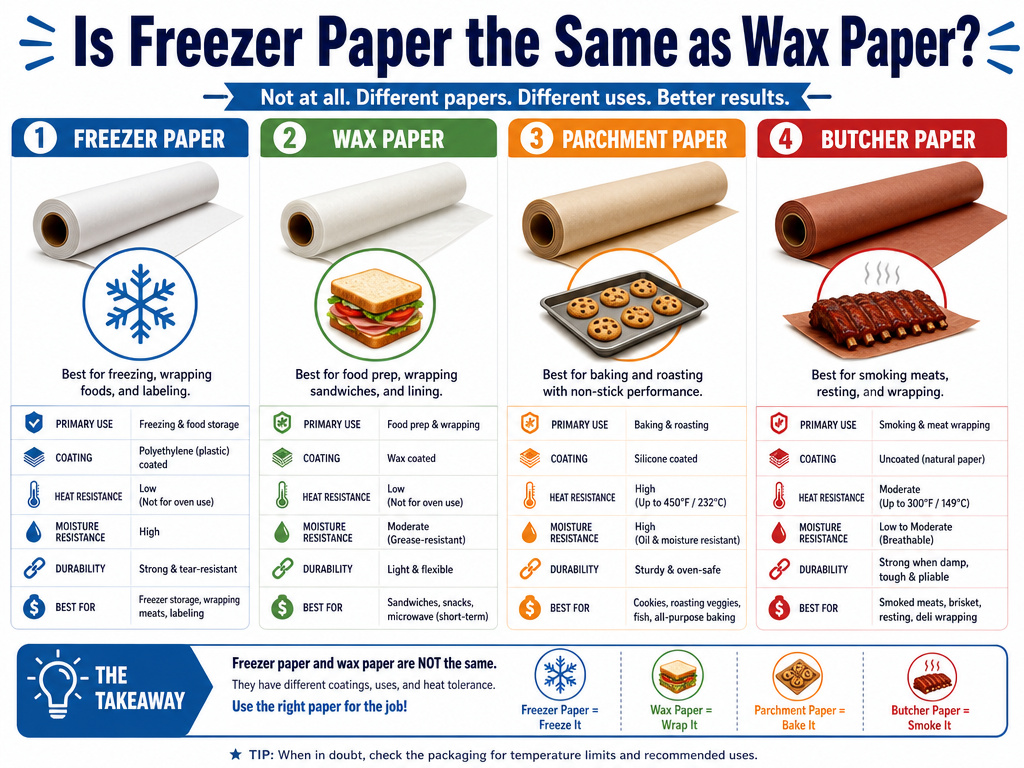
Your choice should be binary based on temperature.
For Freezing: You need a wrap labeled “freezer paper.” Do not accept substitutes. Look for the word “freezer” on the package, as advised in the K-State food freezing newsletter. Reynolds and D&W make common consumer brands. For better performance, seek out a heavier-duty roll from a restaurant supply store. The plastic coating should feel substantial, not flimsy.
For Non-Stick Wrapping at Room Temp: Use wax paper. It’s perfect for separating layers of cookies, wrapping cheeses for the fridge (short-term), or packing a lunch sandwich. It’s a barrier against liquid moisture, not vapor.
For the Oven: Use parchment paper. Always.
What about butcher paper? That’s a different tool, typically uncoated or lightly sized kraft paper meant for breathable wrapping, like for hot barbecue. It is not a substitute for freezer paper unless you plan to eat the food within a day or two.
| Paper Type | Coating | Best For | Do Not Use For | Key Property |
|---|---|---|---|---|
| Freezer Paper | Polyethylene (one side) | Long-term frozen meat/fish | Oven, microwave, room-temp direct wrap | Moisture-vapor resistant |
| Wax Paper | Wax (both sides) | Short-term fridge wrap, separating foods | Freezer, oven, grill | Moisture resistant, non-stick |
| Parchment Paper | Silicone (one/both sides) | Baking, roasting, air frying | Long-term freezer storage | Heat resistant, non-stick |
| Butcher Paper | None or light sizing | Hot BBQ, short-term meat hold | Freezing, liquid containment | Breathable |
If you want one answer for protecting food in the deep freeze: buy a roll of name-brand freezer paper. Use it only for freezing. Keep a roll of parchment for baking and a roll of wax paper for everything else. Trying to make one paper do all three jobs is how you lose food and money.
Frequently Asked Questions
Can you put freezer paper in the oven?
No. Freezer paper is not oven-safe. The polyethylene plastic coating can melt at high temperatures, potentially releasing chemicals into your food and creating a mess. For oven use, you need parchment paper.
Is wax paper waterproof?
Wax paper is water-resistant, not waterproof. It can handle light moisture for a short time, like in a lunchbox. However, it is not a vapor barrier, which is why it fails in the freezer where water sublimation occurs over time.
What is the shiny side of freezer paper for?
The shiny, plastic-coated side of freezer paper is the functional side. It must face inward, touching the food, to create the moisture-vapor barrier that prevents freezer burn. The dull paper side is meant to be on the outside for labeling.
Can you use aluminum foil instead of freezer paper?
Heavy-duty aluminum foil is a moisture-vapor-resistant material and can be used for freezing. However, it tears and punctures more easily than freezer paper. It’s often recommended as an overwrap for an additional layer of protection, not as a sole wrapping material for irregular shapes.
How long does freezer paper last in the freezer?
Quality freezer paper, when used correctly (tight wrap, plastic side in, sealed with tape), can protect food from freezer burn for up to 12 months. The actual safe storage time depends more on the type of food being frozen than the paper itself.
Is freezer paper recyclable?
Typically, no. The plastic polyethylene coating is difficult to separate from the paper fiber, making it non-recyclable in most municipal recycling programs. It should be disposed of with regular trash.
The Bottom Line
Freezer paper and wax paper are not interchangeable. One has a plastic coat for the cold; the other has a wax coat for the counter. The moment you confuse them, you start the clock on food degradation.
The rule is simple and comes directly from extension services: for freezing, use packaging marked for the freezer. That means freezer paper, freezer bags, or rigid freezer containers. Wax paper is a short-term helper, not a long-term preserver, and is therefore not on that list. Choose based on the coating, and your food will thank you months later.
