Is It Safe to Freeze Salmon in Store Packaging? Your Guide
This post contains affiliate links. As an Amazon Associate, we earn from qualifying purchases.
You can freeze salmon in its original store packaging, but the quality guarantee drops off a cliff after 3 months. The USDA says it’s safe indefinitely at 0°F, but the Oregon State University Extension Service caps home-frozen salmon quality at 3 months, 6 months for leaner fish. The store wrap is permeable, letting air contact the fish. Oxidation turns the fat rancid, and moisture loss creates freezer burn.
That gap between “safe” and “good” is where most guides stop. They’ll tell you to overwrap. They won’t tell you why your salmon still tastes like cardboard after you do, or that most home freezers can only freeze 1-2 pounds per cubic foot per day. Overload it, and you lose the texture before the clock even starts.
What follows: three specs from the extension services, two certifications to look for on overwrap film, and the one field-test result that reframes both.
Key Takeaways
- Freezing salmon in store packaging is safe forever at 0°F, but flavor and texture degrade noticeably after 3 months due to air exposure and freezer burn.
- For quality beyond 3 months, you must overwrap with a moisture-vapor-resistant material like heavy-duty aluminum foil, freezer-grade plastic wrap, or a vacuum-sealed bag.
- Your freezer’s freezing rate is the hidden variable. Most home units freeze 1-2 pounds per cubic foot per 24 hours. Overloading it causes large ice crystals that shred cell walls.
- Thawing is not the reverse of freezing. Thaw slowly in the fridge over 24 hours. Running cold tap water over a sealed package works in a pinch, but room-temperature thawing breeds surface bacteria.
- The best overwrap method isn’t the most complex. A double layer of plastic film pressed directly onto the fish, then a foil or bag outer layer, beats a single bulky bag every time.
Why “Safe” and “Good” Are Different Timelines
The USDA’s freezing safety guidelines are clear: food stored constantly at 0°F (-18°C) is safe indefinitely. Pathogens don’t grow at that temperature. That’s the safety floor.
Quality is a separate clock. It starts ticking the moment the fish hits the freezer air. The Oregon State University Extension Service puts a hard cap on it: most home-frozen seafood shouldn’t be stored more than 6 months, and not more than 3 months for salmon and crab to maintain optimal quality. Their home freezing of seafood PDF is blunt, commercial packaging may allow a year, but home methods generally won’t.
The store’s cling film or styrofoam tray wrap is designed for a 3-day fridge life, not a 3-month deep freeze. It’s slightly permeable to air and moisture vapor. That slow leak is what ruins the fish.
Common mistake: Assuming “safe indefinitely” means “tastes fine indefinitely.” The safety clock stops at 0°F. The quality clock speeds up with every fluctuation in temperature and every molecule of oxygen that reaches the fat.
Freezer burn is dehydration. Ice crystals sublimate directly from the fish’s surface into the freezer’s dry air, leaving behind dry, grayish-white patches.The texture turns spongy, then tough. In fatty fish like salmon, oxidation attacks the omega-3 fats. The flavor goes from rich and clean to flat, then cardboardy, then outright rancid. You’ll smell it when you cook it.
The 3-Step Overwrap Method That Actually Works
Overwrapping aims to eliminate air. The goal is a barrier that moisture and oxygen can’t cross.You need a material labeled moisture-vapor-resistant. Standard plastic wrap from the grocery roll isn’t.
| Overwrap Material | Best For | The Catch |
|---|---|---|
| Heavy-duty aluminum foil | Irregular cuts, whole fish | Can puncture if jostled; not see-through |
| Freezer-grade plastic wrap (Polyvinylidene chloride – PVDC) | Fillets, steaks | Must be pressed directly onto the fish’s surface |
| Vacuum-sealed bags | Portion control, long-term (6+ month) storage | Requires a vacuum sealer; initial cost |
| Freezer bags (heavy-duty polyethylene) | General use, bulk storage | Squeeze out as much air as possible by hand |
The University of Alaska Fairbanks Cooperative Extension Service notes store wrap is not for freezer storage longer than two weeks. Their freezing publication calls for overwrapping with foil, plastic, or laminated paper.
Here’s the method that prevents the gray, leathery patches:
- Pat the salmon completely dry. Any surface moisture freezes into frost, which then sublimates away, taking fish moisture with it. Use paper towels.
- Wrap tight, then wrap again. Use your chosen moisture-vapor-resistant material. For plastic film, press it directly onto every contour of the fish to push out air pockets. Then, add a second, loose outer layer, a freezer bag or foil, to protect against punctures.
- Label with date, weight, and cut. “Salmon” isn’t enough. Write “Sockeye fillet – 1.5 lb – Nov 2024.” You will forget.
Where this goes sideways: Wrapping in a single, loose freezer bag. The bag has air inside. That air holds moisture that will deposit as frost on the inside of the bag, stolen from your fish. Press the wrap onto the fish, then bag it.
If you’re planning for a continuous supply of high-quality frozen foods, the rule is “first in, first out.” Eat the oldest package first. This is a core principle of any organized food storage system.
Your Freezer’s Hidden Limit: The Freezing Rate
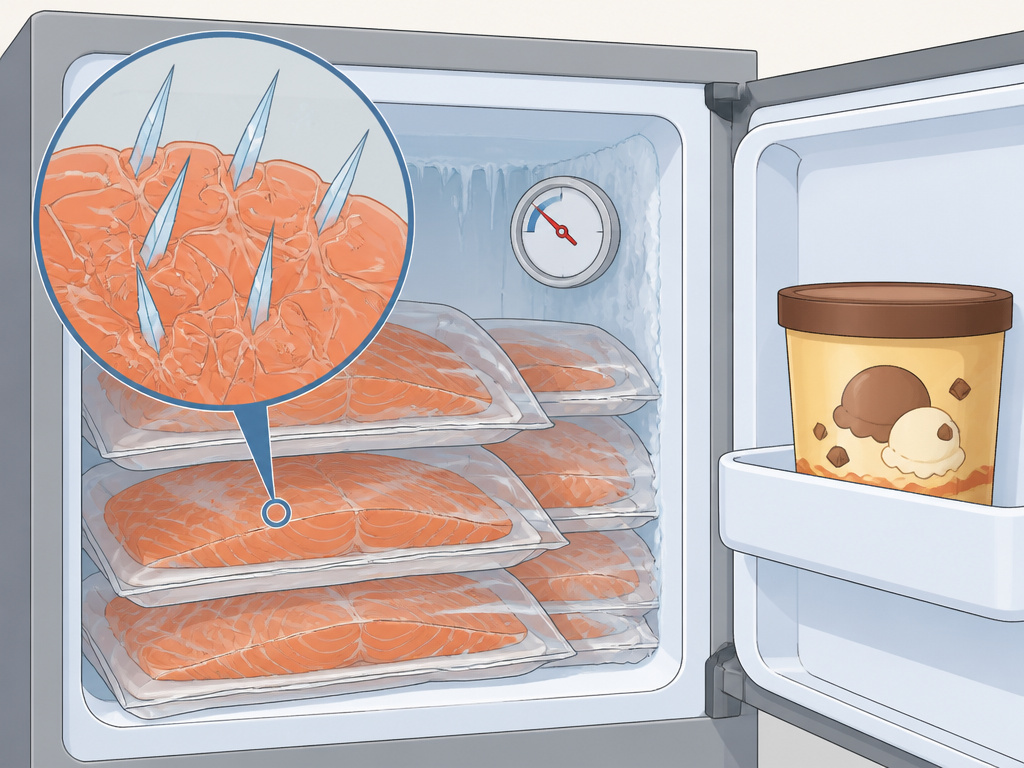
Your freezer has a maximum freezing capacity. Most home freezers, according to the Oregon State guide, can properly freeze about 1–2 pounds per cubic foot in 24 hours. Exceed that, and you get slow freezing.
Slow freezing is the enemy. It allows large, jagged ice crystals to form. These crystals puncture the cell walls of the fish muscle. When you thaw it, all the flavorful juices and moisture that were inside those cells leak out as drip loss. The result is a dry, stringy, tasteless fillet, regardless of how well you wrapped it.
If packages take more than 5–6 hours to freeze, they are too large for long-term storage in your freezer.
Check your freezer’s temperature. It must hold a steady 0°F (-18°C). The back of the freezer, away from the door, is the most stable zone. That’s where your salmon should live. The door shelf is for ice cream, not fish.
This principle applies to all freezing jarred sauce or freezing coffee, rapid freezing preserves cellular structure. Overloading the chamber wrecks everything inside.
Salmon vs. Other Fish: Why the 3-Month Rule Exists
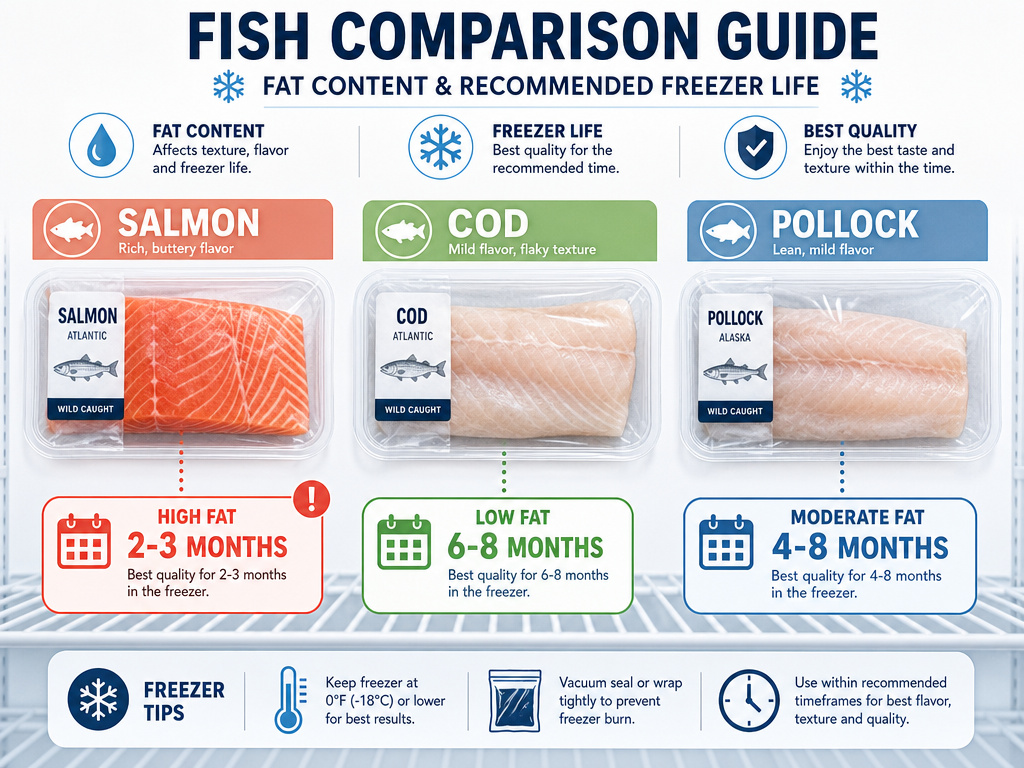
Not all fish freeze the same. The clock ticks fastest for the fattiest.
| Fish Type | Fat Content | Recommended Freezer Storage (for quality) | Why It’s Shorter |
|---|---|---|---|
| Salmon, Mackerel, Tuna | High (Rich in Omega-3s) | 2-3 months | Fats oxidize (go rancid) quickly, even at 0°F |
| Cod, Flounder, Haddock, Sole | Low (Lean) | 6-8 months | Less fat to oxidize; primary risk is texture loss from freezer burn |
| Pollock, Ocean Perch, Rockfish | Moderate | 4-8 months | Middle ground; watch for both oxidation and dryness |
Salmon sits at the top of this list for a reason. Those prized omega-3 fatty acids are highly unsaturated, great for health, terrible for freezer longevity. They’re chemically unstable. Exposure to oxygen, even the tiny amount trapped in a mediocre wrap, causes them to break down. You taste it as a sharp, fishy, or paint-like off-flavor.
Lean fish like cod mainly battle texture loss. Their freezing flour or herbs like freezing cilantro is about preserving structure and preventing odor absorption. For salmon, it’s a race against chemistry.
A peer-reviewed salmon freezing article confirms the mechanism: slow freezing causes larger ice crystals, greater cell damage, and higher drip loss. Faster freezing preserves the muscle’s intracellular structure. Your home freezer’s rate is the limiting factor.
Thawing: The Step Everyone Rushes (And Ruins It)
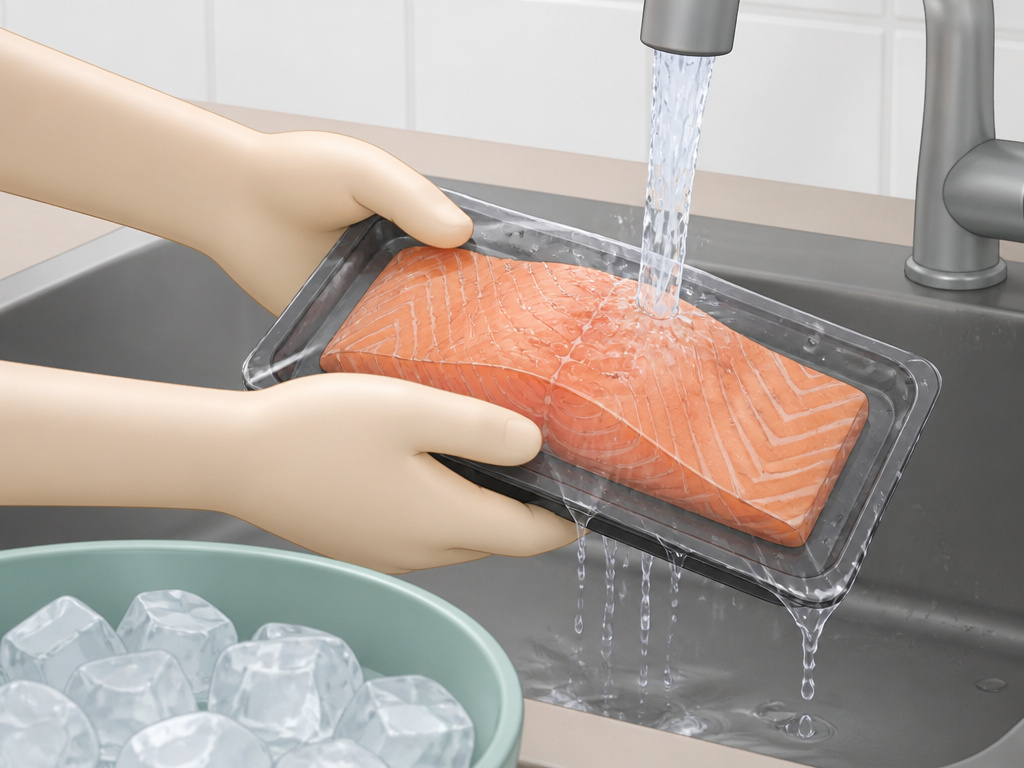
Thawing is not the reverse of freezing. How you reheat matters less than how you defrost.
The only reliable method for a whole fillet is in the refrigerator. Plan for 24 hours per 5 pounds. Place the wrapped package on a plate or tray to catch any seepage. This slow, cold thaw keeps the fish below 40°F, the danger zone for bacterial growth.
Need it faster? Use cold running water. Keep the salmon in its watertight overwrap (if you vacuum-sealed or used a good freezer bag, it is). Submerge it in a bowl of cold water, changing the water every 30 minutes. A 1-pound portion thaws in about an hour.
What most people get wrong: Thawing at room temperature. The outer layer of the fish spends hours in the bacterial growth zone while the inside is still frozen. Surface spoilage starts there. The Oregon State guide is explicit: don’t thaw at room temperature if it will take more than a couple of hours.
Never thaw in warm water. It cooks the exterior, turning it opaque and mealy before the center is soft.
Once thawed, cook it immediately. Refreezing thawed raw salmon is a gamble on texture and safety. The cell damage from the first freeze-thaw cycle is done; a second cycle turns it to mush.
Frequently Asked Questions
Is it safe to eat salmon that’s been frozen for a year?
Yes, from a pathogen standpoint, if it’s been at a constant 0°F. The USDA says it’s safe indefinitely. Quality, however, will be severely degraded, expect freezer burn, rancid flavors, and a dry, tough texture. It won’t make you sick, but you probably won’t enjoy it.
Can I freeze salmon in the original styrofoam and plastic wrap?
You can, but only for very short-term storage, a week or two. The University of Alaska Fairbanks CES states store wrap is not for freezer storage longer than two weeks. For anything beyond that, you must overwrap.
How can I tell if my frozen salmon has freezer burn?
Look for dry, grayish-white, leathery patches on the surface. It will feel frosty or have large ice crystals clinging to it. The flesh underneath will be drier and tougher. It’s not unsafe to eat, but the affected parts will have little flavor and a poor texture.
Does vacuum sealing make a big difference?
Absolutely. Removing nearly all the air dramatically slows oxidation and prevents freezer burn. It’s the single most effective method for long-term storage, easily doubling or tripling the quality window compared to standard overwrapping. It’s the same principle used for freeze-dried foods destined for years in storage.
Can I cook salmon directly from frozen?
You can, but it requires technique. Bake it at a lower temperature (300°F) for longer, or pan-sear from frozen using a covered pan to steam the interior. The result will never be as good as properly thawed fish, the exterior often overcooks before the center is done. Thawing first gives you control.
Before You Go
The store packaging question has a short answer: yes, for safety; no, for quality. The real work happens before the fish hits the freezer. Dry it. Wrap it tight against its skin with a proper barrier. Respect your freezer’s capacity. Label it.
That three-month window for salmon is the line where the fat turns. For leaner fish, you get more time.For herbs like freezing mint or freezing garlic scapes, the fight is against moisture loss and flavor fading. For salmon, it’s a battle against chemistry itself.
Your best tool is a vacuum sealer. Your second-best is heavy-duty foil pressed onto the flesh, then bagged. Your third is knowing that “safe” and “good” stopped meaning the same thing around month four.
