Practical Tips on How to Keep Your Refrigerator Door Shut
This post contains affiliate links. As an Amazon Associate, we earn from qualifying purchases.
To keep a refrigerator door closed, level the appliance so the front is slightly higher than the back, inspect and clean the magnetic door gasket for tears or debris, ensure door bins and shelves aren’t overstuffed, and check for obstructions like a misaligned flipper mullion. On models with automatic closers, the door must be open less than 40 degrees to engage.
That tilt-forward rule isn’t a suggestion. It’s printed in the Electrolux owner’s guide: “slightly elevate the front to assist with door and drawer closing.” Skip it, and the door will swing back open every time you walk away, no matter how clean the seal looks.
What follows is the sequence that actually works: three mechanical checks (level, gasket, hinge), the one shelf-organization mistake that blocks closure, and what to do when the door alarm won’t stop beeping.
Key Takeaways
- Tilt it forward. The front feet should be 1/4 to 1/2 inch higher than the back. This uses gravity to pull the door shut.
- A dirty seal is a broken seal. Clean the magnetic gasket with soapy water and check for cracks that let cold air escape.
- Overstuffed door bins are the hidden problem. A gallon jug on the door shelf can tilt the entire unit back and hold the door ajar.
- Slamming can cause a bounce-back. LG manuals warn that too much force can make the door “remain briefly open before closing.”
- Know your model’s features. KitchenAid auto-close works under 40 degrees; LG’s alarm beeps three times in 30 seconds if the door is ajar for a minute.
The First Thing to Check: Is Your Refrigerator Level?
Your refrigerator should be level side-to-side, but never perfectly level front-to-back. The front needs to be higher. This isn’t about stability—it’s about physics. Gravity pulls the door closed when the cabinet tilts forward a fraction of an inch.
The Electrolux guide states it directly: “Refrigerator is level side-to-side and slightly elevated in front to assist with door and drawer closing.” That’s a manufacturer mandate, not a handy tip.
Where this goes sideways: Adjusting only the back feet. If you crank the front legs down to stop a wobble, you’ve eliminated the tilt that makes the door self-close. The door will drift open on a flat floor.
How to check and adjust leveling:
- Place a small bubble level on top of the fridge, centered side-to-side. Adjust the left or right leveling feet until the bubble is centered. The side-to-side check is non-negotiable.
- Move the level so it spans from the front to the back of the top. You should see the bubble drift toward the back of the level, indicating the front is higher.
- If the front is lower or even, turn the front leveling feet clockwise to raise the front of the cabinet. Aim for a 1/4 to 1/2 inch gap at the top-rear when measured with a ruler.
- Open the door to about a 45-degree angle and let go. It should swing shut completely on its own. If it doesn’t, add another quarter-turn to the front feet.
This simple adjustment solves more door-closure issues than any other single step. It’s the foundation.
When the Gasket Is the Culprit
The magnetic rubber seal around the door, called the gasket, is your primary airlock. If it’s dirty, torn, or warped, the magnet can’t pull the door tight against the cabinet. You’ll feel warm air near the seal, see frost in the freezer, and hear the door click shut without actually sealing.
A faulty door seal is a leading cause of temperature fluctuations and frost buildup. If your freezer is frosting up, this is the first place to look.
Inspect and clean the gasket:
- Visual check: Look for obvious tears, splits, or sections that are curled inward. Pay special attention to the corners, where stress cracks often start.
- Dollar bill test: Close the door on a dollar bill (or a piece of paper) halfway around the perimeter. Pull the bill out. You should feel consistent, firm resistance. If it slides out easily, the seal is weak at that spot.
- Cleaning: Wipe the entire gasket with warm, soapy water and a soft cloth. Grease and food debris prevent the magnet from making full contact. Dry it thoroughly.
If you find a damaged section, the gasket needs replacement. Continuing to use it wastes energy and risks food spoilage. While a new gasket is a specific repair, keeping the area clean is general maintenance you should perform alongside tasks like cleaning refrigerator shelves and drawers.
Obstructions, Inside and Out
A door that won’t close is often being blocked. The obstruction can be inside the fridge, on the door itself, or even part of the fridge’s frame.
| Obstruction Type | Where to Look | Fix |
|---|---|---|
| Overstuffed Door Bins | Gallon milk jugs, large condiment bottles | Rearrange. Move heavy items to lower shelves or the main compartment. |
| Misaligned Shelves | Glass shelves not seated fully in rear supports | Remove and reseat the shelf, listening for a firm click. |
| Flipper Mullion | The plastic trim between French doors | Ensure it’s flipped fully inward (toward the fridge) before closing the left door. |
| Food Packages | Bags or boxes leaning against the door frame | Push items back from the front edge. |
The flipper mullion is a frequent offender. Electrolux and Bigcentric manuals list it as a specific cause: “flipper mullion on left fresh food door is not in the correct position.” On French-door models, this piece must be tucked inward. If it’s sticking out, the right door will hit it and bounce back.
Door bins are a hidden problem. Modern fridges have deep, sturdy bins, but physics hasn’t changed. A full gallon of milk weighs over 8 pounds. Mounted on the door, that weight acts as a lever, pulling the top of the fridge backward. This can reduce the effective tilt, making the door reluctant to close. Good fridge organization considers weight distribution—heavy items belong on the bottom shelf, not the door.
Hinges, Handles, and Automatic Closers
If the door is level, the seal is clean, and nothing’s blocking it, the mechanism itself might be the issue. This ranges from simple hinge wear to sophisticated auto-close features you might not know you have.
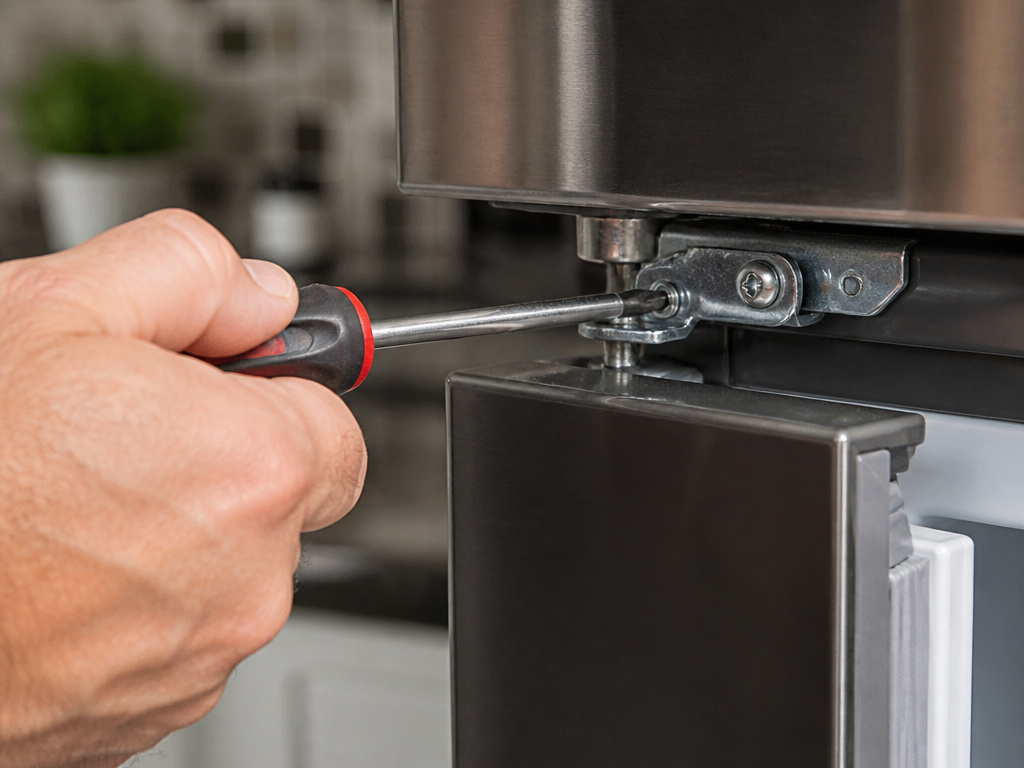
Loose or worn hinges: Over years, hinges can sag, causing the door to drop and catch on the frame. Check for vertical misalignment by comparing the top edges of the two doors (or the door to the cabinet). A slight adjustment is usually possible via screws on the hinge plate.
Common mistake: Oiling the hinges. Refrigerator door hinges are designed to operate dry. Adding oil attracts dust and creates a gummy paste that slows movement, making the problem worse.
Automatic door closers: Brands like KitchenAid build a gentle-close mechanism into some models. The manual specifies: “if a door is open at a 40° or smaller angle, the door will automatically, softly close.” For this to work, the door must be perfectly balanced. If the fridge isn’t level or the hinge is binding, the mechanism won’t engage.
Damaged hinge: The LG manual is blunt: “If the hinge of the appliance door is damaged or operates improperly, stop using the appliance and contact an authorized service centre.” A broken hinge isn’t a DIY fix; it’s a safety issue.
Understanding the Door-Open Alarm
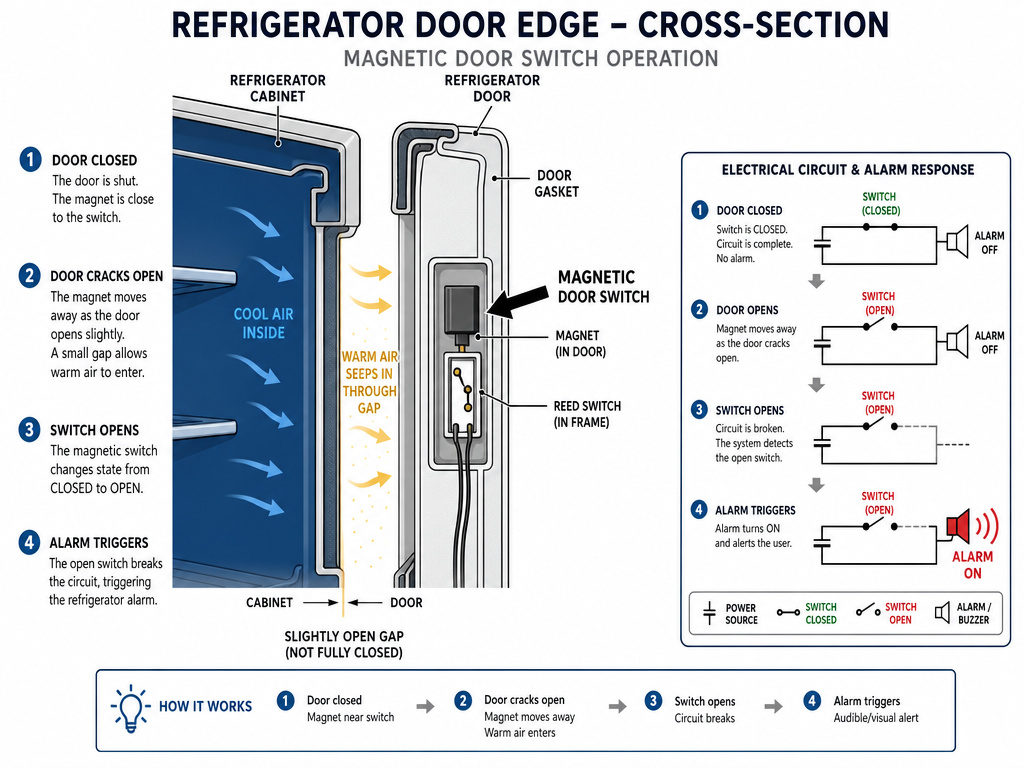
Many modern fridges have a door-open alarm to prevent energy waste. If you hear beeping from the fridge, this is likely why. The LG manual provides the exact timing: “The alarm sounds 3 times in a 30 seconds intervals if one of the doors is left open or not completely closed for one minute.”
That’s your cue. The alarm isn’t broken; it’s telling you the door isn’t sealed. Walk through the checklist: level, gasket, obstruction. If the alarm persists after the door visibly clicks shut, the magnetic switch that detects “closed” might be faulty. That’s a service call.
This alarm is part of a system designed to maintain safe food storage temperatures. A door left ajar lets the temperature rise, which is why maintaining refrigerator temperature for safety involves more than just setting a dial.
What Not to Do: Habits That Prevent Closure
Sometimes the cause isn’t a broken part but a repeated action. Break these habits to keep the door shut.
Slamming the door. It feels satisfying, but it’s counterproductive. The LG manual warns: “Applying too much force or speed when closing the door may cause it to remain briefly open before closing.” The momentum can bounce the door off the seal just enough to break the magnetic hold.
Overloading the top shelf. This is similar to overloading door bins but less obvious. Excessive weight high up can torque the entire cabinet, throwing off the careful leveling you just did.
Ignoring condensation or frost. If you see moisture around the door seal, the gasket is already failing to do its job. This is a precursor to a door that won’t stay closed. It’s also a sign of excess humidity inside, which can relate to other issues like persistent fridge odors.
Step-by-Step Diagnostic Flow
When the door won’t stay shut, follow this sequence. It moves from the simplest, most common fix to the more complex.
- Listen and Observe. Does the door swing shut on its own from a 45-degree angle? If not, go to step 2. If it does but then pops open, go to step 3.
- Check and Adjust Leveling. Verify the front is higher than the back. This solves the majority of cases.
- Inspect the Gasket. Clean it and perform the dollar bill test. A cold, clean, intact gasket is essential.
- Look for Obstructions. Scan shelves, bins, and the flipper mullion. Remove any item within an inch of the door frame.
- Test the Door’s Weight. With the fridge empty, does the door close properly? If yes, an overload is your issue. Revisit how to organize a fridge for better weight distribution.
- Consult the Manual. Look up your model’s specific features (auto-close, alarm). Ensure you’re using it as designed.
- Call a Pro. If hinges are damaged, the gasket is torn, or the door is structurally warped, professional repair is the next step.
Frequently Asked Questions
Why does my refrigerator door swing open by itself?
The fridge is likely leaning backward, or the front leveling feet are too low. Gravity isn’t pulling the door shut. Adjust the front feet up 1/4 inch and test again.
How do I know if my refrigerator door seal is bad?
Perform the dollar bill test. If you can pull the bill out without resistance at any point, the seal is failing. Visually look for cracks, tears, or a flattened, non-springy section.
What does it mean when my fridge beeps three times?
This is typically the door-open alarm. On LG models, it means a door has been ajar or not fully closed for one minute. The alarm sounds three times over 30 seconds. Check that both doors are sealed completely.
Can I fix a refrigerator door that won’t close myself?
Yes, for the most common causes: leveling the fridge, cleaning the gasket, and removing obstructions are all DIY tasks. Replacing a damaged gasket or repairing hinges is more advanced but still doable with the right parts and instructions.
Why does my French door refrigerator not close on one side?
Check the flipper mullion (the plastic center divider). If it’s not flipped fully inward, it will block the right door. Also, ensure the left door is closing first and completely; the right door seals against it.
The Bottom Line
A refrigerator door that won’t stay closed is usually a simple physics problem, not a complex breakdown. Start with the tilt. Then look at the seal. Those two steps cover most cases.
The specifics from the manuals change the game. Knowing that slamming can cause bounce-back, or that an auto-closer needs a 40-degree angle, turns vague advice into actionable checks. Your fridge is telling you what’s wrong—through an alarm, a slow drift, or a warm seal. Your job is to run the sequence.
Fix the level, clean the gasket, clear the path. That keeps the cold in, the food safe, and the beeping quiet.
