How to Properly Store Cooked Rice & Prevent Food Poisoning
This post contains affiliate links. As an Amazon Associate, we earn from qualifying purchases.
Store cooked rice safely by cooling it from 135°F to 70°F within two hours, then to 41°F within four more hours. Divide it into shallow containers less than 10cm deep and refrigerate immediately. Eat refrigerated rice within 24 hours for guaranteed safety, though it can last up to 7 days if kept consistently below 41°F. Never reheat rice more than once.
That two-hour window is the whole game. Bacillus cereus spores survive cooking. They wake up as the rice cools through the danger zone between 135°F and 41°F. Your job is to rush the rice through that zone before the spores can multiply and produce their toxin.
What follows: the exact temperature targets and timelines from public health manuals, why your container choice matters more than your fridge’s cold setting, and the one reheating mistake that makes safe rice dangerous again.
Key Takeaways
- Cool cooked rice from 135°F (57.2°C) to 70°F (21°C) within two hours, then to 41°F (5°C) within four more. Slower cooling requires tossing the batch.
- Use shallow containers less than 10 cm (about 4 inches) deep. A deep pot of rice can stay in the danger zone for over four hours at its core.
- Refrigerated rice is microbiologically safe for up to 7 days at or below 41°F, but texture and flavor degrade after 24 hours.
- Reheating does not destroy the heat-resistant toxin produced by Bacillus cereus. If rice was stored incorrectly, reheating it thoroughly will still make you sick.
- Never reheat rice more than once. Each cycle back through the danger zone allows new bacterial growth.
The 2-Hour Cooling Rule That Stops Bacillus cereus
The spores are already in the rice when you buy it. Cooking doesn’t kill them. They only become a problem when the cooked rice lingers between 135°F (57.2°C) and 41°F (5°C)—the temperature danger zone. In that window, spores germinate into bacteria, which multiply and can produce a toxin.
Common mistake: Leaving a full rice cooker on “keep warm” overnight. The warming function often holds rice around 120°F, squarely in the danger zone. After six hours, the toxin load can be high enough to cause vomiting within an hour of eating.
The N.C. Cooperative Extension provides the specific cooling targets that define safe food storage. Rice must cool from 135°F to 70°F within two hours. It must then reach refrigerator temperature (41°F or below) within an additional four hours. If it doesn’t hit 70°F in the first two hours, the entire batch should be discarded.
This is not a gentle suggestion. It’s the difference between a safe leftover and a biological timer.
| Stage | Target Temperature | Max Time Allowed | What Happens If You Miss It |
|---|---|---|---|
| Initial Cool | 135°F → 70°F (57°C → 21°C) | 2 hours | Spores germinate; bacteria begin rapid multiplication. |
| Final Cool | 70°F → 41°F (21°C → 5°C) | 4 hours | Toxin production may begin; rice must be pitched. |
| Total Time in Danger Zone | — | 6 hours maximum | Rice is unsafe, regardless of reheating. |
The clock starts the moment cooking ends. Take the rice out of the pot, steamer, or cooker to stop residual heat from slowing the cool-down.
How to Cool Rice Fast Enough (The Practical Steps)
You cannot rely on a refrigerator to cool a large, hot mass. The fridge’s job is to keep cold food cold, not to chill hot food quickly. The cooling happens before the rice goes in.
- Transfer Immediately. As soon as the rice is done, empty it from the cooking vessel into a clean, wide bowl or pan. The increased surface area is critical.
- Divide and Conquer. If you’ve made more than four cups, split it into two smaller containers. This cuts the thermal mass in half.
- Spread It Thin. Use a shallow container. The Western Australia safe rice cooling guide specifies a depth of less than 10 cm (about 4 inches) for a reason. A deep pot insulates its own core.
- Let It Breathe. Do not cover the rice while it’s cooling on the counter. Covering it traps heat and steam. Let the heat dissipate into the air for 20-30 minutes.
- Refrigerate Promptly. Once it’s no longer steaming hot to the touch (around 70°F), cover the container and move it to the fridge. Do not wait for it to reach room temperature.
I learned the shallow-container rule the hard way. I cooled a large batch of jasmine rice in its original 8-inch deep pot. The outside felt cool after two hours, but the center was still warm. That rice tasted fine but gave me stomach cramps within three hours. The center had never left the danger zone.
The goal is to minimize the time the rice spends between 40°F and 140°F. Every minute counts.
Choosing the Right Container for Storage
Your container does two jobs: it facilitates rapid initial cooling, then maintains a consistent, cold temperature. A container that fails at either task undermines the entire process.
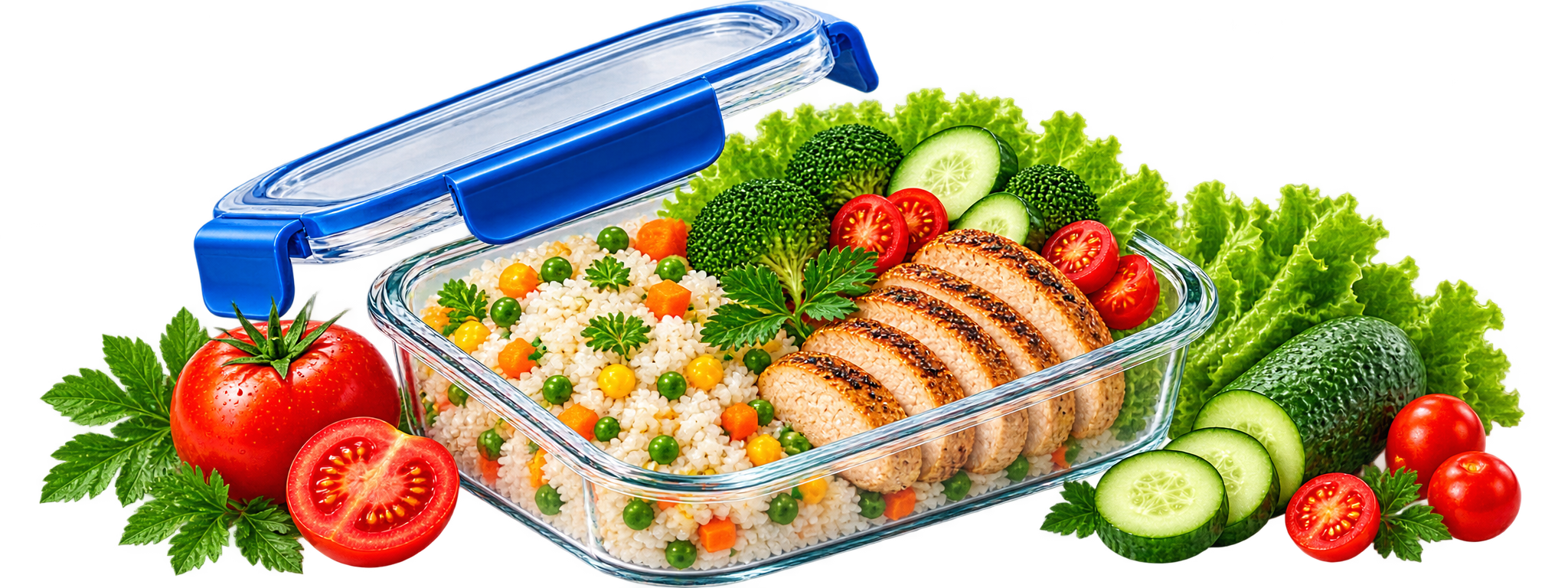
For cooling and short-term storage (1-7 days), you need airtight glass or BPA-free plastic containers. Avoid storing rice in the pot it was cooked in.
- Glass Containers: Pyrex or similar glass storage sets are ideal. They don’t retain odors, are easy to clean, and you can see the contents. Their typically wide, shallow shapes are perfect for fast cooling.
- BPA-Free Plastic: Look for containers specifically marketed as meal-prep or refrigerator storage. Ensure they have a reliable sealing lid.
- Stainless Steel: Excellent for rapid cooling, but not always airtight for long-term fridge storage. Best used for the initial cool-down before transferring to a sealed container.
Where this goes sideways: Using a “leftover saver” plastic container that’s deep and narrow. It might seal well, but if you put hot rice directly into it, the center will stay warm for hours, turning the container into an incubator.
For integrating rice into your long-term rice storage methods, the principles are the same. The best rice storage containers are always airtight and sized appropriately to avoid empty air space.
How Long Does Cooked Rice Last in the Fridge?
 Here is the central conflict in food safety advice, and it stems from two different standards: absolute safety versus optimal quality.
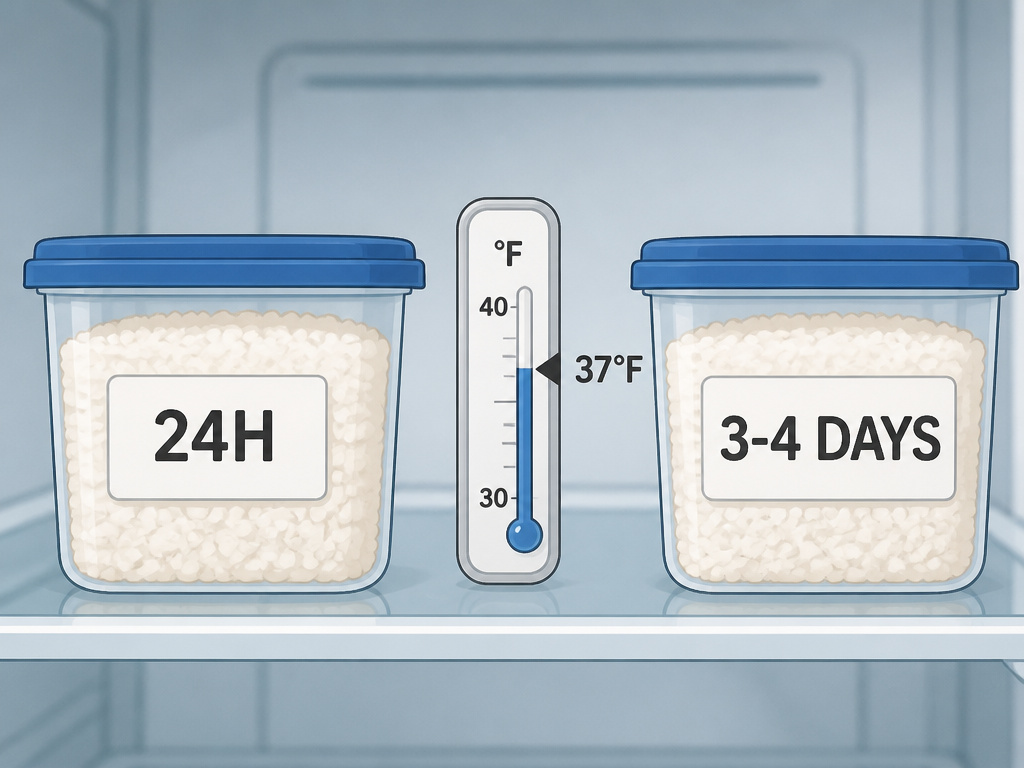
Food Standards Scotland advises eating refrigerated cooked rice within 24 hours. This is a conservative, zero-risk guideline that accounts for less-than-ideal home refrigeration and potential temperature fluctuations.
The N.C. Cooperative Extension states that cooked rice is microbiologically safe for up to 7 days if held at or below 41°F (5°C) the entire time. This assumes perfect, consistent refrigeration.
| Guideline Source | Recommended Fridge Time | Basis |
|---|---|---|
| Food Standards Scotland | 24 hours | Conservative public health advice, prioritizes guaranteed safety. |
| N.C. Cooperative Extension | 7 days (at ≤41°F) | Microbiological safety based on controlled temperature. |
| Practical Reality | 3-4 days | Balance of safety, texture, and flavor degradation. |
The truth for most home kitchens lies in the middle. Your fridge likely has warm spots, gets opened frequently, and may not hold a perfect 37°F throughout. Rice also stales and dries out.
Bottom line: For guaranteed safety, follow the 24-hour rule. If your refrigerator is reliable and you monitor its temperature, 3-4 days is a reasonable practical limit. By day five, the texture is often unappealing anyway.
If you can’t eat it within a few days, freezing is a safer alternative for long-term rice storage. While the texture becomes softer upon thawing, freezing stops all biological activity.
How to Reheat Rice Safely (It’s Not What You Think)
 A critical misconception is that reheating rice kills the bacteria and makes it safe. This is dangerously wrong. While reheating kills the active Bacillus cereus bacteria, it does nothing to the heat-resistant toxin they may have already produced.
Reheating does not destroy the heat-resistant toxin. If the rice was improperly stored and toxins formed, reheating it thoroughly will still make you sick.
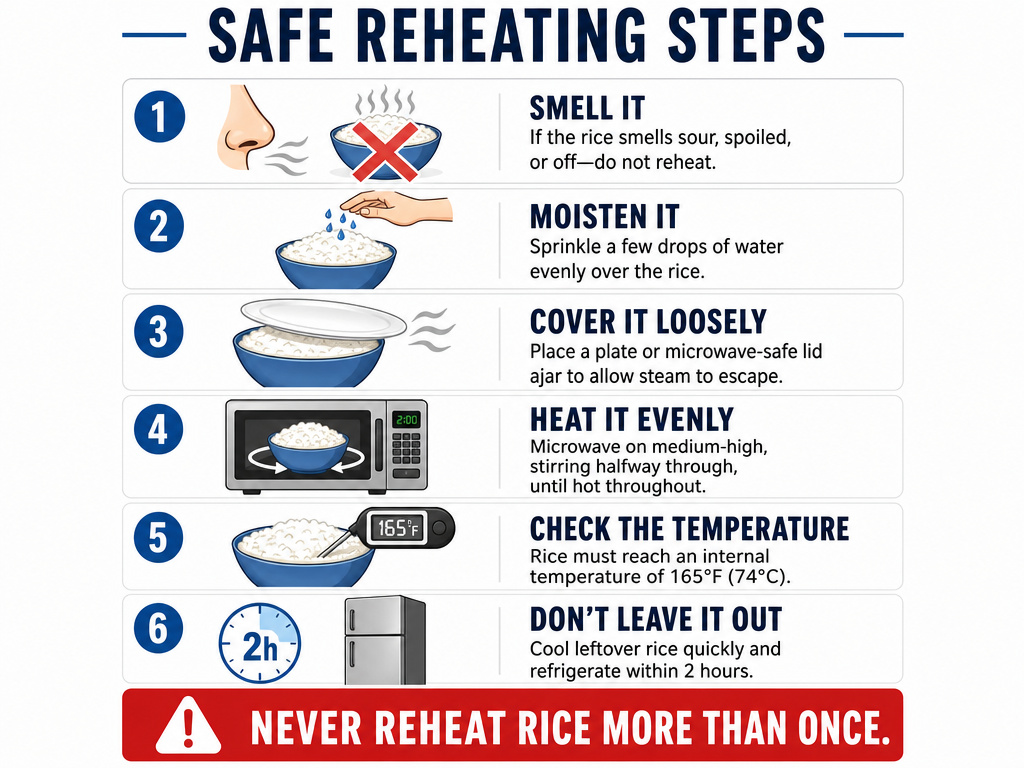
Therefore, safe reheating is only possible if the rice was cooled and stored correctly in the first place. Given that, here is the safe method:
- Check First. Smell the rice. If it has any off, sour, or alcoholic odor, discard it immediately. Do not taste it.
- Add Moisture. Place the rice in a microwave-safe dish. Sprinkle 1-2 tablespoons of water per cup of rice over it. This replaces steam lost during refrigeration.
- Cover Loosely. Place a lid or microwave-safe plate on top, slightly ajar to allow steam to escape while containing heat.
- Heat Thoroughly. Microwave on high until the rice is piping hot and steaming throughout. There should be no cold spots.
- Verify Temperature. Use a food thermometer. The Torbay Council rice handling guide and the USDA state that reheated leftovers must reach an internal temperature of 165°F (74°C). Stir the rice and check multiple spots.
- Serve Immediately. Do not let reheated rice sit out. Return any uneaten portion to the fridge within two hours.
Never reheat rice more than once. Each cycle of cooling and reheating gives any surviving spores another chance to germinate and multiply as the rice passes through the danger zone again. Reheat only the portion you plan to eat.
Frequently Asked Questions
Can you get food poisoning from refrigerated rice?
Yes, if the rice was not cooled quickly enough before refrigeration. Bacillus cereus spores can produce a heat-resistant toxin while the rice is slowly cooling in the danger zone (between 135°F and 41°F). Refrigerating after that point will not remove the toxin, and reheating will not destroy it.
Does reheating rice kill bacteria?
Reheating kills the active Bacillus cereus bacteria, but it does not destroy the toxin they may have already produced. If toxins are present, you will get sick from the reheated rice. Proper initial cooling is the only prevention.
What is the best container to store rice in the fridge?
Wide, shallow, airtight glass container is best. The shallow depth (under 10cm/4 inches) allows for rapid cooling, the glass doesn’t harbor odors, and the airtight seal keeps the rice from drying out and absorbing other fridge smells. This is a core principle of proper storage for cooked rice.
How can you tell if cooked rice has gone bad?
Signs include a sour, fermented, or unusual odor; a slimy or mushy texture; visible mold (which can appear as fuzzy spots in various colors); or an off taste. When in doubt, throw it out. The potential toxin is odorless and tasteless, so a lack of obvious signs does not guarantee safety if cooling was slow.
Is it safe to eat cold rice from the fridge?
Yes, cold cooked rice is safe to eat if it was cooled rapidly and stored correctly in the refrigerator. It’s a common ingredient in cold rice salads. Just ensure it has been stored for less than 24 hours (or up to 3-4 days under ideal conditions) and has no signs of spoilage.
Can you freeze cooked rice?
Yes. Freezing stops bacterial growth and is an excellent method for extended rice storage. Portion the cooled rice into airtight freezer bags or containers, removing as much air as possible. It will remain safe indefinitely but is best used within 6 months for acceptable texture. Thaw in the refrigerator before reheating.
The Bottom Line
Safe rice storage is a race against a microscopic clock. Win the race by cooling cooked rice from 135°F to 70°F in under two hours, using wide, shallow containers. Lose the race, and a heat-resistant toxin can form—a toxin that no amount of reheating can fix.
Commit to the two-hour rule. Invest in a few good shallow glass containers. And respect the timeline: 24 hours for certainty, 3-4 days for practicality with perfect fridge conditions. This turns a common kitchen staple from a potential hazard into a reliable, safe leftover every time.
