Can Pancake Batter Be Stored in the Fridge? A Complete Guide
This post contains affiliate links. As an Amazon Associate, we earn from qualifying purchases.
**You can store pancake batter in the fridge, but you have a tight 48-hour window from the USDA, and the leavening agents that make pancakes fluffy start dying the moment you mix wet and dry.After two days, the batter becomes a higher-risk food safety item.
That gap between possible and advisable is where most guides stop. The official line says 48 hours. Your nose might tell you three days is fine. The pancakes you cook on day three will be dense, gummy, and a gamble.
What follows: the sourced safety rules, the chemistry behind the sad second-day pancake, the two batters that break the standard rule, and the method that actually works for meal prep.
Key Takeaways
- The USDA and FDA state refrigerated raw egg batter is safe for up to 48 hours at or below 40°F (4°C).
- Leavening failure happens faster than spoilage. Baking powder reacts on contact; by morning, half its lift is gone.
- Yeast-based or buttermilk batters change the rules, yeast keeps working, and acidity can inhibit bacteria but accelerates starch breakdown.
- Freezing cooked pancakes preserves texture and eliminates raw egg safety concerns entirely.
- The right container is non-negotiable: use a glass or plastic airtight container, never metal for acidic batters.
The 48-Hour Safety Window (USDA & FDA Rules)
The question concerns Salmonella and Staphylococcus aureus. Raw eggs are the vector, and once cracked and mixed, any contamination spreads through the entire batch.
The U.S. Food and Drug Administration (FDA) categorizes pancake batter as a perishable “raw egg mixture.” Their directive is specific: refrigerate it promptly, within two hours of mixing, and keep it at or below 40°F (4°C). Even at that temperature, they advise use within a day or two because bacterial growth can occur over time, especially with common fridge temperature fluctuations.
Before you start: The USDA puts the maximum safe window at about 48 hours for refrigerated raw egg mixtures. This isn’t a freshness guideline; it’s a food safety ceiling based on pathogen doubling rates at or below 40°F.
This 48-hour rule is your hard stop. It accounts for the reality that home refrigerators aren’t lab-grade. The door gets opened. A leftover takeout container goes in warm. The temperature at the back of the shelf might be 37°F, but the front where you shoved the batter bowl could creep toward 45°F.
| Factor | Ideal Condition | What Happens If Compromised |
|---|---|---|
| Temperature | ≤ 40°F (4°C) | Pathogens like Salmonella can double every 20 minutes above 40°F. |
| Time | ≤ 48 hours | Risk of bacterial growth and toxin formation increases non-linearly after 48 hours. |
| Container | Airtight, non-metal | Metal can react with acidic batters; non-airtight containers allow odor absorption and faster spoilage. |
Your first move after mixing should be transferring the batter to a clean, airtight container. Glass or food-grade polypropylene works. Don’t leave it in the mixing bowl covered with a plate. That’s how you end up with batter that smells like last night’s onion dip.
This is also where your general food storage habits matter. A consistent fridge temperature is the foundation of safety for this and every other perishable.
Why Day-Two Pancakes Are a Letdown (The Chemistry)
Safety is one clock. Palatability is another, and it runs out faster. The fluffiness of a pancake depends entirely on trapped gas bubbles. Those bubbles come from your leavening agents, baking powder or baking soda.
Baking powder is “double-acting.” Its first reaction happens the instant liquid hits the dry mix, creating bubbles. Its second reaction needs heat, waiting for the griddle. When you refrigerate batter, you’re putting that first reaction on slow-motion, not stopping it. The bubbles slowly coalesce and escape. The lifting power you counted on seeps out through the container walls.
By the next morning, a significant portion of your leavening potential is just gone. You can try to whisk in a pinch more baking powder before cooking, but it’s a patch job. The distribution is never even, and you’re now mixing a rested, thickened batter, which overdevelops the gluten. The result is a pancake that’s both dense and tough.
I tried the “whisk in more powder” trick for a week. The pancakes didn’t get taller; they got bitter from the uneven chemical taste and developed a rubbery skin. The gas had already left the building.
Baking soda is even more straightforward. It needs an acid to react, buttermilk, yogurt, lemon juice. That reaction is immediate and exhaustive. If you’re making a buttermilk batter on Saturday for Sunday morning, the soda spent its force in the bowl. Your Sunday pancakes will be leaden.
This is why the consensus advice to “use within 24 hours for best quality” exists. It’s not arbitrary. It’s the point where leavening decay becomes obvious on the plate. The pancake mix itself can last ages in the pantry, but the clock starts at mixing.
The Two Batters That Break the Rules
Not all batters follow the 48-hour/flop-24-hour schedule. Two common types operate on different principles.
Yeast-Based Batters (like for Dutch babies or certain waffles) Yeast is alive. Refrigeration slows it but doesn’t stop it. The yeast will continue to ferment and produce gas. This sounds good, free rise!, but it’s messy. Without the structure of a dough, the batter can over-ferment, collapsing into a boozy, sour soup. For yeast batters, the window shrinks to 24 hours max in the fridge. After that, the flavor is off and the structure is gone.
Fermented or Highly Acidic Batters (sourdough pancakes, long-term buttermilk batters) Acidity (a low pH) inhibits pathogens like Salmonella, which is good for safety. However, it accelerates the enzymatic breakdown of the flour‘s starch. The batter can thin out dramatically, losing 15% or more of its viscosity in two days. It might be safe slightly longer, but it will pour like soup and cook into a flat, crêpe-like thing. Rely on smell and visible separation here, if it’s watery and smells sharply sour, it’s past its prime.
| Batter Type | Standard Rule | Edge-Case Behavior | Revised Timeline |
|---|---|---|---|
| Standard (Baking Powder) | 48-hr safety, 24-hr quality | Leavening decays; batter thickens. | Use within 24 hrs for acceptable rise. |
| Yeast-Based | 48-hr safety | Yeast ferments continuously; over-rises & sours. | Use within 24 hrs. Discard if boozy or separated. |
| Acidic (Buttermilk/Sourdough) | 48-hr safety | Acids inhibit bacteria but break down starch; batter thins. | Safe maybe 72 hrs, but quality plummets after 48. |
Storing these specialty batters requires extra attention. The vessel matters even more, never use a metal bowl for a long-term acidic batter. The acid can react with the metal, leaching ions that create a bitter, off taste.
The Better Move: Freeze the Pancakes, Not the Batter
If your goal is meal prep or saving leftovers, you’re asking the wrong question. Storing batter is a technical headache. Storing cooked pancakes is simple physics.
Cooking the batter locks in the structure and rise at its peak. Freezing halts all chemical and microbial activity dead. You’re preserving a finished product, not a unstable chemical reaction.
Here’s the full swap, step-by-step:
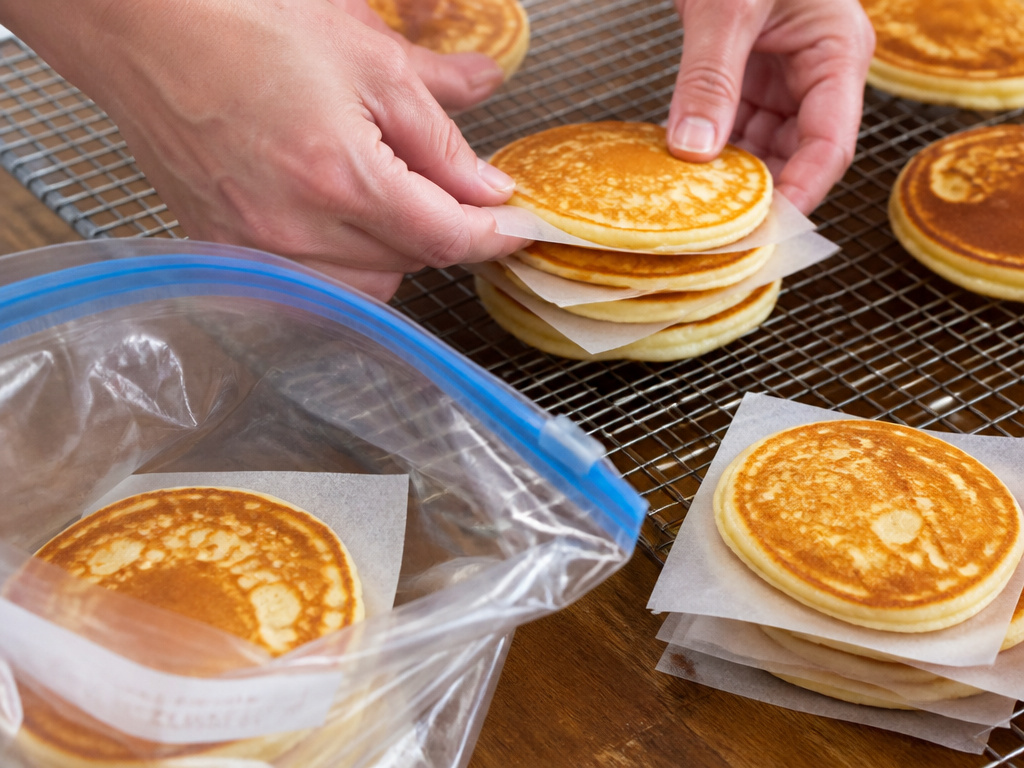
- Cook All the Batter. Even the dregs. Make every pancake.
- Cool Completely. Spread them on a wire rack. If you stack them hot, steam turns them soggy. This is the most-skipped step.
- Portion & Separate. Stack pancakes with parchment paper between each. This prevents them from freezing into a single, unbreakable lump.
- Bag & Freeze. Slide the stack into a resealable freezer bag, press out the air, and label it. They’ll keep for up to 2 months.
The part nobody mentions: A wire rack isn’t just for cookies. It allows air to circulate under the pancake, wicking away steam from the bottom. A plate or towel traps it, guaranteeing a gummy underside.
To reheat, you don’t even need to thaw. Pop a frozen pancake straight into the toaster, a 350°F oven for 5-7 minutes, or a microwave for 30-60 seconds. It rehydrates from the inside, coming out nearly as good as fresh.
This method sidesteps the raw egg safety question entirely and preserves quality for weeks. It also turns your freezer into a instant breakfast station. The same principle applies to other baked goods, like knowing how to properly store a cake or cheesecake for optimal freshness later.
Your Fridge & Container Setup Matters
You can follow every rule and still fail if your tools are wrong. This isn’t about fancy gear; it’s about avoiding common mistakes.
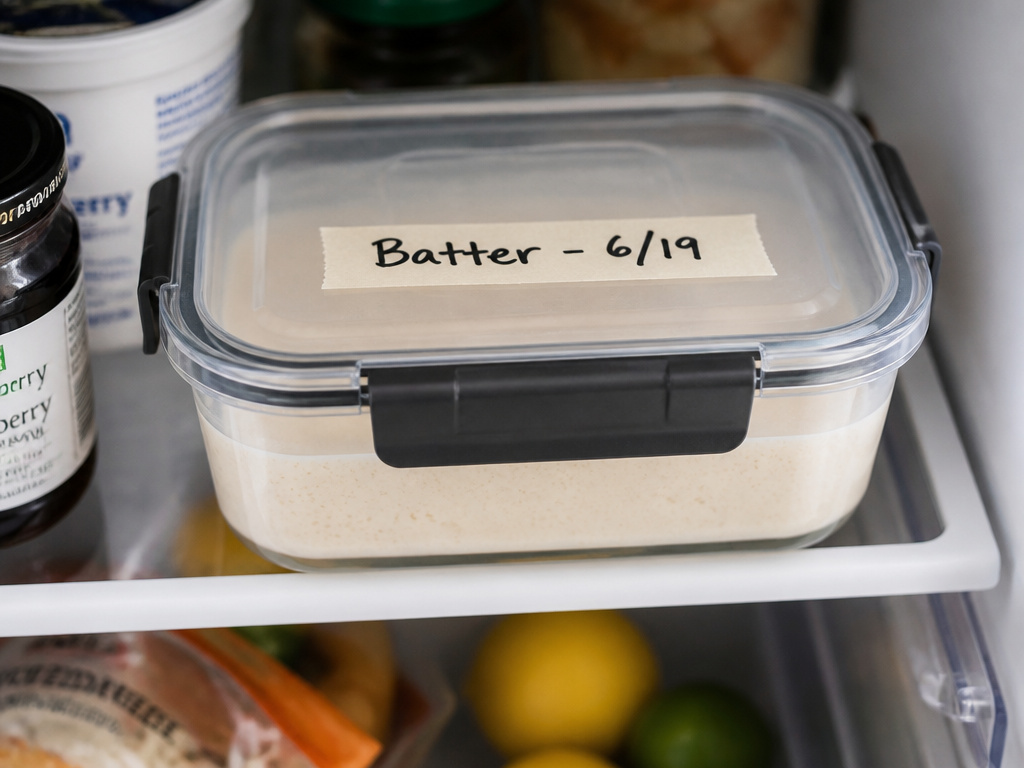
The Container: Use a rigid, airtight container. A glass Pyrex with a locking lid or a heavy-duty plastic container with a silicone gasket. The goal is zero air exchange. A loose-covered bowl lets batter absorb fridge odors and dries out at the surface. * Never use metal for acidic batters. The reaction is slow but real. * Label it. Write “Batter – [Date]” on tape. At 7 AM, you won’t remember when you made it.
The Fridge Real Estate: Don’t shove the container in the door. That’s the warmest, most temperature-fluctuating zone. Place it on a middle shelf toward the back, where the temperature is coldest and most stable. This is basic fridge organization: perishables in the cold zone, condiments in the door.
If you’re serious about storing batter or anything else, investing in a few dedicated storage containers is a one-time fix. The right tool removes the guesswork.
Frequently Asked Questions
Can you store pancake batter in the fridge overnight?
Yes, storing pancake batter in the fridge overnight is safe and common. However, the pancakes you make in the morning will be noticeably denser and less fluffy than if cooked immediately, as the leavening agents lose potency over those 8-12 hours.
How can you tell if pancake batter has gone bad?
Smell it. Spoiled batter will have a sour, unpleasant, or “off” odor, distinct from the normal floury-eggy smell. Visually, look for unusual discoloration (grey or green tinges) or a slimy texture. If you see bubbles or foam that weren’t there initially, that’s likely fermentation from unwanted bacteria. When in doubt, throw it out.
Does buttermilk pancake batter last longer in the fridge?
No, it doesn’t last longer. The acidity in buttermilk can inhibit some bacterial growth, but it also reacts fully and immediately with baking soda, leaving the batter with no lift after a few hours. Buttermilk batter is often at its best used within 12 hours.
Can you freeze pancake batter instead?
You can freeze pancake batter, but it’s a subpar solution. Freezing damages the leavening agents’ ability to create gas, and thawed batter often separates and requires significant re-mixing. You’ll get edible, but flat and rubbery, pancakes. Freezing the cooked pancakes is a vastly superior method.
What’s the best container for storing pancake batter?
Glass or BPA-free plastic airtight container is best. Ensure the lid has a tight seal. Avoid metal containers (especially with acidic batters) and never use a loosely covered bowl, as it leads to odor absorption, drying, and faster spoilage.
Before You Go
You can store pancake batter in the fridge. The USDA says you have 48 hours before the safety risk climbs. Your taste buds will tell you you have less than 24 before the quality drops off a cliff.
The real takeaway is about choosing the right method for your goal. If you want “make-ahead,” mix your dry and wet ingredients separately and combine them in the morning.If you want “leftover management,” cook all the batter and freeze the pancakes. That path gives you safety, quality, and a real instant breakfast.
Stop trying to make day-two batter work. The chemistry is against you, and your weekend deserves better.
