The Best Methods for Preserving Aloe Vera Gel Effectively
This post contains affiliate links. As an Amazon Associate, we earn from qualifying purchases.
You can preserve aloe vera gel by freezing it, refrigerating it with specific additives, or using high-pressure processing. The goal is to slow oxidation and microbial growth, which begin degrading the gel’s antioxidants within days of exposure to air. A 2023 study found that adding 0.1% benzoic acid and 300 ppm vitamin E maintained 50% antioxidant activity for 30 days at 4°C.
That specific combination of preservatives targets both the microbes and the chemical breakdown. Benzoic acid drops the pH, creating an environment where spoilage bacteria struggle. Vitamin E scavenges free radicals, slowing the oxidative browning that turns fresh gel from clear to yellow-brown. Without both, you’re fighting only half the battle.
What follows: the three most common home methods dissected, the commercial science that makes shelf-stable products possible, and a step-by-step guide that names the exact additives and their safe concentrations.
Key Takeaways
- Untreated aloe gel loses over 75% of its antioxidant power within three weeks in the fridge. Adding preservatives like vitamin C or benzoic acid is not optional for any storage beyond a few days.
- Freezing is the most effective home method, preserving the gel’s structure and potency for up to a year. Thawed gel works best for topical use, not internal consumption.
- The “honey method” popular on social media lasts only 1-2 months refrigerated and dilutes the gel’s active compounds. It’s a poor choice for therapeutic use.
- Commercial stabilization uses heat, pressure, and specific antioxidants. A patented process involves rapid heating to 80°C, adding a tocotrienol/tocopherol blend, then rapid cooling.
- Always store preserved gel in opaque, airtight containers. Light and oxygen are the primary drivers of degradation, regardless of your preservation method.
The 3 Most Common Methods (and Where They Fail)
Most guides list freezing, fridge-with-additives, and honey. They rarely tell you why each one works, or more importantly, where it falls apart. Knowing the mechanism prevents wasted effort and spoiled gel.
Freezing aloe vera gel halts all enzymatic and microbial activity by reducing molecular motion. Ice crystal formation can damage cell walls, which is why thawed gel is best for external use where texture matters less than internal use.
Freezing: The One-Year Solution
Pour your blended gel into an ice cube tray, freeze solid, then transfer the cubes to a dated freezer bag. This method preserves the gel’s chemical profile almost perfectly for 8-12 months. The ice cube portioning means you only thaw what you need.
The failure point is texture. Thawed gel will be more watery and separated. That’s fine for a face mask or after-sun gel, but it’s unacceptable for a smoothie or a commercial product. If you plan to drink it, consider the additive methods below.
Refrigeration with Additives: The 2-6 Month Window
This is where most home preservers get the science wrong. They toss in some lemon juice and hope. The research is more precise.
Vitamin C (Ascorbic Acid): Use 1 gram of pure ascorbic acid powder per half-cup of gel. Blend thoroughly. The acid lowers the pH, inhibiting some microbes, and acts as an antioxidant. This mix lasts about 2 months refrigerated. It will foam initially—that’s normal.
Vitamin E (Tocopheryl Acetate): For 1 liter of gel, use 6000 IU of vitamin E oil. This is a fat-soluble antioxidant that protects the gel’s lipids from rancidity. It’s excellent for topical preparations and can extend fridge life to 6-8 months. Don’t use it for gel you intend to consume in large quantities.
The Professional Blend: A study published in the Annals of Dermatological Science used 0.1% benzoic acid, 300 ppm vitamin E, and 0.2% xanthium gum. This combination addressed microbial stability, oxidative resistance, and texture. It’s the gold standard for a reason, as detailed in their preservatives in aloe vera gel study.
Where this goes sideways: Using “a splash of lemon juice” instead of measured ascorbic acid. Lemon juice introduces water and sugars, diluting the gel and potentially feeding yeast. Your preservation window drops from months to weeks.
The Honey Method: A Shelf-Life Compromise
Mixing gel with an equal part of honey creates an environment too sugary for most microbes. It’s a valid preservative, but with major trade-offs.
Honey-diluted gel lasts only 1-2 months in the refrigerator. More critically, you’re cutting the concentration of aloe’s active polysaccharides in half. Any therapeutic benefit is diluted. This method is best for a pre-mixed skin moisturizer where the honey itself is desirable, not for preserving pure gel potency.
| Method | Max Shelf Life | Best For | Biggest Risk |
|---|---|---|---|
| Freezing | 8-12 months | Topical use, portion control | Texture loss; separation after thawing |
| Vitamin C Fridge | 2 months | Internal consumption | Under-dosing leads to mold within 3 weeks |
| Vitamin E Fridge | 6-8 months | Topical skincare | Oil can separate; not for ingestion |
| Honey Blend | 1-2 months | Pre-mixed skin moisturizers | Dilutes actives; shortest fridge life of all methods |
The Commercial Science of Long-Term Gel Stability
Home methods are about slowing decay. Commercial methods aim to stop it entirely. They use tools most kitchens don’t have, but understanding the principles shows you what you’re up against.
High Hydrostatic Pressure (HHP) Processing
This industrial technique subjects sealed gel to immense pressure—between 150 and 550 MPa—for five minutes. The pressure inactivates pathogens and enzymes without the heat that degrades nutrients. A high hydrostatic pressure application study found HHP at 400 MPa retained 93% of vitamin C in aloe gel.
The equipment costs tens of thousands of dollars. You won’t be doing this at home. But it explains why store-bought gel can sit on a shelf for years: the spoilage machinery inside the gel itself has been permanently disabled.
Heat Stabilization & Patented Processes
Many commercial gels are heat-treated. The trick is doing it fast and at a precise temperature to kill microbes while minimizing nutrient loss. A patent held by Aloe Vera of America outlines a rapid-heat, rapid-cool method with specific antioxidant blends.
The gel is heated to between 35°C and 80°C, a tocotrienol/tocopherol antioxidant mix is added, then it’s rapidly cooled to 20-30°C. This locks in stability. It’s why the gel in a bottle from the drugstore is clear and odorless after months, while your homemade version turns yellow and sour.
The Role of Gums and Stabilizers
Xanthan gum or xanthium gum (used in the study cited earlier) isn’t just a thickener. It forms a network that traps water molecules, limiting their mobility. This makes it harder for enzymes and bacteria to move through the gel and do their work. In simple terms, it puts the gel into a state of suspended animation. For home recipes aiming for longer storage, a tiny 0.2% addition of xanthan gum can significantly improve texture and stability, much like storing basil in oil creates a physical barrier against spoilage.
How to Preserve Aloe Vera Gel at Home: A Step-by-Step Guide
This process assumes you start with fresh, clean gel extracted from the leaf. Contamination at this stage ruins everything that follows.
Before you start: The yellow latex (aloin) between the leaf skin and the gel is a skin irritant and laxative. Make sure you’ve washed and scraped it all away. Wear gloves if you have sensitive skin.
Step 1: Harvest and Clean the Gel
Cut a leaf from the plant, stand it upright in a cup for 10 minutes to let the latex drain. Rinse the leaf. Slice off the spiky edges and the flat top and bottom. Slit the leaf open and use a spoon to scrape the clear fillet of gel away from the green rind. Rinse the gel fillets briefly under cold water.
Step 2: Blend and Strain
Place the gel fillets in a blender. Pulse until smooth. Pour the blended gel through a fine-mesh sieve or cheesecloth into a clean bowl. This removes any remaining fibrous bits that can harbor bacteria or speed up fermentation. You want a perfectly smooth, viscous liquid.
Step 3: Choose Your Preservation Path
This is the decision point. Your choice depends on how you’ll use the gel and how long you need it to last.
- For long-term topical use (8-12 months): Pour the strained gel into ice cube trays. Freeze overnight. Pop out the cubes and store them in a labeled, dated freezer bag. This is as effective as freezing whole lemons for locking in freshness.
- For short-term internal use (2 months): For every half-cup of gel, add 1 gram (about 1/4 teaspoon) of food-grade ascorbic acid powder. Blend vigorously for 30 seconds. The gel will foam. Transfer to a clean, airtight glass jar. Store in the back of the refrigerator, where the temperature is most stable.
- For mid-term topical use (6-8 months): For each liter of gel, add 6000 IU of vitamin E oil (d-alpha tocopheryl acetate). Use a hand blender to emulsify it thoroughly. Store in an opaque, airtight bottle in the refrigerator. This method parallels the safe method for preserving garlic in oil by using the preservative to create a hostile environment for spoilage organisms.
Common mistake: Storing gel in a clear jar in the fridge door. Light and temperature fluctuations will oxidize and degrade it within a week, regardless of additives. Always use opaque, airtight containers in the main fridge compartment.
Why Your Gel Turns Brown and Watery (The Science of Spoilage)
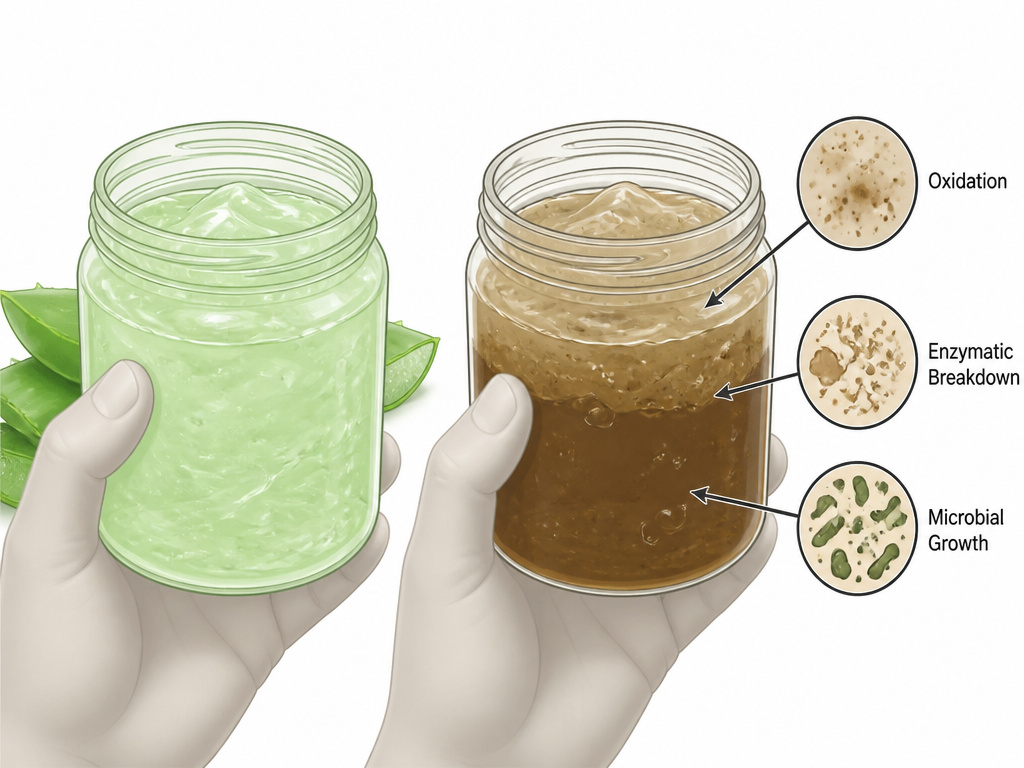
If you’ve ever opened a container of aloe gel to find a separated, yellowish-brown liquid, you’ve witnessed oxidation and enzymatic breakdown. Here’s what’s happening on a molecular level.
Oxidation: When gel is exposed to air, its phenolic compounds react with oxygen. This creates quinones, which polymerize into brown pigments. Antioxidants like vitamins C and E donate electrons to these compounds, stopping the chain reaction. Without them, the browning starts within hours.
Enzymatic Activity: Aloe leaves contain enzymes like polyphenol oxidase. When you blend the gel, you release and activate them. These enzymes accelerate the oxidation process. Heat (pasteurization) or extreme pressure (HHP) denatures these enzymes, stopping the reaction. Home freezing slows it to a crawl.
Microbial Growth: Fresh gel is a buffet of sugars and water. Yeast and bacteria introduce fermentation, which produces acids, gases, and off-flavors. Preservatives like benzoic acid lower the pH below 4.0, a zone where most spoilage microbes can’t thrive. This is a core principle in many food preservation techniques.
| Symptom | Likely Cause | Timeline | Can It Be Saved? |
|---|---|---|---|
| Gel turns yellow/brown | Oxidation (lack of antioxidants) | 1-3 days | No. The antioxidant capacity is gone. Discard. |
| Gel separates, watery | Enzymatic breakdown | 1-2 weeks | Possibly. Blend again, but potency is reduced. |
| Sour smell, bubbles | Microbial fermentation | 3-7 days | No. Contains potentially harmful bacteria. Discard. |
| Slime formation | Bacterial contamination | 5-10 days | No. Biofilm indicates advanced spoilage. Discard. |
Frequently Asked Questions
Can I preserve aloe vera gel without a refrigerator?
Yes, but with severe limitations. The honey method can be stored in a cool, dark pantry for about a month. Solar drying, as studied in Colombia, can reduce water activity to 0.473, creating a stable powder. This is a complex process requiring specific humidity (50-60%) and temperature (21-22°C) controls. For most people, freezing or refrigeration is the only practical non-refrigerated method, similar to challenges faced when preserving vegetables without cooling.
How long does homemade aloe vera gel last in the fridge without preservatives?
About 7 days. A study tracking antioxidant capacity found untreated gel lost over 75% of its DPPH inhibition activity after 21 days at 4°C. By day 7, significant degradation has already occurred. It might not smell bad yet, but its therapeutic value is plummeting.
Is it safe to use aloe vera gel preserved with vitamin C on the skin?
Generally, yes. A 1% concentration of ascorbic acid in gel is well-tolerated by most skin types and is actually used in anti-aging serums. Do a patch test on your inner arm first. If you feel stinging, wash it off and dilute the gel with more plain gel or a neutral carrier like aloe itself.
What’s the difference between preserving the gel and the whole leaf?
The whole leaf, with its green rind intact, contains higher concentrations of aloin (the latex). This compound degrades faster and is a skin irritant. Preserving just the inner gel fillet is cleaner and safer. Processing the whole leaf requires filtration with activated carbon to remove aloin, a step used in commercial production but difficult at home.
Can I use lemon juice instead of vitamin C powder to preserve aloe gel?
You can, but it’s less effective. Lemon juice is about 5-6% citric acid and contains water, sugars, and other organic compounds. You’d need to add a large volume to achieve a pH low enough to preserve, which dilutes the aloe gel significantly. For a reliable, concentrated preservative effect, pure ascorbic acid powder is superior, just as precise measurements matter in preserving lemon zest.
Before You Go
Preserving aloe vera gel isn’t about picking a method from a list. It’s about matching a method to your actual use case and understanding the trade-offs. Freezing is the hands-down winner for shelf life and simplicity if you’re using it on your skin. If you want to drink it, the vitamin C method is your best bet, but mark your calendar for two months out.
The honey method is the weakest link. It gives you a short shelf life and a diluted product. Skip it unless you’re making a specific honey-aloe blend for immediate use.
The real secret isn’t a secret at all: contamination and oxidation are your enemies. Start with impeccably clean gel, add measured preservatives, and store it in the right container. That discipline turns a perishable kitchen project into a stable, useful product. For other ingredients that demand similar precision, our guides on preserving fruit and using a vacuum sealer follow the same principle—control the environment, control the shelf life.
