How to Store Homemade Chicken Stock for Safety & Freshness
This post contains affiliate links. As an Amazon Associate, we earn from qualifying purchases.
Store homemade chicken stock by cooling it to 70°F within two hours, then moving it to an airtight container in a refrigerator at 40°F or below. It lasts 3 to 4 days there. For longer storage, freeze it at 0°F in freezer-safe containers, where it maintains best quality for 4 to 6 months but remains safe indefinitely.
That two-hour window is the USDA’s “danger zone” rule in action. Bacteria double every 20 minutes between 40°F and 140°F. A pot left to cool on the stovetop overnight spends six hours in that range, turning a rich stock into a high-risk culture.
What follows: the three storage paths (fridge, freezer, canning), the exact timelines from government charts, and the single cooling method that cuts the risk period in half. You’ll also get the specifics on thawing, the method you choose rewrites the clock.
Key Takeaways
- The USDA’s 2-hour cooling rule is non-negotiable; use an ice bath to hit 70°F in under an hour.
- Refrigerated stock lasts 3 to 4 days at 40°F; the Minnesota Department of Health chart says 1 to 2 days for broth.
- Frozen stock at 0°F is safe forever, but best quality lasts 4 to 6 months before flavor degrades.
- Thawing method dictates safety: fridge-thawed stock gets 3 to 4 extra days; microwave-thawed must be used immediately.
- Canning allows room-temperature storage, but a false seal, a lid that depresses but isn’t vacuum-sealed, means immediate refrigeration.
The 2-Hour Window: Cooling Stock to the Safe Zone
You finish simmering. The stock is done. This is the most critical phase for safety, not the weeks of storage that follow.
The U.S. Department of Agriculture defines the “danger zone” as temperatures between 40°F and 140°F. In this range, bacteria like Salmonella and Staphylococcus aureus can double in number every 20 minutes. The official rule is that perishable food must not remain in this zone for more than two hours total. A large, hot pot of stock is a perfect incubator.
Where this goes sideways: Letting a stockpot cool on the stovetop overnight. The center mass can stay above 140°F for hours, then drift down through the entire danger zone. By morning, even if it smells fine, bacterial loads can be dangerously high.
The goal is to move the stock from 140°F to 70°F as fast as possible. An ice bath is the most effective tool for a home cook. 1. Fill your sink or a large basin with ice and cold water. 2. Place the pot of hot stock directly into the ice bath. Stir the stock gently but continuously. This circulates the hot liquid from the center to the cold edges of the pot. 3. Check the temperature with a food thermometer after 30 minutes. Aim for 70°F. This method can cut the cooling time from 4+ hours to under 60 minutes.
Only after it hits 70°F should you portion it into storage containers and refrigerate. Pouring boiling stock into a container and putting it directly in the fridge is a different kind of mistake, it raises the fridge’s ambient temperature, jeopardizing everything else inside.
Refrigeration: The Short-Term Hold
Your refrigerator must be at 40°F or below to safely store stock. Use a standalone appliance thermometer to verify this; the built-in dial is often inaccurate.
Once cooled and transferred to an airtight container, homemade chicken stock will keep for 3 to 4 days in the refrigerator. This is the consensus from food safety aggregators citing USDA data.
However, some official sources are more conservative. The Minnesota Department of Health cold storage chart lists a shelf life of just 1 to 2 days for “gravy, broth” in the fridge. This discrepancy is a useful reminder: the 3–4 day guideline is for peak quality and safety under ideal conditions. If your fridge is older, fuller, or opened frequently, lean toward the shorter timeline.
| Storage Location | Temperature | Safe Shelf Life | Best Quality Timeline |
|---|---|---|---|
| Refrigerator | 40°F or below | 3 to 4 days | 3 to 4 days |
| Freezer | 0°F | Safe indefinitely | 4 to 6 months |
The signs of spoilage are straightforward. Toss the stock if you see any mold, catch a sour or “off” smell, or notice a slimy texture. When in doubt, throw it out. This principle applies to all your general food storage.
Freezing: The Long-Term Solution
Freezing stops bacterial growth entirely. At a constant 0°F, frozen chicken stock remains safe to eat indefinitely. The clock that matters here is for quality, flavor and aroma fade over time. For best results, use frozen stock within 4 to 6 months.
The physical process of freezing presents two practical challenges: container choice and expansion.
- Choose the right vessel. Rigid, airtight containers designed for freezing are best. Glass jars rated for canning (like Ball or Kerr jars) work if you leave ample headspace. Flexible, heavy-duty freezer bags (like Ziploc Freezer Bags) are excellent for flat storage, which saves space and thaws faster.
- Leave headspace. Water expands when it freezes. Fill containers only ¾ full, leaving at least a half-inch of space at the top. A full jar will crack; a full plastic container will warp and likely leak.
Portioning is your friend. Freeze stock in volumes you typically use: two-cup portions for soups, one-cup portions for sauces, or even ice cube trays for deglazing a pan. For a detailed look at your options, see our notes on the best containers for stock.
Common mistake: Thawing a giant block of stock, using one cup, and refreezing the rest. Each freeze-thaw cycle degrades quality and increases the risk of contamination. Portion before you freeze.
Thawing and Reusing Frozen Stock
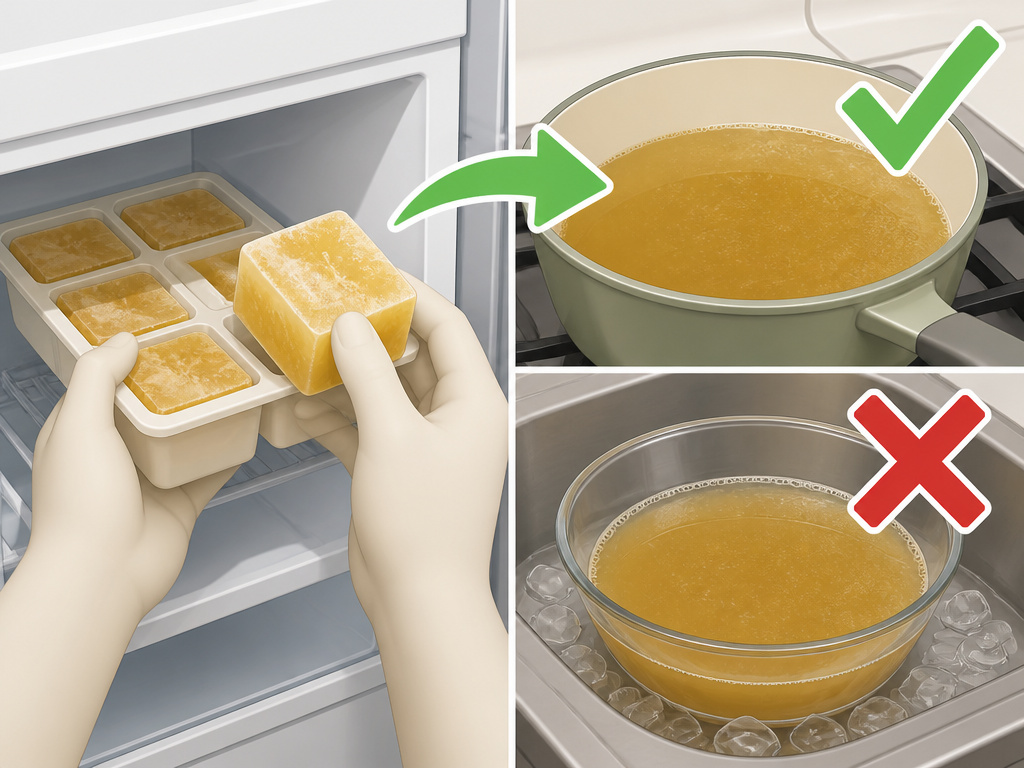
How you thaw it dictates what you can do next. This is a direct, non-negotiable rule from food safety databases.
- Thawed in the refrigerator: This is the only safe method that grants extra fridge life. Stock thawed this way can be kept in the refrigerator for an additional 3 to 4 days before cooking.
- Thawed in cold water or the microwave: Stock thawed by these faster methods must be used immediately. Do not refrigerate it for later use.
The reason is temperature control. Thawing in the fridge keeps the stock below 40°F the entire time. Thawing in water or a microwave brings parts of the stock back into the danger zone, allowing any surviving bacteria to wake up and multiply rapidly. The same strict rule applies to refreezing chicken that has been thawed.
Canning for Room Temperature Storage
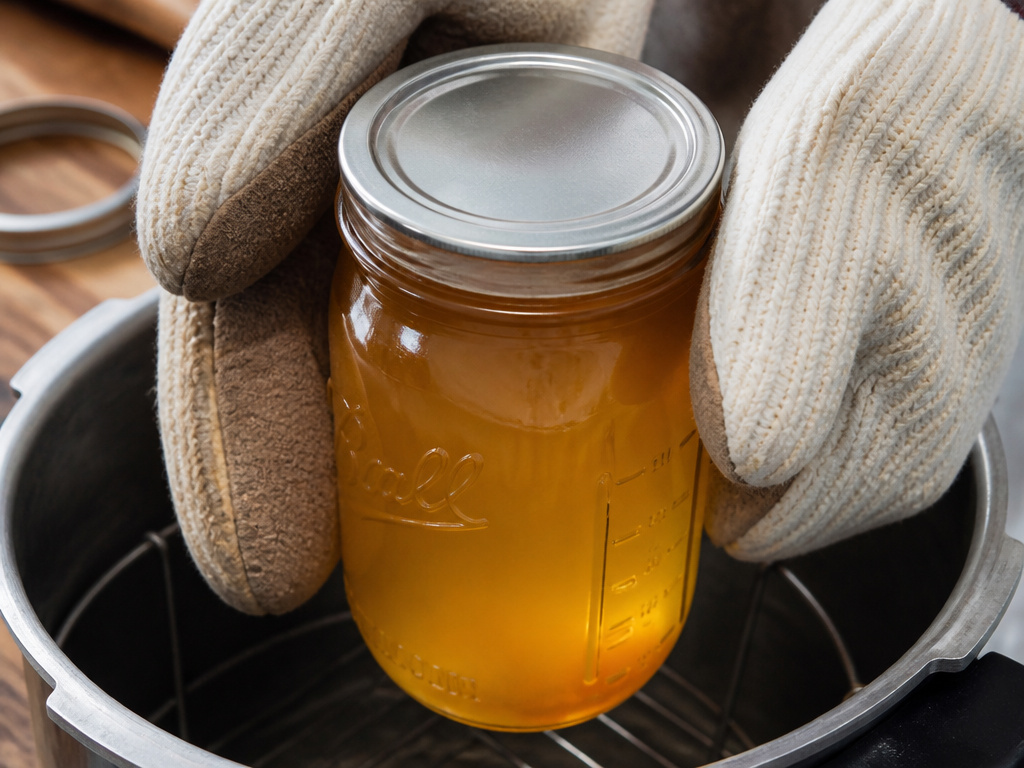
Canning is a preservation method that uses heat to destroy microorganisms and create a vacuum seal, allowing safe storage at room temperature. It’s a commitment of equipment and time, but it frees up fridge and freezer space.
The safe method for stock is pressure canning, not water bath canning. Stock is a low-acid food, and only the higher temperatures achieved in a pressure canner can destroy botulism spores. Follow a tested recipe from a reliable source like the National Center for Home Food Preservation.
After processing and cooling for 12–24 hours, test every seal. Press the center of the lid. It should not move or pop back. A lid that stays down when pressed but wasn’t vacuum-sealed is a “false seal.” Any jar with a false seal is not safe for the pantry; refrigerate it and use it within three days.
Properly canned, sealed stock can be stored without the metal ring bands in a cool, dark place. For the best flavor, plan to use it within one year.
What Not to Freeze (And Why)
Not all soups and stocks freeze equally. The ingredients matter.
- Dairy-based soups (chowders, bisques): The fat can separate and the texture often turns grainy or curdled upon thawing.
- Soups with pasta, rice, or potatoes: These starches absorb liquid and become mushy or disintegrate during freezing and reheating.
- Soups with delicate herbs: Herbs like parsley or basil turn black and lose their fresh flavor.
The solution is to freeze a plain base. Prepare and freeze your chicken stock. Cook and add your pasta, dairy, or fresh herbs only when you’re ready to serve the final soup. This is the same logic used for storing components like cooked rice separately from sauces.
Frequently Asked Questions
Can I store stock in the pot I cooked it in?
No. Even after cooling, transferring stock to a clean, airtight container is essential. The large surface area in a pot and exposure to fridge odors increase the risk of spoilage and flavor transfer.
Does stock last longer if you boil it every few days?
This is an old practice, but it’s not recognized as safe by modern food science. Reboiling may kill some bacteria, but it does not destroy the heat-stable toxins some bacteria produce as they grow. It also significantly degrades the flavor and texture of the stock.
How can I tell if my frozen stock is still good?
Check for freezer burn, those white, icy patches on the surface. Freezer burn causes dry, tough spots and off-flavors but does not make the food unsafe. If the stock has an off odor or flavor after thawing, discard it.
Is there a difference between storing stock and broth?
In terms of food safety and the basic principles of storing food, no. Both are perishable, low-acid liquids and must follow the same cooling, refrigeration, and freezing rules. Stock is typically simmered longer with bones, which may give it a slightly higher fat content.
Can I use plastic deli containers to freeze stock?
You can, but choose containers labeled as freezer-safe. Thin plastic not designed for freezing becomes brittle and can crack. Always leave expansion space. For long-term storage, dedicated freezer containers or bags are more reliable.
The Bottom Line
Cool it fast, within two hours. Fridge it for up to four days in an airtight container. Freeze it at 0°F in usable portions for best quality within half a year. The method is straightforward, but the timing is precise. That two-hour window from stove to safe temperature is the line between a kitchen staple and a safety hazard. Treat it with the same seriousness you would when handling raw chicken, because the same bacteria are waiting for a mistake.
