Learn How to Preserve Papaya Fruit for Long-Term Freshness
This post contains affiliate links. As an Amazon Associate, we earn from qualifying purchases.
To preserve papaya fruit, you must match its stage of ripeness to a precise temperature and humidity range. Unripe fruit stored below 10°C (50°F) suffers chilling injury, surface pitting and failed ripening. Ripe, full-color fruit can be held at 1-3°C (34-37°F) for over a week. The shelf life stretches from 4-6 days at room temperature to 3 weeks or more under controlled, cool conditions with the right packaging.
That temperature gap isn’t academic. It’s the line between a fruit that ripens normally and one that turns into a blotchy, flavorless mess. Getting it wrong wastes the whole papaya.
What follows is a breakdown of those temperature specs, the packaging that makes them work, and the step-by-step methods for your kitchen. We’ll cover why chilling injury happens, how commercial exporters ship papayas for three weeks, and the one mistake that turns frozen papaya to mush.
Key Takeaways
- Chilling injury is irreversible. Storing unripe papaya below 10°C (50°F) causes surface pitting, discoloration, and halts ripening. The damage is done before you see it.
- Temperature is everything, and it changes with ripeness. Target 15-18°C (59-64°F) for green fruit, 13-15°C (55-59°F) for partially yellow fruit, and 1-3°C (34-37°F) for ripe, full-color fruit.
- Packaging is a force multiplier. In a 2013 study, papayas in an evaporative cooler combined with polyethylene bag packaging maintained marketable quality for 21 days, more than double the ambient shelf life.
- Freezing requires a ripe start. Only freeze papaya that is fully yellow and slightly soft. Unripe fruit will not magically ripen in the freezer; it thaws into a hard, tasteless lump.
- Stand it up. Store whole papayas upright on their base, not on their sides. Pressure on the curved sides accelerates softening and leads to overripe spots.
The Critical Role of Temperature
Forget a single “best” temperature. Papaya preservation hinges on a sliding scale tied directly to how yellow the skin is. The wrong setting at the wrong stage guarantees failure.
The optimum storage temperature for mature green to 1/4th yellow papayas is 15-18°C and partially ripe (¼ to ½ yellow) papaya is 13-15°C and the optimum RH is 90-95%. However, for maximum shelf life the ideal storage temperature is 13°C.
This guidance from a commercial storage manual highlights the precision needed. A few degrees shift changes the metabolic rate. Go too warm, and ripening races ahead. Go too cold, and you trigger a physiological disorder.
Chilling injury is the silent killer. It occurs when unripe papaya is exposed to temperatures below 10°C (50°F). The cells break down before ripening enzymes can activate. Symptoms include sunken pits on the skin, dark streaks in the flesh, and a complete loss of flavor development. Once pitted, the fruit is also far more susceptible to rots like Phomopsis and Alternaria.
Ripe fruit is far more cold-tolerant. Research indicates ripe, full-color papaya can be held at 1 to 3°C (34-37°F) for more than 1 week without significant quality loss. The fruit’s metabolism has slowed, and its sugars and acids are in balance.
The part nobody mentions: Your home refrigerator averages about 4°C (39°F). That’s perfect for ripe papaya but squarely in the danger zone for anything with more than a sliver of green. If your fruit isn’t mostly yellow, the fridge will ruin it.
| Stage of Ripeness | Ideal Temperature Range | Ideal Relative Humidity | Maximum Shelf Life |
|---|---|---|---|
| Mature Green to ¼ Yellow | 15–18°C (59–64°F) | 90–95% | 14–21 days (with disease control) |
| ¼ to ½ Yellow | 13–15°C (55–59°F) | 90–95% | 2–3 weeks |
| Ripe (Full Color) | 1–3°C (34–37°F) | 85–90% | 7+ days |
| Danger Zone (Unripe Fruit) | Below 10°C (50°F) | – | Causes chilling injury |
Preserving Whole Papayas at Room Temperature
Room temperature storage is for slowing ripening, not stopping it. It’s the default for fruit you plan to eat within the week.
First, assess ripeness. A papaya at the “color break” stage, with just one or two yellow stripes, will ripen to 60-70% yellow in four to six days at 25-28°C (77-82°F). This is your window.
Stand it upright. This isn’t trivial. A common YouTube tip stresses storing papaya on its base, not its side. The curved sides are vulnerable; pressure there accelerates localized softening and leads to wasted, overripe sections. The base can handle the weight.
Control ethylene exposure. Papayas produce ethylene gas, which accelerates their own ripening and that of nearby fruit. Don’t store them in a sealed plastic bag on the counter. A paper bag can concentrate ethylene slightly for uniform ripening, but check daily. For general storing fruit on the counter, keep papayas separate from other ethylene-sensitive produce like bananas or avocados.
Common mistake: Storing a cut papaya half on the counter without its seeds. The seeds and the white pith underneath act as a natural barrier. Leaving them in place while covering the cut surface with a paper towel can keep that half usable for another day or two, as some home cooks demonstrate.
This method is for short-term holding only. For any period beyond five days, you need to move to cool storage.
Refrigeration: The Art of the Cold Hold
Refrigeration is your most powerful tool, but only if you time it perfectly. The rule is simple: only refrigerate ripe, or nearly ripe, papaya.
If your papaya has reached at least a half-yellow stage, your home fridge’s 4°C (39°F) environment will hold it nicely. The goal is to slow respiration and microbial growth to a crawl.
- Prep for the cold. Wash and dry the fruit thoroughly to remove field dirt. Place it in the crisper drawer, which maintains higher humidity.
- Use a humidity barrier. Loosely wrapping the fruit in a paper towel or placing it in a perforated plastic bag prevents excessive moisture loss without causing condensation, which invites mold. This aligns with best practices for any fruit preservation effort in the fridge.
- Monitor closely. Even at cool temperatures, ripening continues slowly. Check every two days for excessive softening or any signs of sunken spots.
For a significant shelf-life extension, science points to combined techniques. A Brazilian study on ‘Tainung 1’ papaya found that refrigeration at 10°C (50°F) alone was good, but adding a wrap of PVC stretchable film (17µm thick) was better. That combination maintained apparent quality for 7 days.
The real jump came with additives. Combining the PVC film with a 4% chitosan coating extended quality to 14 days. Chitosan, derived from shellfish, forms a semi-permeable film that slows respiration and has mild antifungal properties.
This is a viable alternative to chemical fungicides for long-term cold storage. You won’t find chitosan at the grocery store, but it’s a glimpse into the methods for preserving fruit used commercially.
Step-by-Step Guide to Freezing Papaya
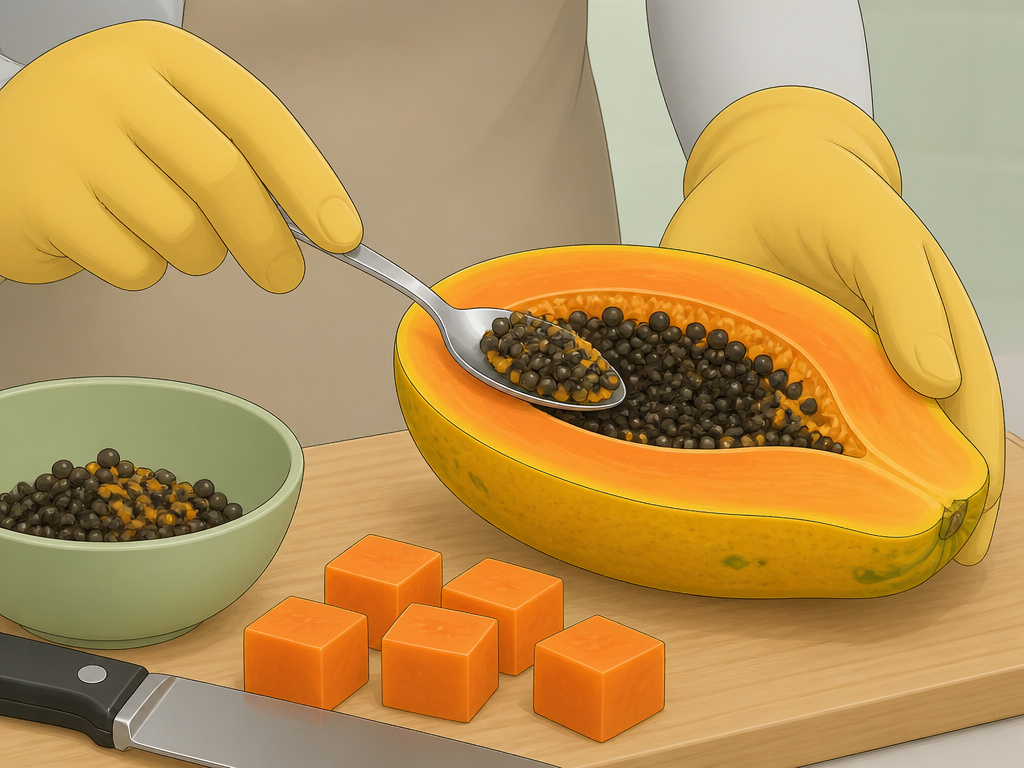
Freezing is your best bet for long-term preservation, but it fundamentally changes the fruit’s texture. Frozen-thawed papaya is best for smoothies, purees, or baking, not fruit salad.
The non-negotiable first step: ripeness. The fruit must be fully yellow and yield slightly to gentle pressure. Freezing locks in the state of the fruit; an unripe one will never develop flavor.
- Wash, peel, and seed. Cut the fruit in half, scoop out the seeds with a spoon, and peel the skin with a sharp knife or vegetable peeler.
- Cut into uniform chunks. Aim for bite-sized pieces, about 1-inch cubes. For smoothie-specific packs, you can go smaller.
- Flash-freeze. This is the step that prevents a solid papaya lump. Spread the chunks in a single layer on a baking sheet lined with parchment paper. Ensure they are not touching. Place the sheet in the freezer for 2-3 hours until the pieces are rock solid.
- Bag and seal. Transfer the frozen chunks into a heavy-duty freezer bag or airtight container. Remove as much air as possible before sealing. Label with the date.
- Store. Frozen papaya will maintain best quality for 6 months at -18°C (0°F). After that, it’s safe but may develop freezer burn or off-flavors.
This flash-freezing method is the same used for freezing plums and other soft fruits to keep them separate. The texture after thawing is soft and somewhat watery, perfect for blending.
Where this goes sideways: Skipping the flash-freeze step. If you pour fresh chunks straight into a bag, they freeze into a single, brick-like mass. You’ll have to thaw the entire block just to use a cup for a smoothie, and re-freezing the rest degrades quality further.
Commercial-Grade Preservation: MAP & Evaporative Cooling
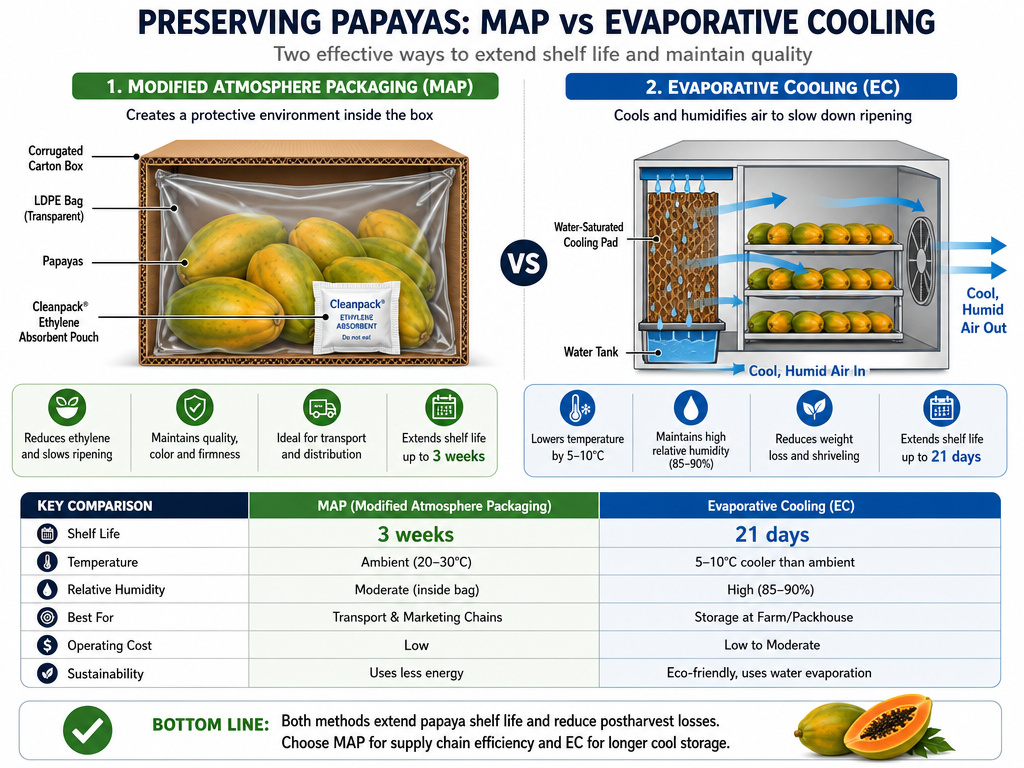
The three-week shelf life isn’t magic; it’s applied food science. Exporters use two primary technologies to ship papayas from tropical farms to distant markets: Modified Atmosphere Packaging (MAP) and evaporative cooling.
Modified Atmosphere Packaging (MAP) alters the gas composition around the fruit. It’s detailed in the University of Hawaii papaya postharvest guidelines. For sea shipment, papayas are packed in corrugated cartons lined with 0.04mm thick Low-Density Polyethylene (LDPE) bags.
A critical addition is 40g of ethylene absorbent (often a product like ‘Cleanpack’) per bag. Ethylene is the ripening hormone; trapping it around the fruit would speed up spoilage. Absorbing it presses pause on the process. With MAP at 10-12°C, Eksotika papaya maintains quality for 3 weeks, enough for a sea voyage plus distribution.
Evaporative cooling is a low-tech miracle for hot, dry regions. An experiment published in a PMC study on packaging and storage demonstrated its power. Researchers stored papayas in an evaporative cooler that maintained 12.4–19.7°C and 71.4–90.7% humidity.
The results were stark. Papayas stored loose at ambient conditions were unmarketable after 9 days. Those stored in the evaporative cooler, especially when packaged in polyethylene bags, retained superior quality for 21 days. The cooler mitigated temperature spikes and maintained high humidity, reducing weight loss from 18.3% to under 6% for packaged fruit.
| Technology | Core Mechanism | Key Component | Documented Shelf-Life Extension |
|---|---|---|---|
| Modified Atmosphere Packaging (MAP) | Lowers O2, raises CO2, absorbs ethylene | LDPE liner + ethylene absorbent (e.g., ‘Cleanpack’) | Up to 3 weeks at 10-12°C for sea shipment |
| Evaporative Cooling | Lowers temperature via water evaporation, boosts humidity | Cooling chamber + water-saturated pad | More than 2-fold extension, to 21 days |
| Combined Packaging | Barrier to moisture loss and gas exchange | Polyethylene (HDPE/LDPE) bags | 37% less weight loss after 18 days vs. Unpackaged fruit |
These methods are out of reach for a home kitchen, but they explain why your store-bought papaya can last. They also highlight the universal principles: control temperature, control humidity, control gases.
Drying and Dehydrating Papaya
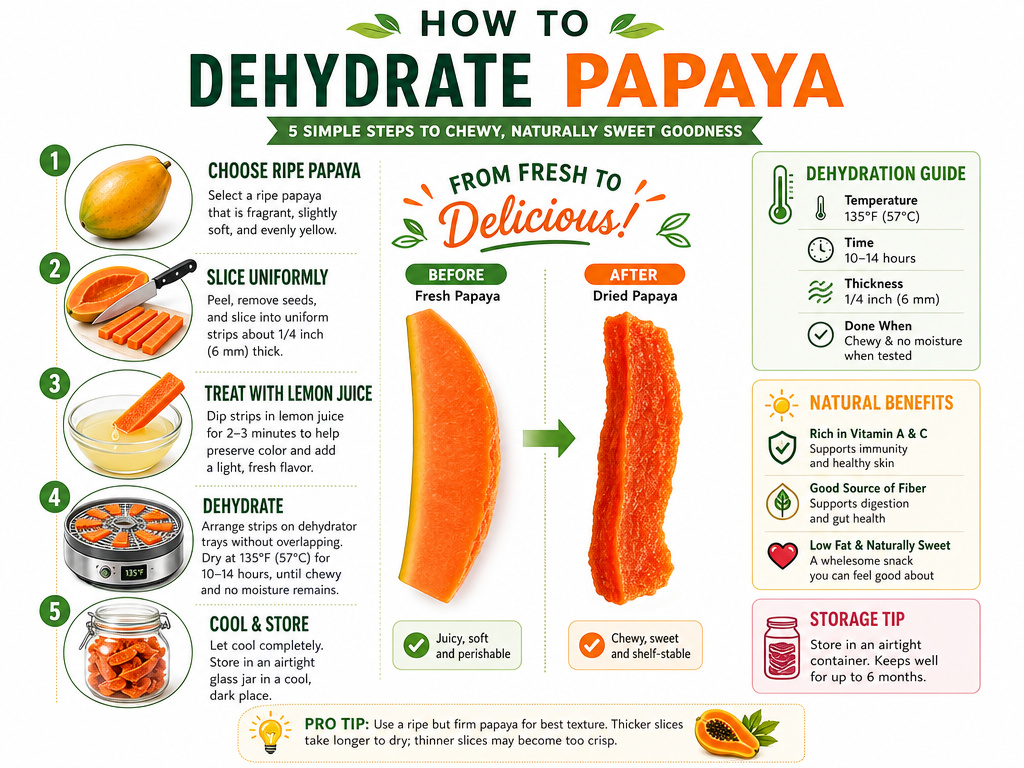
Dehydration removes the water that microbes need to grow, offering a shelf life of months. The result is a chewy, sweet snack entirely different from fresh fruit.
Papaya is a high-moisture fruit, so drying takes time and patience.
- Start with ripe fruit. As with freezing, use fully yellow, fragrant papaya. Green fruit lacks the necessary sugars and will taste bland.
- Prepare uniformly. Peel, seed, and slice the flesh into thin, even strips, no thicker than 1/4 inch. Uniformity is crucial for even drying.
- Pre-treat (optional). A quick dip in a solution of ascorbic acid (vitamin C) or lemon juice can help prevent browning during the long drying process.
- Dry. Use a food dehydrator set at 57°C (135°F) for 8-12 hours, until the pieces are leathery with no moist spots. Oven drying is possible on the lowest setting with the door propped open, but it’s less efficient and even.
- Condition and store. After drying, let the pieces cool completely. Place them in a large, open jar for a week, shaking daily. This allows remaining moisture to redistribute. Then, store in airtight containers in a cool, dark place. For specifics on storing dehydrated fruit, keep it in glass jars with oxygen absorbers for the longest shelf life.
Dried papaya is a space-efficient way to handle a surplus, much like preserving pears or other seasonal gluts. The texture is pleasantly chewy, and the flavor intensifies.
Troubleshooting Common Papaya Preservation Problems
Even with perfect technique, things can go wrong. Here’s how to diagnose and salvage what you can.
- Fruit ripens unevenly, with hard green spots. This is often blotchy ripening or “green islands,” caused by physical abrasion on the skin during handling or storage. The damaged areas fail to produce chlorophyll-degrading enzymes. Prevent it by handling fruit gently and using storage containers that cushion rather than rub. Once it occurs, you can’t fix it; cut away the green portions.
- Refrigerated papaya develops sunken, dark pits. This is the classic sign of chilling injury. The fruit was stored below 10°C (50°F) while still unripe. Unfortunately, the damage is internal and irreversible. Use the fruit immediately in cooked applications like a curry or puree, as the texture will be poor.
- Cut papaya half turns slimy or moldy in the fridge. This is a moisture problem. The cut surface was not dried thoroughly before storing, or it was wrapped in non-breathable plastic. Always pat the cut flesh dry, cover with a paper towel, and place in a loosely covered container. This approach is similar to that for preserving avocado halves and mash to prevent browning and spoilage.
- Frozen papaya tastes bland and has a weird texture. The fruit was likely underripe when frozen. Sugar content is locked in at the time of freezing. Next time, wait for full ripeness. For now, use it in strongly flavored smoothies or sweetened purees.
- White, thread-like mold appears on stored fruit. This is likely the early stage of a fungal rot like Phomopsis. It spreads quickly in warm, humid conditions. Immediately remove and discard any infected fruit. Ensure your storage area has good air circulation and isn’t overly damp.
Frequently Asked Questions
Can you freeze papaya with the skin on?
No. The skin becomes tough and bitter when frozen. Always peel papaya thoroughly before freezing. The skin also holds dirt and microbes you don’t want in your long-term storage.
How long does fresh papaya last in the refrigerator?
Ripe, whole papaya stored in the crisper drawer at around 4°C (39°F) will last 5-7 days. Once cut, the flesh should be consumed within 2-3 days, even when stored properly in an airtight container.
What’s the best way to store a half-cut papaya?
Leave the seeds in the unused half. Place it cut-side down on a plate lined with a paper towel, or cover the cut surface directly with a paper towel and place it in a loosely covered container in the fridge. The seeds and paper towel help manage moisture.
Can I preserve papaya by canning it?
It is not generally recommended for home canning. Papaya is a low-acid fruit, and a safe canning process requires pressure canning to prevent the risk of botulism. For most home preservers, freezing or drying are safer, more reliable methods for a fruit surplus.
Does papaya continue to ripen after it’s cut?
No. Unlike some fruits, papaya does not continue to ripen enzymatically once cut. The ripening process, driven by ethylene gas and enzymes, requires a living, intact fruit. Cutting halts further sugar development and color change.
Is it better to store papaya in plastic or paper?
It depends on the goal. For short-term, room-temperature ripening, a paper bag traps ethylene and speeds the process. For refrigerator storage of ripe fruit, a perforated plastic bag or loose plastic wrap helps retain moisture without causing condensation. Never use a sealed plastic bag for unrefrigerated fruit.
Before You Go
Preserving papaya isn’t about a single trick. It’s a system built on understanding the fruit’s biology. Match the temperature to the color of the skin. Use packaging as a shield against moisture loss and microbes. Apply the right long-term method, freezing for bulk, drying for snacks, with strict attention to ripeness.
The commercial data is clear: with precise control, a three-week shelf life is achievable. At home, that translates to choosing the right moment for the fridge, mastering the flash-freeze, and never letting an unripe fruit see the inside of your cold drawer.
Start with a ripe fruit, and you control the process. Start with a green one, and you’re just waiting for something to go wrong.
