How to Tell If Something Is Freezer Burned: A Visual Guide
This post contains affiliate links. As an Amazon Associate, we earn from qualifying purchases.
You can tell if something is freezer burned by looking for three specific signs: discolored grayish-brown leathery spots, a heavy coating of large ice crystals on the surface, and a dry, tough, or grainy texture. These changes happen when air reaches the food, causing moisture loss through sublimation. While freezer-burned food is usually safe to eat according to the USDA, severe cases taste awful and should be discarded.
The grayish-brown spots and dry texture are the direct result of that moisture loss. They tell you the food’s surface has oxidized and dehydrated, which is a quality problem, not a safety emergency.
What follows: a breakdown of exactly what freezer burn looks like on meat, ice cream, bread, and vegetables, the science of why it happens, and a clear guide on when to cut away a small spot and when to throw the whole package out.
Key Takeaways
- Freezer burn appears as dry, grayish-brown leathery patches on meat and fish, large, gritty ice crystals on ice cream and frozen fruit, and a tough, shrunken texture on baked goods.
- The process is called sublimation, ice turns directly to vapor, leaving the food dehydrated and exposed to oxygen.
- Food with freezer burn is safe to eat per the USDA and Iowa State University, but the University of Missouri Extension recommends against eating it due to poor quality.
- For mild freezer burn, trim off the affected area before or after cooking. Severely burned food with an off smell or taste should be discarded.
- Prevention is about air removal: use vacuum sealers, freezer paper under foil, or freezer-safe bags with the air squeezed out.
What Does Freezer Burn Look Like?
Look for a combination of color change, ice crystals, and texture. The specific signs depend entirely on what you’re looking at. A steak and a pint of ice cream tell different stories.
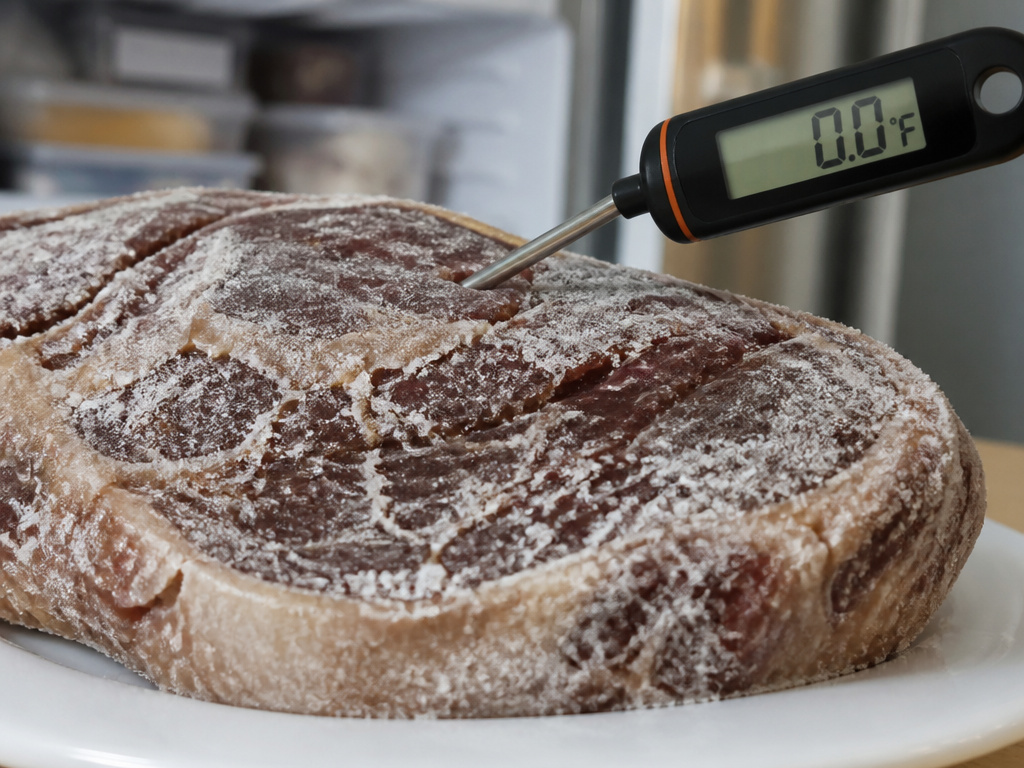
Freezer burn on meat, poultry, and fish appears as grayish-brown or grayish-white leathery spots where the surface has dried out. On ice cream and frozen fruits, it shows as a layer of large, coarse ice crystals. On baked goods like bread, it causes a dry, rough, and shrunken texture. These visual cues are the result of moisture loss and oxidation.
Meat, Poultry, and Fish: The Leathery Patch
The most recognizable sign. The surface loses its red or pink hue and turns a dull, lifeless gray, brown, or white. The affected area feels dry and tough, like leather, even while frozen. This is explicitly noted in guides from Texas A&M AgriLife Extension. You’re not imagining the texture change, the muscle fibers have literally dehydrated.
Common mistake: Thinking a single small spot means the whole cut is ruined. If the freezer burn is confined to one edge, you can often salvage the rest. The problem is surface-deep.
Ice Cream and Frozen Desserts: The Icy Coating
Open the container to find a crust of jagged, frosty ice crystals where the smooth cream should be. The ice cream underneath may have shrunk away from the sides. This isn’t just frost from a temperature swing; it’s the dessert’s water content separating and crystallizing on the surface. The texture goes from creamy to crumbly and icy.
Baked Goods, Bread, and Cooked Grains: The Stale Shrink
Bread, cake, and cooked pasta or rice lose moisture evenly. They don’t spot like meat. Instead, the entire item becomes drier, tougher, and less voluminous. A loaf of bread feels light and hard. Cooked rice grains look coated in frost and feel gritty. The Texas A&M AgriLife Extension PDF calls out this rough texture specifically.
Fruits and Vegetables: The Frosted Freeze
Berries and vegetable pieces become encased in a thick, white frost. They often stick together in a solid, icy clump. The individual pieces lose their bright color and become dull. Once thawed, they’ll be mushy and watery because the cell walls were damaged by the large ice crystals.
The Science Behind the Burn: It’s Sublimation
Freezer burn isn’t random spoilage. It’s a predictable physical process called sublimation. Understanding this turns the problem from mysterious to manageable.
At a steady 0 °F, ice is stable. But temperature fluctuations, even minor ones, provide enough energy for ice molecules on the food’s surface to skip the liquid phase entirely and jump straight to water vapor. This is sublimation. The Iowa State University freezer burn guide explains this moisture loss leaves the surface layers dried out and discolored.
That escaping water vapor leaves behind tiny air pockets. Oxygen rushes in. This oxygen bleaches the color from meat (causing gray spots) and oxidizes fats, which can lead to off flavors. The double damage is dehydration plus oxidation.
| Factor | Effect on Freezer Burn | Why It Matters |
|---|---|---|
| Temperature Fluctuation | Speeds up sublimation | Opening the freezer door or an overfull freezer causes minor thaws. |
| Air Exposure | Allows oxygen to bleach and oxidize | Loose packaging or containers with headspace are the main culprits. |
| Freezer Type | Impacts temperature stability | A refrigerator’s freezer compartment cycles more than a deep freezer. |
| Food Water Content | Influences severity | Ice cream and berries show burn faster than dense, low-moisture bread. |
This is why the first line of defense is always a steady, cold temperature and an airtight seal. Methods like vacuum sealing work because they remove the air that drives the oxidation side of the equation.
Is Freezer Burned Food Safe to Eat?
Here is where official guidance splits, and your nose becomes the final judge. The safety consensus is clear, but the quality advice has a real disagreement.
The USDA Food Safety and Inspection Service (FSIS) and the Iowa State University freezer burn guide state the core rule: freezer burn affects quality, not safety. Microbes are inactive at 0 °F. The food is safe to eat, but it may be unpalatable. They advise that heavily freezer-burned foods may be discarded for quality reasons.
However, the University of Missouri Extension takes a harder line. It classifies food with freezer burn as being of “such poor quality, we do not recommend eating it.”
Where this goes sideways: Assuming all freezer-burned food is fine. The “safe to eat” rule applies only if the food has remained solidly frozen. If it thawed and refroze, bacterial risks are present and the food is unsafe.
Your decision tree:
- Mild burn (small spots, light frost): Cut away the affected portions. The rest is fine. This is standard practice for freezer-burned meat.
- Moderate burn (larger areas, noticeable texture change): Consider the use. Burned stew meat can be hidden in a heavily seasoned chili. Burned chicken breast for a salad will be too dry.
- Severe burn (off smell, pervasive leathery texture, foul taste): Discard it. The quality is gone. Trust the Missouri guidance here.
The nutritional loss is minor, some vitamins may degrade, but the protein and calories remain. You’re deciding on taste and texture, not health risk.
How to Prevent Freezer Burn Before It Starts
Prevention is straightforward once you know the enemy is air. Your goal is to create a cold, stable, airtight environment for every item.
The Gold Standard: Vacuum Sealing
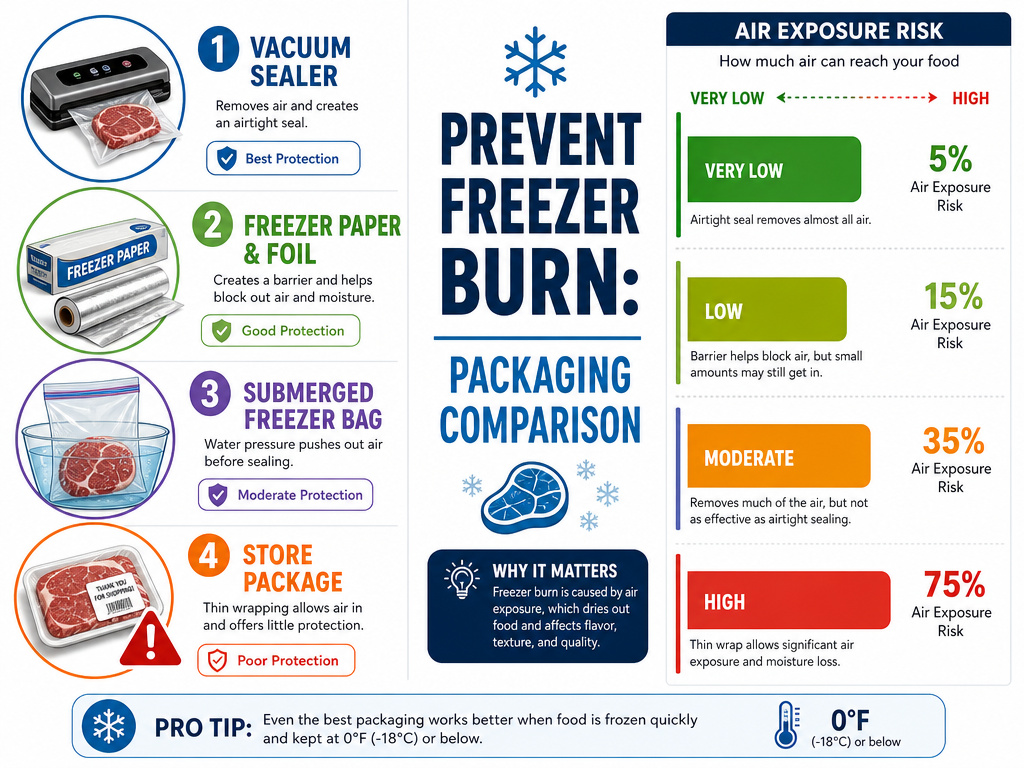
A vacuum sealer removes almost all air from the bag before sealing. It’s the most effective method for long-term storage of meats, fish, and bulk items. The USDA Freezing and Food Safety guidelines recommend airtight packaging as a primary defense.
The Practical Workhorse: Double Wrapping
For items without a vacuum sealer, the double-wrap is king. This is where freezer paper shines. 1. Wrap the item tightly in plastic wrap or freezer paper, pressing out air pockets. 2. Follow with an outer layer of heavy-duty aluminum foil or place the wrapped item inside a freezer-safe bag. The paper or plastic provides a moisture barrier; the foil or bag provides a physical air barrier.
For Everything Else: The Air-Squeeze Bag
When using freezer bags alone, submerge the bag (seal open) in a bowl of water to push air out via water pressure, then seal. Or, use the straw trick: seal most of the bag, insert a straw into the opening, suck the air out, and quickly finish sealing.
General Freezer Management:
- Keep it full: A full freezer maintains temperature better. If space is low, fill voids with bags of ice or water bottles.
- Maintain 0 °F: Use a freezer thermometer. The Iowa State University freezer burn guide confirms this as the target.
- Don’t overload: Adding too much unfrozen food at once raises the internal temperature and promotes slow freezing, which creates larger, more damaging ice crystals.
- First in, first out: Use older items first. Keep an inventory list taped to the door.
| Packaging Method | Best For | Air Exposure Risk | Notes |
|---|---|---|---|
| Vacuum Sealer | Meats, fish, bulk vegetables, sous-vide | Very Low | Requires equipment; bags are an added cost. |
| Double Wrap (Paper/Foil) | Irregular cuts, roasts, baked goods | Low | Freezer paper technique is a skill worth learning. |
| Freezer Bag (air removed) | Vegetables, fruits, leftovers, soups | Medium | Cheapest and most flexible method. |
| Original Store Packaging | Short-term storage only | High | Always overwrap for anything kept longer than 2 weeks. |
Step-by-Step: What to Do When You Find Freezer Burn
Don’t panic. Assess, then act.
- Identify the Severity. Is it a dime-sized spot on one side of a steak, or is the entire chicken breast gray and leathery? Is the ice cream just frosty on top, or is it a solid block of ice?
- Check the Smell (Once Thawed). After thawing in the refrigerator, give it a sniff. Freezer burn itself doesn’t smell, but oxidation can cause a stale, cardboard-like odor. Any sour, putrid, or ammonia-like smell means spoilage, discard it immediately.
- Trim or Use As-Is. For mild cases, use a sharp knife to cut away the discolored, dry sections. You can do this while frozen or after thawing. For items like frozen berries or soups where trimming isn’t possible, decide if the texture loss will ruin the dish.
- Adjust Your Cooking Method. Freezer-burned meat has lost moisture. Cook it with moisture-adding methods: braise, stew, or use in a sauce. Dry-heat methods like grilling will yield a tough result.
- Prevent the Next Time. Note what the item was packaged in and how long it was stored. This is your cue to upgrade to a vacuum sealing system, start double-wrapping, or simply move items to the front of the freezer to be eaten sooner.
Easy to miss: Freezer burn on ground meat. It’s harder to see the discoloration. Rely on texture and smell, if thawed ground meat feels excessively dry or crumbly and smells off, don’t use it.
Frequently Asked Questions
Can freezer burn make you sick?
No. Freezer burn itself is not a food safety issue. The dehydration and oxidation do not produce toxins. Illness would only occur if the food was unsafe before freezing or thawed improperly and bacterial growth occurred.
Does freezer burn mean the food is bad?
“Bad” is the wrong word. The food is of lower quality, drier, tougher, and potentially off-tasting. It is not spoiled or rotten in the microbial sense. Understanding the causes of freezer burn helps separate quality loss from spoilage.
How long does it take for freezer burn to happen?
It depends on packaging and temperature stability. Poorly wrapped food in a frequently opened freezer door can show signs in a month. Well-wrapped food in a deep freezer at a constant 0 °F may last a year or more without noticeable burn. Always refer to a freezer storage chart for optimal quality times.
Can you fix freezer burn?
No. The physical and chemical changes are permanent. You cannot rehydrate the dried-out cells or reverse the oxidation. You can only remove the affected parts or mask the texture with specific cooking methods.
Is it okay to refreeze food with freezer burn?
Yes, from a safety standpoint, if it still contains ice crystals or has been thawed in the refrigerator for less than two days. However, refreezing will further degrade texture and quality. It’s better to cook it first, then freeze the cooked dish.
The Bottom Line
Spotting freezer burn is about recognizing the trio of discolorations, crystals, and texture changes. That gray patch on your steak or the icy crust on your ice cream is a sign of moisture loss, not spoilage.
The science is clear: sublimation and oxidation are the culprits, and they’re defeated by airtight seals and a steady, cold freezer. While the USDA says it’s safe to eat, your palate is the final judge, trim the bad bits, cook with extra moisture, or toss it if the quality is gone.
Your best move is prevention. Invest in good freezer-safe containers, learn to use freezer paper effectively, and manage your freezer’s inventory. Knowing how to prevent freezer burn from the start saves you from having to diagnose it later.
