The Right Way to Store Hot Food in the Refrigerator Safely
This post contains affiliate links. As an Amazon Associate, we earn from qualifying purchases.
Yes, you can store hot food in the refrigerator. The critical rule is to get it there within two hours of cooking, one hour if your kitchen is above 90°F. Waiting for food to cool completely on the counter is the real risk, as it lingers in the temperature danger zone where bacteria multiply fastest.
That two-hour window is the line between safe practice and a food safety violation. The outdated advice to let food cool completely stems from icebox-era concerns about melting ice, not modern refrigeration. Your fridge’s compressor can handle the load; bacteria cannot handle the cold.
What follows: the precise temperature danger zone, a step-by-step method for cooling large batches safely, the one type of hot food you should leave uncovered, and how to verify your fridge is actually cold enough.
Key Takeaways
- Get hot food into the refrigerator within two hours of cooking (one hour above 90°F).
- Divide large quantities into shallow containers no more than two inches deep to cool rapidly.
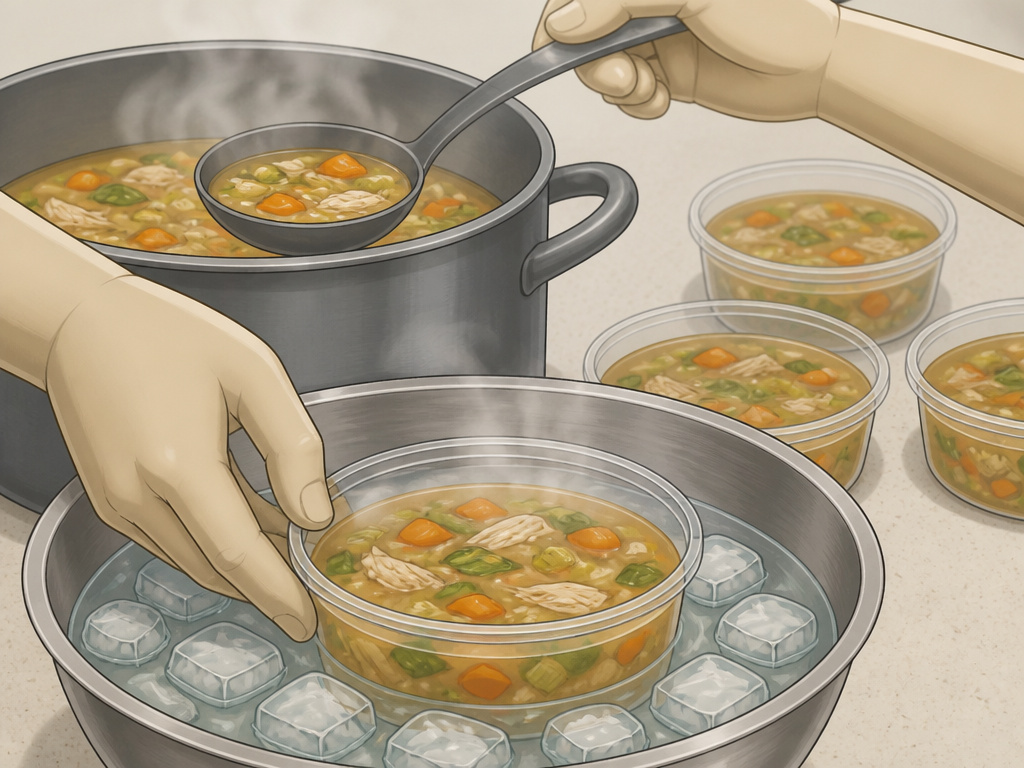
- Use an ice water bath for pots of soup or stew to drop the temperature before refrigerating.
- Leave hot cooked meat uncovered in the fridge until cool to prevent condensation, then wrap it.
- Verify your refrigerator temperature is at or below 40°F with an appliance thermometer.
The 2-Hour Window & The Real Danger Zone
The countdown starts when you turn off the heat. Food safety agencies like the USDA safe food handling steps are unanimous: perishable food must be refrigerated within two hours. In a hot kitchen, that window shrinks to one.
The temperature danger zone for food is 41°F to 135°F. Bacterial growth is most rapid between 70°F and 125°F, potentially doubling in number in as little as 20 minutes.
This zone isn’t a gentle suggestion. It’s where pathogens like Salmonella and E. Coli thrive. A large pot of chili left to cool on the stove for three hours is a perfect incubator. The goal is to move food through this zone as quickly as possible, not let it sit there. Your refrigerator is the tool that halts the clock.
The old fear was about overworking the appliance. Modern refrigerators use compressors and evaporator fans that recover. A brief rise in internal temperature from a hot dish is temporary. The UMN Extension cooling temperatures guide confirms that rapid cooling is the priority. The risk of bacterial overgrowth far outweighs a minor, short-term spike in your energy bill.
Why “Let It Cool Completely” Is a Food Safety Myth
This advice is a relic. It made sense for iceboxes, where a hot pot would melt the expensive block of ice and ruin the cooling for everything else. Modern refrigerators don’t have that limitation.
The Australian government’s scientific agency, CSIRO, directly addresses this. Their guidance states modern refrigerators can cope with small amounts of hot food. They recommend only a brief cooling period, not more than one hour, to avoid excessive condensation, not for safety.
Common mistake: Leaving a whole roast or deep pot of stew on the counter overnight to “cool.” The center of that food stays in the danger zone for hours, allowing bacteria to reach dangerous levels by morning.
Condensation is a nuisance. Food poisoning is a hospital visit. The rule is simple: if you can’t get it chilled within two hours, you didn’t make it safe to eat. This principle is a cornerstone of all general food storage principles.
Step-by-Step: The Safe Cooling Method
Don’t just dump a steaming pot into the fridge. You need a strategy to crash the temperature fast. This method works for soups, stews, casseroles, and cooked meats.
- Portion it out. Transfer the food into several shallow containers for the fridge. Depth is the enemy of rapid cooling. Aim for containers two inches deep or less. A large, deep mass cools slowly, even inside the refrigerator.
- Stir and ice-bath. For liquids, stir the pot to release heat. Then, set the pot (or your portioned containers for hot meals) into a sink or larger bowl filled with ice water. This can bring the temperature down to a safe level in minutes instead of hours.
- Cover loosely. Place a lid on askew or cover loosely with foil for the first hour in the fridge. This lets residual steam escape without contaminating other foods. After an hour, seal it tight.
- Leave space. Don’t crowd the refrigerator shelf. Cold air needs to circulate around the containers to work efficiently. Overloading a shelf traps heat.
Skipping the ice-bath for a big batch means the center of the food might stay warm for hours inside the fridge. That’s how you get a spoiled surprise two days later.
The Special Case for Hot Meat & Casseroles
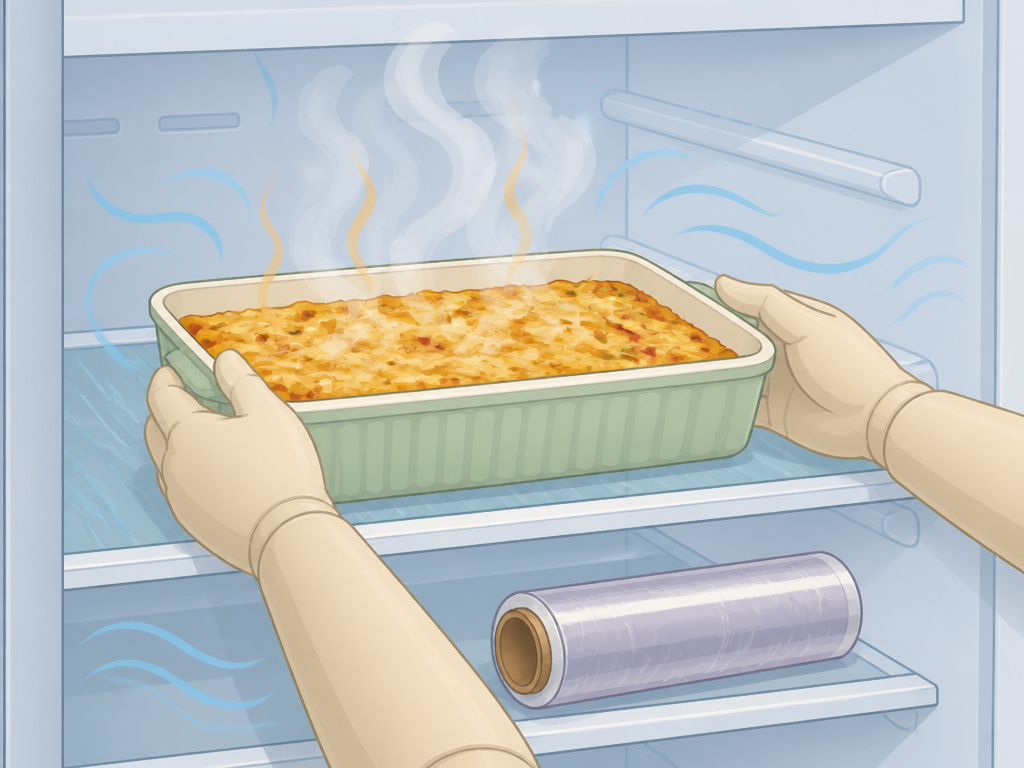
Cooked meat and dense casseroles have their own rule. The CSIRO guidance is specific: leave them uncovered in the refrigerator until cool, then cover them.
Here’s why. Covering hot meat traps steam. That moisture condenses on the underside of the wrap or lid and drips back onto the food surface, creating a wet environment where bacteria can migrate and grow more easily. Letting the meat cool uncovered allows that moisture to dissipate into the fridge’s dry air.
Leave hot meat pieces uncovered in the refrigerator until they are cool, then cover the container or wrap the meat tightly.
After the meat has chilled, wrap it tightly in cling film or move it to an airtight container. Always store cooked products above raw meat on separate shelves to prevent cross-contamination from drips. This is a key part of proper storage for hazardous foods.
What About the Freezer? A Different Game
The freezer is not a shortcut. Placing hot food directly into the freezer is a bad idea for food quality and appliance efficiency.
Rapid freezing creates small ice crystals that do less damage to food’s cellular structure. A hot item freezes slowly from the outside in, forming large, jagged crystals that turn meat mushy and cause creamy sauces to separate. The USDA refrigeration safety guide advises cooling food in the refrigerator first, or using an ice bath, before transferring it to the freezer.
Always leave headspace in containers, about an inch for pints, to allow for expansion as the liquid freezes. A sealed, full container of hot soup will crack in the freezer.
Tools & Verification: Don’t Guess, Measure
Your strategy hinges on one thing: a reliably cold refrigerator. You cannot manage the two-hour rule if your appliance is running at 45°F.
| Tool | Purpose | Why It’s Non-Negotiable |
|---|---|---|
| Appliance Thermometer | Monitor fridge & freezer temps | Fridge dials are notoriously inaccurate. You need to see 40°F or below. |
| Shallow Containers | Rapid cooling of leftovers | A deep tub cools too slowly, defeating the purpose of quick chilling. |
| Ice Bath Setup | Crash-cool large batches | Cuts hours off the cooling time for stocks, soups, and braises. |
A refrigerator thermometer is the most important tool in your kitchen for food safety storage. Place it on a middle shelf and check it weekly. If your fridge struggles to hold 40°F after adding a hot item, it might be overloaded or in need of maintenance.
Avoid using plastic containers for piping-hot food, especially acidic or oily items, as heat can accelerate chemical migration. Transfer food to insulated containers or glass after the initial cool-down.
Frequently Asked Questions
Can I cool food outside if it’s cold out?
You can, but it’s a risky temporary measure. Outdoor temperatures fluctuate, and you must ensure the food stays below 40°F and is protected from animals, insects, and contaminants. An ice-filled cooler is a more controlled and safer alternative for temporary overflow.
Does putting hot food in the fridge spoil other food?
It can temporarily raise the temperature on the surrounding shelf. This is why portioning and the ice-bath method are crucial, they minimize the heat you introduce. A well-functioning fridge will stabilize quickly. Don’t place a hot dish directly next to milk or eggs.
How long are hot leftovers good for once refrigerated?
The clock resets once the food is chilled. Cooked leftovers are generally safe for 3 to 4 days when stored correctly in the refrigerator. Use your senses: if it smells off, has an unusual texture, or shows mold, discard it.
My grandmother always let food cool overnight. Was that wrong?
By today’s food safety standards, yes. Older practices were based on different technology (iceboxes) and a less scientific understanding of bacteriology. We now know the speed of cooling is critical to preventing foodborne illness.
The Bottom Line
Stop waiting. The safest place for hot food after cooking is the refrigerator, as long as you get it there within two hours. Portion it into shallow dishes, use an ice bath for big batches, and let hot meat cool uncovered. Trust the compressor, not the counter. Your best defense is a verified cold fridge and a timer.
