
Your Guide: How to Store Condensed Milk After Opening Safely
This post contains affiliate links. As an Amazon Associate, we earn from qualifying purchases.
Store opened condensed milk in a clean, airtight container in the refrigerator at or below 40°F (4.4°C). Major brands like Eagle Brand and Carnation advise using it within 3-4 days, while USDA guidelines suggest it can remain safe for 2-3 weeks if consistently kept cold and uncontaminated.
That 3-4 day window is a manufacturer’s conservative play. The real limit is set by temperature, container integrity, and your own kitchen’s contamination risk. Leaving the opened can on the counter resets the clock in a way refrigeration can’t fix.
What follows: the exact transfer method that buys you the longest safe window, the physical changes that don’t mean spoilage, the stark disagreement on freezing, and the three visual and olfactory signs that mean you should pour it out.
Key Takeaways
- Transfer to an airtight glass or plastic container immediately; never refrigerate the opened can.
- Keep it at or below 40°F (4.4°C) and use it within the brand’s advised 3-4 days for guaranteed quality, though it may remain safe longer under ideal conditions.
- Discard it if left between 40°F and 140°F for more than 2 hours (1 hour above 90°F).
- Freezing is effective for 3-4 months but is not recommended by the manufacturer due to texture changes and potential can damage.
- Thickening and a light caramel color are natural over time and do not indicate spoilage; smell for sourness and look for mold.
Why the Opened Can is the Enemy
An unopened can of condensed milk is a sealed, sterile environment. The moment you puncture it, you introduce air, moisture, and microbes. The high sugar content inhibits bacterial growth, but it doesn’t stop it entirely. The biggest mistake is sticking the opened can directly in the fridge.
Common mistake: Refrigerating the opened can. The thin metal liner can impart a faint metallic taste within a couple of days, and every time you open the fridge door, you introduce new contaminants to the wide surface area.
The goal is to minimize exposure. You need a clean, non-reactive container with a tight seal. This simple switch is the single most effective step in extending the usable life of your leftover condensed milk.
The Core Steps for Refrigerator Storage
This isn’t about just putting it away. It’s a specific sequence to lock out air and microbes.
- Prepare your container. Use a clean glass jar or BPA-free plastic container with an airtight lid. The container should be just large enough to hold the milk with minimal headspace.
- Transfer promptly. Pour the condensed milk from the can into your container immediately after measuring what you need for your recipe. Do not let it sit out.
- Seal and label. Press the lid on firmly. Use a piece of masking tape and a marker to write the date you opened it. This defeats the “how long has this been in here?” mystery.
- Refrigerate correctly. Place the container in the main body of your refrigerator, not on the door. The door is warmer and experiences temperature fluctuations. Ensure your fridge is at or below 40°F (4.4°C).
Pouring condensed milk into an airtight container is non-negotiable for food safety. The Clemson University dairy safety factsheet emphasizes that unused milk left out should never be returned to its original container to prevent contaminating the entire supply. This principle applies directly to condensed milk.
What happens if you skip the airtight container?
Condensed milk absorbs odors from other foods (like onions or fish) and can develop an off-flavor within 48 hours. Surface exposure also allows for faster sugar crystallization, leading to a grainy texture.
The Timeline Disagreement: 3 Days vs. 3 Weeks
Here’s where advice diverges, and your decision depends on risk tolerance.
| Source | Recommended Fridge Life After Opening | Rationale |
|---|---|---|
| Eagle Brand | 3-4 days | Conservative guarantee of perfect quality and texture. |
| Carnation | 3 days | Treat it like fresh milk once opened. |
| USDA/FDA Guidance | 2-3 weeks | If held constantly at ≤40°F in a clean, sealed container. |
The manufacturer timelines are about optimal performance in recipes. The USDA timeline is about safety. Your condensed milk might be safe for two weeks, but its viscosity and ease of pouring will degrade. For critical baking where texture is everything, like in a key lime pie filling, stick to the 3-4 day rule. For sweetening a coffee or oatmeal after a week, the longer window is likely fine if it passes the smell and look test.
This is similar to the judgment call you make with other dairy products like cheese or coconut milk—the printed date is a guide, not an automatic expiry.
To Freeze or Not to Freeze
This is the great debate. The manufacturer’s stance and practical reality are in direct conflict.
Eagle Brand explicitly states: “It is not recommended to freeze sweetened condensed milk, it changes its physical properties (colour, flavour, texture, etc.). Freezing the can could also compromise the seam integrity of the can which in turn would spoil the milk.”
However, general food storage guidance from sources citing the USDA says you can freeze opened condensed milk for 3-4 months. Carnation notes it won’t freeze solid due to the sugar content, which is why it’s used in no-churn ice cream.
The practical verdict: You can freeze it successfully, but never in the can. The water in the milk expands and can warp the can’s seam, breaking the seal.
How to freeze condensed milk (if you choose to):
- Transfer it to an airtight, freezer-safe container or a heavy-duty freezer bag. Leave about half an inch of space for expansion.
- Label it with the date.
- Thaw overnight in the refrigerator. It will likely separate; a vigorous stir or whisk will recombine it.
The texture after thawing is often slightly grainier. It’s perfect for baking where it will be melted or blended, like in fudge or certain banana bread recipes, but less ideal for drizzling.
Reading the Signs: When to Toss It
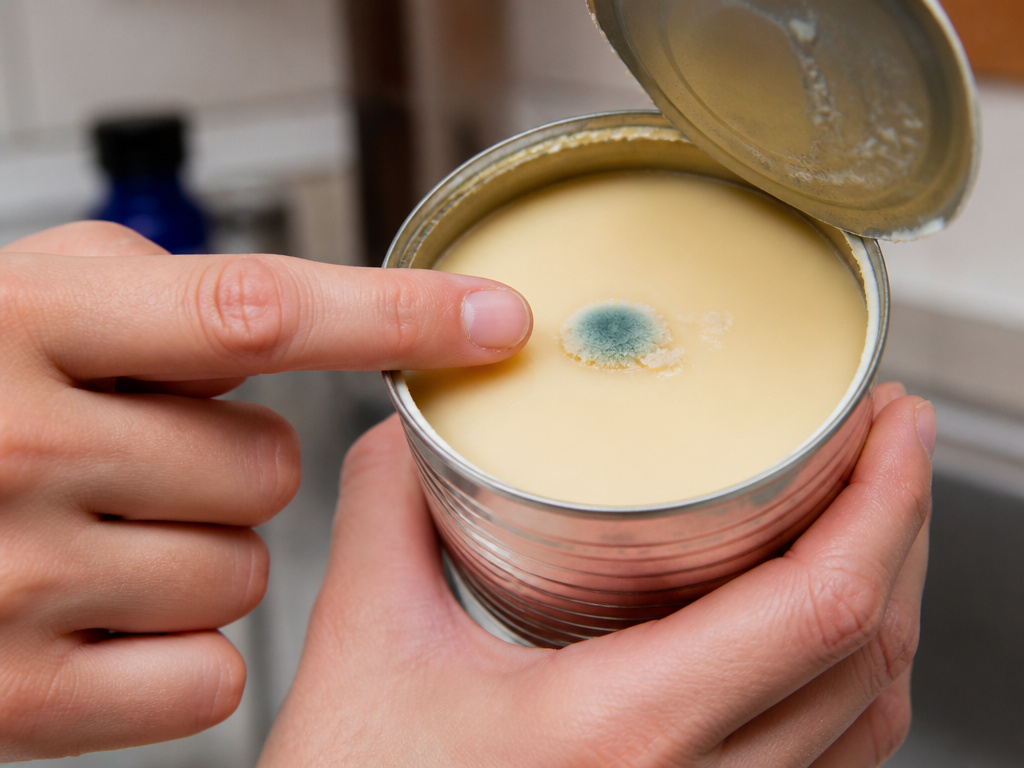
Condensed milk is forgiving, but it does go bad. Know the difference between natural aging and spoilage.
Natural changes (OK to use):
- Thickening: It will get thicker and more viscous over time, especially near the use-by date. Vigorous stirring helps.
- Light caramel color: A pale tan hue is normal and does not affect performance.
Spoilage signs (Discard immediately):
- Smell: A sour, cheesy, or distinctly “off” odor. Fresh condensed milk smells sweet and milky.
- Sight: Any visible mold, which can appear as fuzzy spots in blue, green, or white. Significant dark brown discoloration.
- Texture: A slimy, watery layer separating that cannot be reincorporated, or a curdled appearance.
Where this goes sideways: Assuming refrigeration resets the clock after temperature abuse. If your opened container sat on the counter for an afternoon (more than 2 hours between 40°F and 140°F, or 1 hour above 90°F), toss it. Bacteria produce toxins that are not killed by re-chilling.
This zero-tolerance rule mirrors the safety logic for other cooked staples like cooked rice or hard-boiled eggs.
The Special Case: Making Dulce de Leche
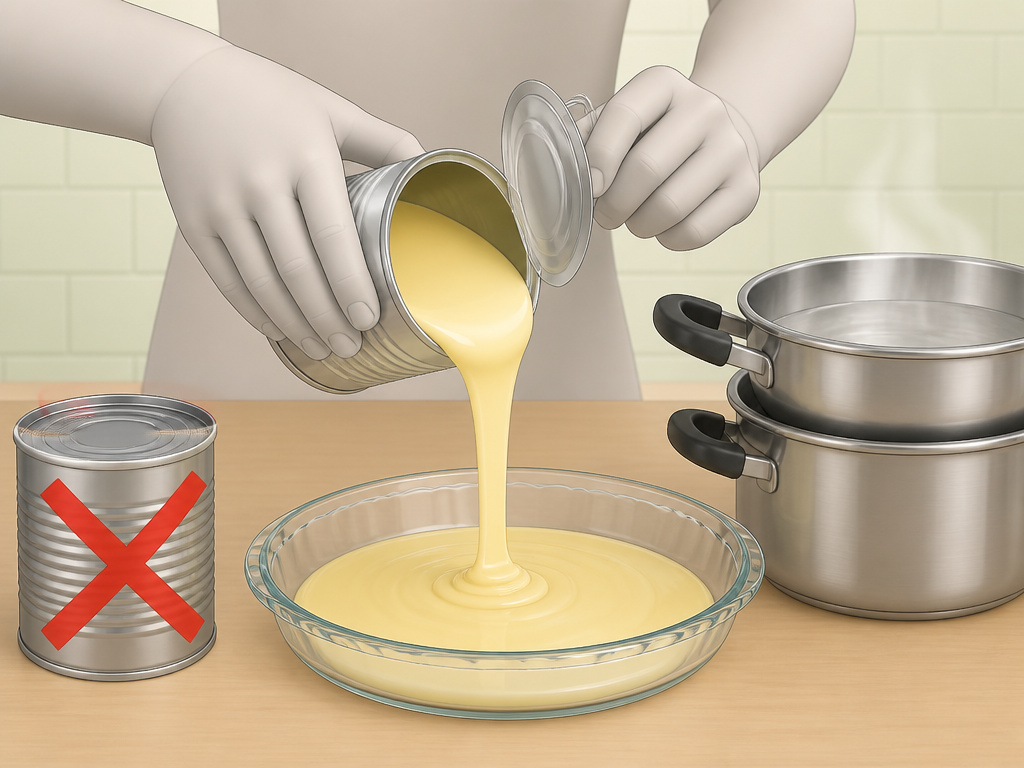
A popular use for condensed milk is turning it into dulce de leche by heating. A critical warning: never heat the can. Eagle Brand’s FAQ is clear: “The current can is not designed to withstand high temperatures.” Heating a sealed can can cause it to explode.
The safe method is to pour the condensed milk into a pie plate or the top of a double boiler and heat it slowly in a water bath. The resulting dulce de leche should then be stored in the refrigerator like any other opened condensed milk, in an airtight container.
Frequently Asked Questions
Can I store condensed milk in the can after opening?
No. You should never store any food in an opened metal can. Transfer it to an airtight glass or plastic container to prevent metallic taste and contamination.
Does condensed milk go bad if unopened?
Yes, but it takes a long time. An unopened can stored in a cool, dry pantry is typically good for up to 2 years past its printed date. Discard any unopened can that is bulging, rusted, or severely dented, as it may be at risk for botulism.
Why is my condensed milk chunky?
If it’s unopened, slight thickening or crystallization can occur with age and is usually remedied by vigorous stirring. If it’s opened and chunky with a sour smell, it has likely spoiled.
Can I use condensed milk that turned yellow?
Light yellow or tan color is a natural result of the Maillard reaction (sugars and proteins reacting) over time and is safe. If it’s a deep, unnatural yellow or has other signs of spoilage, discard it.
How can I use up leftover condensed milk?
Use it in coffee, oatmeal, or smoothies. It’s also great in no-churn ice cream, fudge, or as a sweetener for fruit salads. Think of it as you would a specialty ingredient like a sourdough bread starter—plan a second recipe within a few days of opening.
Before You Go
The rule is simple: out of the can, into a clean jar, and into the cold part of the fridge. Respect the 3-4 day guideline for best results, but trust your senses if it’s been a little longer. Freezing works in a pinch despite the manufacturer’s warning, but never in the original container. Finally, treat any can—opened or not—that shows bulging, rust, or deep dents as hazardous and dispose of it immediately. Your safest bet is to treat that leftover condensed milk with the same caution you’d use for storing batter or other perishable kitchen projects.
