Is Fridge Baking Soda Edible? The Freezer Deodorizer Truth
This post contains affiliate links. As an Amazon Associate, we earn from qualifying purchases.
Fridge and freezer baking soda is sodium bicarbonate, the same edible compound found in your kitchen pantry. It is chemically non-toxic, but you should never cook with a box that has been used for odor absorption because it is now saturated with the very smells you wanted gone.
That distinction between “edible” and “usable” is the whole game. The sodium bicarbonate molecule itself is harmless, even beneficial in some medical contexts. The problem is what it picks up from your fridge’s atmosphere, rancid butter acids, fish amines, bacterial waste, and carries into your batter.
What follows: the exact chemical reaction that makes baking soda work, the 1972 marketing campaign that made it a fridge staple, and the two tests that tell you if your baking soda is still fit for the kitchen.
Key Takeaways
- Baking soda used for odor absorption is chemically edible but culinarily contaminated; it will ruin baked goods with absorbed off-flavors.
- The ARM & HAMMER™ 1972 advertising campaign, not peer-reviewed science, is responsible for the box-in-every-fridge standard.
- For odor neutralization to work, you need maximum surface area, a wide plate, not a box with a tiny opened corner.
- The manufacturer’s Safety Data Sheet lists a pH of 8.3, confirming its mild alkalinity, and notes it is 100% sodium bicarbonate.
- Always perform the vinegar fizz test before using any baking soda for cooking, regardless of its age or source.
The Short Answer: Edible Chemical, Inedible Purpose
Fridge and freezer baking soda is 100% sodium bicarbonate, the same substance regulated as a food additive. According to the Natrium Sodium Bicarbonate Safety Data Sheet, the product is classified as a “food additive; pharmaceutical ingredient.” The sheet lists no health hazards for ingestion under normal conditions.
The Natrium Sodium Bicarbonate SDS identifies the product as 100% Sodium Bicarbonate (CAS 144-55-8), with a recommended use as a food additive and a pH of 8.3 at 25°C for a 0.1 M solution.
So yes, the powder itself is edible. You could technically swallow it without immediate toxic effect. But “edible” and “appropriate for cooking” are different categories entirely. Once that box has been open in your fridge, its job is to act as a chemical sponge. It completes that job admirably, trapping volatile fatty acids and alkaline amines. Those trapped compounds don’t vanish; they reside in the powder. Adding that powder to a cake mix is a direct infusion of fridge-stink into your dessert. The chemistry is sound. The culinary result is disastrous.
The 1972 Campaign That Put a Box in Every Fridge
The idea didn’t come from a food science lab. It came from an advertising department. In 1972, ARM & HAMMER™ launched a campaign promoting an open box of baking soda as a refrigerator deodorizer. The Wikipedia entry on sodium bicarbonate notes that within one year, this campaign led to over half of American refrigerators containing a box.
The campaign was a monumental success in shifting consumer behavior. It was not, however, a landmark in verified efficacy. The same Wikipedia entry dryly states there is “little evidence that it is effective in this application” for refrigerators. The box became a fixture based on marketing reach, not on published, controlled studies proving it outperformed other methods.
This history matters because it frames the practice as a cultural habit, not an ironclad scientific protocol. It also explains why the replacement interval has shifted over time. ARM & HAMMER™ now advises replacing their Fridge-n-Freezer™ box every 30 days, a change from the older “every 3 months” guidance. They attribute this to “continuing research efforts to understand the process of odor elimination.” In practice, it means the product’s capacity has a finite, short window.
How Does Baking Soda Actually Neutralize Odors?
It’s not magic. It’s a simple acid-base reaction. Many foul fridge smells, like rancid butter, are caused by volatile fatty acids such as butyric acid. Baking soda (sodium bicarbonate) is a base.
When butyric acid meets sodium bicarbonate, they react to form sodium butyrate and carbon dioxide. Sodium butyrate is a salt that is not volatile, it doesn’t evaporate into the air for your nose to detect. The McGill University Office for Science and Society explains this specific transformation: “It reacts with butyric acid to form sodium butyrate which has no smell because it is not volatile.”
Baking soda is also amphoteric, meaning it can react with alkaline (basic) odor molecules, like those from fish, converting them into neutral salts as well. Furthermore, it absorbs ambient moisture, which can help slow the growth of odor-producing bacteria and mold. This multi-pronged approach is why a dedicated fridge odor removal strategy often starts with baking soda before a deeper clean.
The Surface Area Secret Most Boxes Miss
The chemical reaction requires contact. A molecule of butyric acid floating in the air must physically land on a molecule of sodium bicarbonate to react. This is where the standard box fails.
Common mistake: Using a box with only a small corner torn open. The McGill source is blunt: “Opening just one little corner of the box does no good. Spreading the baking soda in a plate is the best way to go.”
The packaged boxes with “dual panel flow-through vents” are an attempt to increase airflow over the powder, but they still pale in comparison to the surface area of a thin layer spread on a plate. For severe odors, the physical limitation of a box is real. This is also why proper cleaning a freezer involves removing all items and shelves to eliminate the odor source directly, not just masking it.
| Odor Source | Primary Smell Compound | How Baking Soda Reacts | Why a Box Might Fail |
|---|---|---|---|
| Rancid Butter | Butyric Acid (Acidic) | Neutralizes to sodium butyrate | Limited air contact inside box |
| Spoiled Fish | Trimethylamine (Alkaline) | Converts to neutral salt | Powder saturation after 30 days |
| General Spoilage | Mixed Acids & Bacteria | Absorbs moisture, neutralizes acids | Cannot remove source from walls |
Is It Safe to Cook With Fridge Baking Soda?
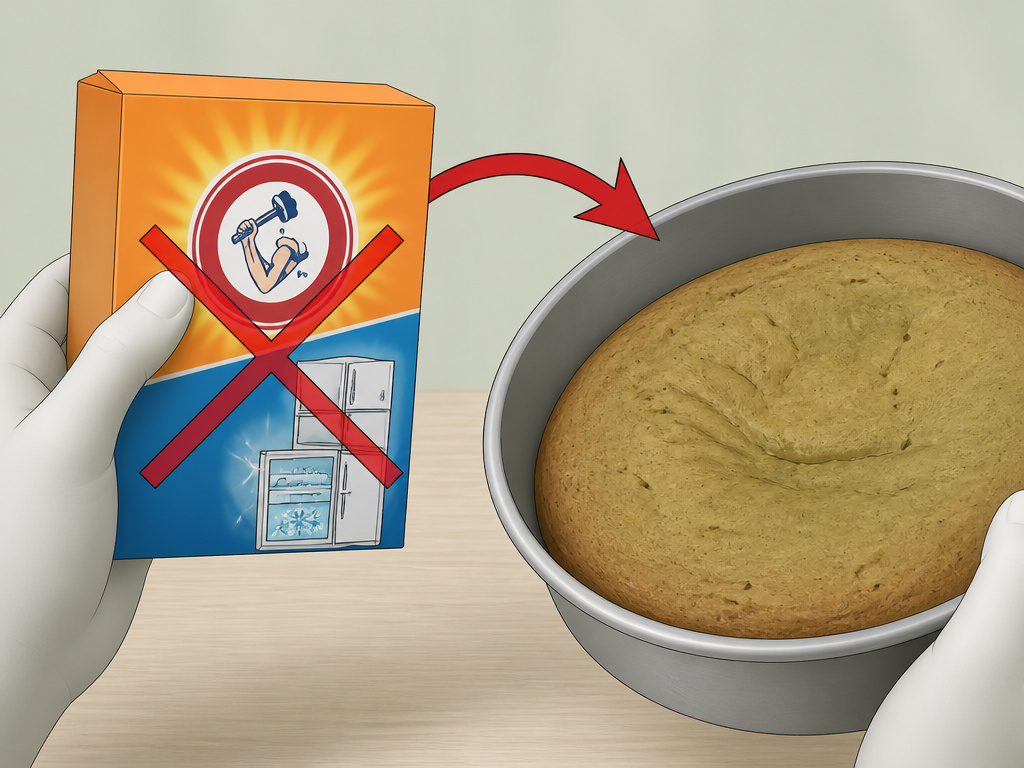
Let’s separate safety from suitability.
Safety (Toxicology): The raw material is safe. The LD50 (the lethal dose for 50% of test subjects) for sodium bicarbonate in rats is over 7,300 mg per kg of body weight, as listed in the ARM & HAMMER™ Fridge-n-Freezer™ SDS. You would need to consume an impossibly large amount to approach acute toxicity.
Suitability (Culinary): It is categorically unsuitable. The powder has done its job. It is now loaded with neutralized salts and trapped odor compounds. Baking relies on baking soda’s pure, predictable reactivity with acids (like vinegar, buttermilk, or cocoa) to produce carbon dioxide gas and lift your batter. Contaminated baking soda will produce off-flavors and may not provide consistent lift.
The rule is absolute: maintain separate stocks. Use a fresh, sealed box for all cooking and baking. Use an older box or a dedicated product like ARM & HAMMER™ Fridge-n-Freezer™ for odor control. Never cross the streams. This is a core principle of safe storing baking soda for different purposes.
Where this goes sideways: Using the fridge box for a baking emergency. The resulting cake or bread will carry a faint, unplaceable stale note. It won’t be poisonous, but it will be unmistakably wrong.
Fridge Baking Soda vs. Regular Baking Soda
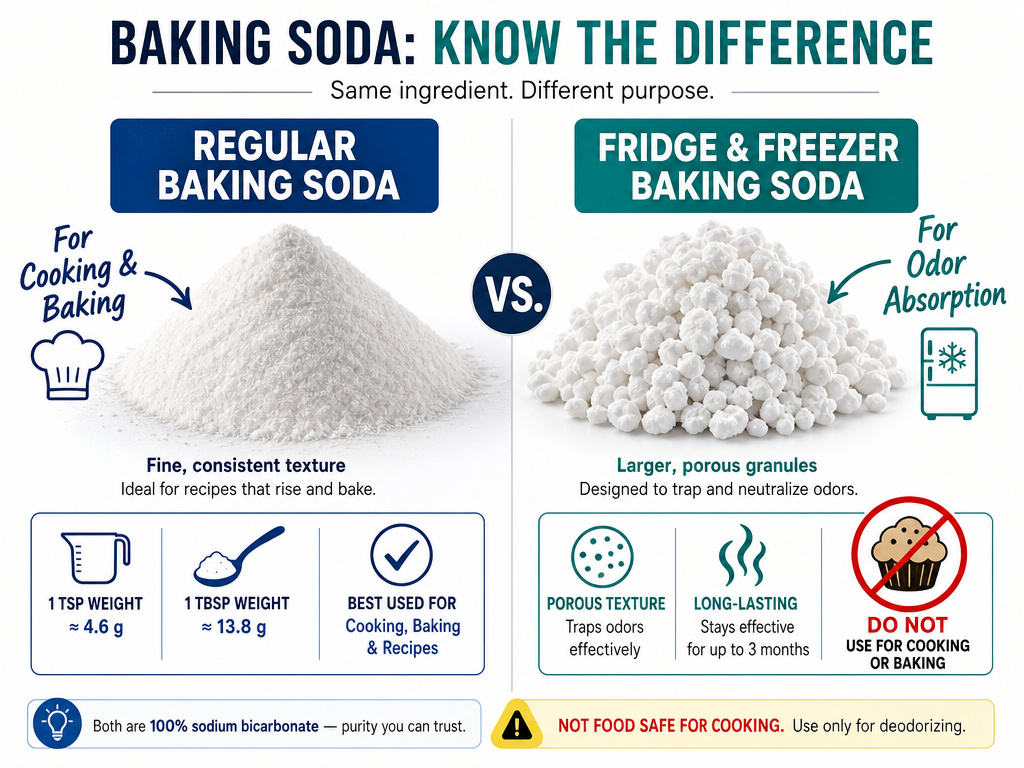
Is there a physical difference? Sometimes.
- Regular Baking Soda: Designed for cooking. Its granulation is fine and consistent to ensure even distribution in dry mixes and a predictable reaction rate.
- Fridge & Freezer Baking Soda: Sometimes marketed as having a “more porous granular structure” to increase surface area for odor absorption. This very porosity can make it less effective as a leavening agent, as it may react too quickly or unevenly.
Chemically, they are identical: sodium bicarbonate. Functionally, they are engineered for different outcomes. You could use regular baking soda in the fridge (spread on a plate for best effect), but you should never use deodorizing baking soda in the oven.
This specialization mirrors how you choose containers for different jobs. You wouldn’t use a flimsy freezer bag for oven roasting, just as you wouldn’t use a heavy freezer-safe glass container for a quick lunchbox salad. The right tool for the right job.
How to Test If Your Baking Soda Is Still Active
Whether it’s from the pantry or the fridge, baking soda loses potency over time. An unopened box lasts about 18 months. An opened box, even in a dry pantry, is good for 6-12 months. Here’s the definitive test:
- Place 1/4 teaspoon of baking soda in a small bowl.
- Add a few drops of lemon juice or distilled white vinegar.
- Watch.
If it fizzes vigorously immediately, it’s active. The acid (vinegar) is reacting with the base (baking soda) to produce carbon dioxide gas, that’s the fizz. If it just sits there with a few lazy bubbles, it’s spent. Discard it.
For the fridge box, this test only confirms chemical reactivity, not culinary purity. A fizzing test doesn’t tell you if the powder tastes like last week’s leftovers. When in doubt for cooking, always open a fresh box.
The Right Way to Use Baking Soda for Fridge and Freezer Odors
If you want to use baking soda effectively, follow the science, not just the packaging.
- Forget the tiny opening. Dump at least half a cup of baking soda into a shallow bowl or plate. Spread it out.
- Place it strategically. Put it on a middle shelf in the fridge, not tucked in the back corner. For the freezer, place it on the floor of the main compartment. This helps with general freezer smell control.
- Replace monthly. Mark your calendar. After 30 days, the powder is saturated. Dump it out (it’s great for scrubbing sinks) and refresh.
- Address the source first. Baking soda is a maintainer, not a miracle worker. For entrenched smells, you must remove fridge odors at the source: clean spills, discard old food, and wash shelves with a vinegar solution.
For a more set-and-forget approach, the ARM & HAMMER™ Fridge-n-Freezer™ Odor Absorber with its vented panel design is a convenient product. Just remember to swap it every 30 days.
Frequently Asked Questions
Can I use baking soda from my fridge if I’m out of the cooking kind?
No. Do not do this. The flavors it has absorbed will transfer to your food. It’s better to find a substitute leavener (like baking powder, though adjustments are needed) or run to the store.
Does baking soda in the freezer work better or worse than in the fridge?
The McGill source notes that odor-producing Pseudomonas bacteria face less microbial competition in the freezer’s cold, dry environment and can proliferate, sometimes creating strong smells. Baking soda can help, but the cold also slows down the chemical reaction rate slightly. It still works, but may be slower against potent freezer odors.
What should I do with used fridge baking soda?
Don’t throw it away. It’s a fantastic, gentle abrasive cleaner. Use it to scrub kitchen sinks, oven tops, or greasy grill grates. You can also use it with vinegar to unclog a drain. Just don’t bake with it.
Are there better alternatives for odor absorption?
Activated charcoal is often more effective at adsorbing a wider range of volatile compounds without chemical reaction. Some refrigerator air filters use carbon technology. For a comprehensive approach, combine source removal (defrosting a freezer to clean it) with an absorber.
Is baking soda safe around my food?
Yes. The 100% sodium bicarbonate itself is inert and food-safe. The ARM & HAMMER™ Fridge-n-Freezer™ SDS confirms it is “not classified” for health hazards. The issue is never safety of the substance; it’s the culinary contamination from its use.
The Bottom Line
Fridge and freezer baking soda is edible sodium bicarbonate, but it is a dedicated appliance deodorizer, not a cooking ingredient. Its history is a marketing story, and its effectiveness hinges on exposing enough surface area, so skip the box and use a plate. Keep two separate supplies: one pristine box for your recipes, and another for fighting odors. When that odor-fighting powder is spent, retire it to cleaning duty. That’s how you respect the chemistry and keep your kitchen, and your cakes, fresh.
