Your Guide to Storing Fresh Parsley for Maximum Shelf Life
This post contains affiliate links. As an Amazon Associate, we earn from qualifying purchases.
To store fresh parsley, treat it like a cut flower: trim the stems, stand them in an inch of water inside a jar, and cover the whole thing with a plastic bag before refrigerating. This method maintains humidity and can keep parsley crisp for 10 days to two weeks. Parsley is very sensitive to ethylene gas and freeze damage, so keep it away from ripening fruit and never let it drop below -1.1°C (30°F).
That water-and-bag trick works because it recreates the conditions commercial growers use for long-term storage: high humidity and cold temperature without direct contact with ice. The plastic bag traps moisture around the leaves, slowing water loss that turns stems limp within 48 hours in a dry fridge drawer. It also partially shields the herb from ethylene gas, a natural ripening agent bananas and apples release that forces parsley to yellow and drop leaves.
What follows: the step-by-step for that 10+ day method, the science behind why parsley fails (ethylene, chilling injury, water loss), a comparison of every other storage option, and how to spot the point of no return.
Key Takeaways
- Store parsley upright in water with a bag cover for 10+ days of freshness. It mimics modified atmosphere storage.
- Parsley yellows from ethylene gas. Keep it away from apples, bananas, and tomatoes.
- Freeze damage starts at -1.1°C (30°F). A fridge’s back wall or crisper drawer can hit that.
- Washing parsley before storage removes surface microbes and can add days to its life, contrary to old advice.
- For long-term storage, freezing in a log or using a vacuum sealer beats drying for cooked dishes.
The 10+ Day Refrigerator Method (Step-by-Step)
This isn’t just putting herbs in water. It’s controlling three variables: stem hydration, air humidity, and ethylene exposure. Skip one, and the timeline shrinks to a week.
You need: a bunch of parsley, a sharp knife, a jar or glass, a plastic bag (gallon size), and a rubber band or twist tie.
- Unbind and inspect. Remove the rubber band or tie. Discard any obviously wilted or slimy leaves. This isn’t being fussy; one decaying leaf spreads mold to the rest in a closed environment.
- Trim the stems. Cut about half an inch off the bottom of the stems. Do this under running water or immediately before placing in water. A fresh cut opens the vascular channels that pull water up into the leaves.
- Place in water. Put the trimmed stems in a jar with about an inch of fresh, cool water. Only the stems should be submerged. Leaves in water rot.
- Cover with the bag. Loosely place the entire plastic bag over the top of the jar and parsley, creating a tent. Secure the bag’s opening around the jar’s rim with a rubber band. Do not seal it airtight; you need a slight gas exchange.
- Refrigerate in the right spot. Place the jar in the main body of your refrigerator, not in the crisper drawer or against the back wall. The center maintains a more stable temperature above freezing.
This method creates a microclimate of high humidity around the leaves, reducing transpiration water loss to under 5%—the same goal as commercial modified atmosphere packaging.
The parsley will drink the water. Check the jar every three days and refill as needed with fresh water. If the water looks cloudy, replace it entirely and give the stems another quick trim. Cloudiness is bacterial growth, which will climb the stems.
How long does it last? With proper tending, 10 to 14 days of crisp, green leaves is typical. After two weeks, even with perfect care, natural senescence begins. You’ll see yellowing at the leaf tips first.
Why Parsley Wills, Yellows, or Gets Slimy
Your fridge is a battlefield of physics and plant hormones. Understanding the enemies lets you place your parsley where it wins.
| Problem | Primary Cause | Timeline & Visible Sign |
|---|---|---|
| Limp, wilted stems | Water loss (transpiration) | Starts within 24–48 hours in dry fridge air. |
| Yellowing leaves | Ethylene gas exposure | Begins at leaf edges after 3–5 days near fruit. |
| Black, slimy spots | Bacterial growth + physical damage | Appears in 5–7 days, often where leaves were bruised. |
| Translucent, mushy leaves | Freeze damage (temperatures ≤ -1.1°C / 30°F) | Shows immediately upon thawing. |
Ethylene is the invisible killer. Parsley is classified as very sensitive to ethylene. This natural plant hormone, released by ripening fruits like apples, bananas, and tomatoes, triggers aging in the herb. The response is epinasty (leaf curling) and chlorophyll breakdown, which you see as yellowing. A plastic bag cover offers partial protection, but distance is better. Never store parsley in the same drawer as your fruit.
Freeze damage is a temperature mistake. The optimal storage temperature for parsley is 0°C (32°F). But its freeze damage threshold is -1.1°C (30.0°F). Many refrigerator crisper drawers or back walls cycle below this. Frozen parsley leaves turn dark green, translucent, and collapse into mush upon thawing. They are not recoverable.
To wash or not to wash before storing? The old rule said don’t wash—added moisture encourages rot. The peer-reviewed cold storage effects and practical tests say otherwise. Washing with cool water removes field soil and surface microbes that accelerate decay. The key is drying the leaves thoroughly afterward. Spin them in a salad spinner or pat gently with paper towels before storing. Wet leaves packed tight will rot; dry leaves stored with humidity will last.
Where this goes sideways: Storing parsley in its original supermarket plastic bag without ventilation. Condensation pools, bacteria multiply, and the bunch turns to a slimy mass in the bottom of the bag within a week.
Parsley Storage Method Comparison: When to Use What
Not every bunch needs to last two weeks. Sometimes you’re processing a harvest, or you only need a few days. Here’s when each method wins.
| Method | Best For | Expected Shelf Life | The Trade-Off |
|---|---|---|---|
| Jar + Water + Bag | Max freshness for daily use | 10–14 days | Requires fridge space, regular water checks. |
| Damp Paper Towel Roll | Short-term (under 1 week), bulk storage | 5–7 days | Less fuss, but leaves can crush, causing bruise spots. |
| Freezing (Log Method) | Preserving flavor for cooked dishes, soups, stocks | 6–12 months | Texture is lost; parsley turns dark but retains taste. |
| Drying | Long-term shelf storage for rubs, seasoning | 1+ years | Volatile oils fade; flavor becomes muted, hay-like. |
| Original Store Bag | Immediate use (within 2–3 days) | 3–4 days | High risk of rapid spoilage; only as a last resort. |
The damp paper towel roll: Lay parsley sprigs on a slightly damp paper towel, roll it up, and place the roll inside a plastic bag. This works for a week if your fridge is reliable. It’s a good technique for storing leafy greens like spinach, too. The towel buffers humidity without drowning the leaves.
The freezer log: This is a game-changer for cooks. Wash and dry parsley thoroughly, strip the leaves from stems, and pack them densely into a freezer bag. Roll the bag into a tight log, squeezing out air, and freeze. You can snap off a chunk for stews. The stems? Freeze them separately for stock. This approach is similar to the best ways for storing fresh ginger.
Drying parsley is the least recommended for flavor. The delicate volatile oils that give parsley its bright, clean note dissipate quickly with heat and air. If you must dry, use the lowest possible heat and store in an airtight jar immediately.
How to Freeze Parsley Without It Turning to Mush
 Freezing changes texture but locks in flavor. For anything cooked—sauces, soups, casseroles—frozen parsley is a pantry staple. The goal is to prevent a solid, icy block you have to hack apart.
- Wash and dry completely. This is non-negotiable. Ice crystals form on surface water, leading to freezer burn and a frosty block.
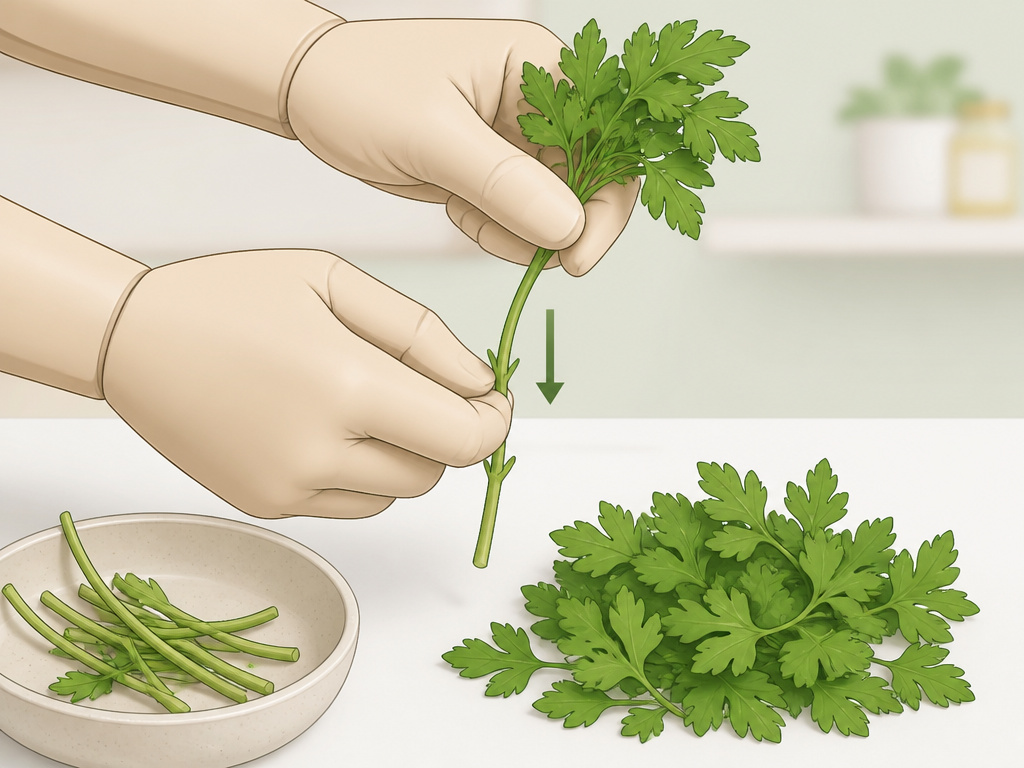
- Remove leaves from stems. Pinch the top of the stem and pull down. The tender leaves come off; the tough stems go to the compost or stock bag.
- Flash-freeze (optional but ideal). Spread leaves in a single layer on a parchment-lined tray. Freeze for 1-2 hours until solid, then transfer to a bag. This keeps leaves separate.
- Pack into a log. If skipping step 3, place leaves directly into a freezer bag. Press into a uniform, flat layer, roll up tightly, and seal.
- Label with date. Frozen parsley is best within 6 months. After a year, flavor noticeably fades.
Frozen parsley will be dark green and wilted when thawed. It is not for garnish. It is for the final stir into a hot pasta sauce, where its flavor blooms.
The Science of Long-Term Storage (What Grocers Use)
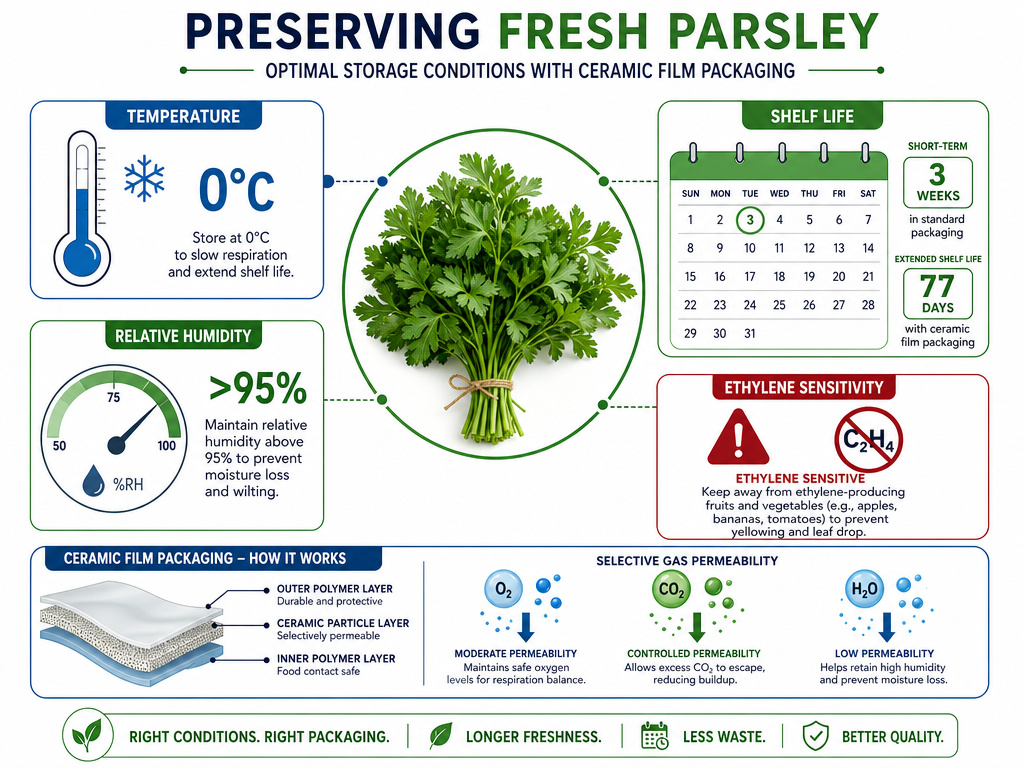 Home methods are scaled-down versions of commercial controlled-atmosphere storage. The numbers from university herb storage guidelines show what’s possible under ideal conditions.
- Optimal Temperature: 0°C (32°F).
- Optimal Relative Humidity: >95%.
- Expected Shelf Life at 0°C: 3 weeks.
- Freeze Damage Threshold: -1.1°C (30.0°F).
- Ethylene Sensitivity: Very high.
Modified atmosphere (MA) storage, which replaces air inside packaging with a specific gas mix, can extend this further. Research from the International Society for Horticultural Science shows parsley can be stored for 77 days at 0°C using a 40 μm ceramic film packing. The film manages oxygen and carbon dioxide levels, slowing respiration. Weight loss stays under 5%, and vitamin C content remains high.
You can’t replicate MA storage at home, but you can understand its principle: limit the herb’s exposure to the open, dry, ethylene-filled air of your fridge. The jar-and-bag method is the home approximation.
This focus on temperature and gas is a core principle of food storage. It applies to fresh basil (which hates cold) and garlic (which needs dry, cool air) alike.
What About Other Herbs? Parsley vs. Cilantro vs. Basil
Parsley is a “hardy” herb, but its storage cousins have different rules. Getting them wrong wastes a lot of cilantro.
- Cilantro is parsley’s closest sibling in storage. Use the same jar-water-bag method. It’s equally prone to wilting and slime. For detailed tips, see our guide on cilantro storage.
- Basil is chilling sensitive. It turns black in the cold. Store basil like a bouquet on your counter, in water, out of direct sun. Refrigeration is its enemy.
- Mint is hardy and can handle the fridge, but its leaves bruise easily. The damp paper towel roll is often better than the jar method. Learn more about keeping mint fresh.
- Rosemary, Thyme, Sage are woody herbs. They store best in the dry paper towel roll or even loosely wrapped in paper and placed in a bag.
The takeaway: treat tender, leaf-heavy herbs (parsley, cilantro, mint) with humidity. Treat woody herbs (rosemary, thyme) with dryness. Treat cold-sensitive herbs (basil) with room-temperature care.
Frequently Asked Questions
Does parsley last longer in the fridge with or without water?
With water. The stems continue to draw up moisture, keeping the entire leaf structure turgid. Without water, the herb relies on its own limited moisture, which the dry fridge air pulls out in days. The Texas A&M Extension food storage guide notes that proper hydration is critical for leafy vegetable quality.
Can you store parsley and cilantro together?
You can, but it’s not ideal. If one starts to decay, it can speed up the other’s spoilage. They have similar needs, so the same jar works, but inspect both bunches daily. For specific cilantro preservation, we have a full article on how to preserve fresh cilantro.
Why did my parsley turn yellow in the fridge?
Ethylene gas exposure. Check what’s nearby. Apples, avocados, bananas, and tomatoes are the most common culprits. Move your parsley jar to a different shelf, away from the fruit drawer. Yellowing is accelerated by warmer temperatures, so ensure your fridge is at or below 4°C (40°F).
How can you tell if parsley has gone bad?
Smell and touch are the best indicators. Fresh parsley has a clean, grassy scent. Bad parsley smells sour, musty, or like fermentation. Visually, look for pervasive sliminess (not just dampness), black spots, or a completely yellowed bunch. If in doubt, toss it.
Is it better to store parsley in a glass or plastic container?
Glass is superior. It doesn’t hold odors and is easier to clean thoroughly, reducing bacterial transfer. A mason jar is ideal for the water method. Plastic bags are fine for the covering tent or the paper towel roll method, but avoid storing the herbs directly in a sealed plastic container without ventilation—condensation will ruin them.
Before You Go
For one bunch you’ll use within two weeks: the jar, water, and bag method. It’s the single most effective technique for storing fresh herbs like parsley and cilantro.
Remember the two big enemies: ethylene gas from fruit and temperatures that dip below freezing in your crisper. Keep parsley central in the fridge, hydrated, and humid.
For a garden harvest or a bulk buy, freeze it. The log method preserves flavor for cooking for months. Don’t bother drying unless you need a shelf-stable sprinkle and accept the flavor loss.
Start with a sharp trim, give it a drink, and keep it covered. Your parsley will stay crisp and green, ready for the next chop.
