Storing Coffee in the Refrigerator: Should You? Key Exception
This post contains affiliate links. As an Amazon Associate, we earn from qualifying purchases.
Should you store coffee in the refrigerator? For roasted beans or ground coffee, no. The refrigerator’s humidity and odors degrade flavor within days. The single exception is cold brew coffee prepared without a heat step, state food safety regulations classify it as a Time/Temperature Control for Safety (TCS) food, requiring storage at 41°F or below for no more than seven days.
That 41°F rule is a public health line, not a suggestion. The Wisconsin Department of Agriculture, Trade and Consumer Protection spells it out: cold brew without a heat step is a TCS food.Mishandled kegged product can support botulism growth. So the answer pivots on what “coffee” you’re talking about. The beans on your shelf and the cold brew concentrate in your fridge live under completely different rules.
What follows: the physics of why your beans go stale, the law that demands your cold brew stays cold, and the one storage method that actually works for each. By the end, you’ll know the exact temperature, timeline, and container that keeps coffee safe without sacrificing its taste.
Key Takeaways
- Roasted coffee beans and grounds are hygroscopic, they pull moisture from the humid fridge air, which mutes flavor and accelerates staling. Store them in an airtight container in a cool, dark pantry.
- Commercially prepared cold brew coffee is often a TCS food. By regulation, it must be stored at 41°F or below and consumed within seven days to prevent microbial growth.
- Your refrigerator operates between 37-40°F, but door openings cause spikes. For safety-critical items like cold brew, store them in the back of the main compartment, not on the door.
- Airtightness matters more than location. A truly sealed container blocks both moisture and odor transfer, whether you’re storing beans at room temp or cold brew in the fridge.
- Freezing whole beans is a viable long-term option, but it requires a perfect vacuum seal and a single thaw cycle. Refreezing introduces moisture every time.
The Physics of a Fridge: Why Beans Hate It
Open your refrigerator door. Feel the cool, damp air. That’s the problem in a bottle. Coffee beans are hygroscopic seeds. After roasting, they’ve lost most of their internal moisture and are eager to reabsorb it from their environment. A refrigerator is a humid box designed to keep vegetables crisp. It’s the worst place for a dry, porous seed.
The moisture doesn’t just make grounds clump. It interferes with the volatile oils and aromatic compounds that give coffee its character. The result is a flat, muted cup. It’s not stale in the traditional oxidized sense, it’s waterlogged. You’re starting with partially brewed coffee before the water even hits it.
Common mistake: Storing ground coffee in its original bag in the fridge. The increased surface area of grounds accelerates moisture absorption. The coffee tastes dull within two days, and you’ll blame the roast instead of the fridge.
Refrigerators also circulate odors. Coffee acts like a carbon filter, absorbing smells from last night’s fish, garlic, or pungent cheese. Those notes then steam out during brewing. Your morning cup shouldn’t taste like a leftover buffet.
The final killer is temperature fluctuation. Every time you open the door, warm, moist room air rushes in, condensing on the cold surfaces, including your coffee bag. This cycle of warming and cooling speeds up oxidation, the chemical process that turns fresh coffee stale. Your beans age faster in the cold than they would in a steady, cool pantry.
The Moisture Numbers You Can’t See
Your fridge’s humidity isn’t a fixed number. According to the Beko refrigerator manual, storing food containing liquid in open containers and installing units in highly humid places are both discouraged. This acknowledges the internal moisture battle. The manual also states frequent door opening is normal but affects conditions. Each opening can raise the internal relative humidity by 10-15% for several minutes.
For storing coffee beans, this is a death sentence. The beans reach equilibrium with that damp air. A good airtight coffee container blocks this exchange entirely, which is why it’s the single most important tool for coffee storage, not the refrigerator itself.
The 41°F Rule: When Refrigeration Is Legally Required
Now flip the script. For cold brew coffee, the refrigerator is the law, not the enemy. The Wisconsin DATCP cold brew guide classifies any cold brew product made without a heat step as a Time/Temperature Control for Safety (TCS) food.That’s a formal regulatory category for items that require temperature control to prevent pathogen growth.
The rules are precise. The coffee must be brewed, stored, and served at 41°F or below. It must be date-marked and discarded after seven days. If it’s kegged using reduced oxygen packaging (like nitrogen), holding it for more than 48 hours requires a formal variance application. The document states bluntly that mishandled kegged cold brew could cause botulism to grow and produce toxin.
Cold brew coffee can be prepared with or without heat, and depending on how it’s made, the final product may require refrigeration. If the production of the cold brew coffee lacks a heat step, the final product is considered a Time/Temperature Control for Safety (TCS) food and requires refrigeration.
This turns the common wisdom upside down. You’re not refrigerating to preserve flavor; you’re refrigerating to prevent illness. The “time abuse” risk kicks in after seven days. This is why commercial cold brew bottles always carry a “keep refrigerated” label and a short shelf life. They assume no heat step was used.
| Coffee Form | Store in Fridge? | Why | Max Fridge Time |
|---|---|---|---|
| Whole Roasted Beans | No | Absorbs moisture & odors, accelerates staling | Not recommended |
| Ground Coffee | No | High surface area absorbs moisture even faster | Not recommended |
| Cold Brew (no heat step) | Yes | TCS food; prevents microbial growth | 7 days at ≤41°F |
| Cold Brew (heat-pasteurized) | Check label | May be shelf-stable | As labeled |
Bottom line: If you’re buying bottled cold brew, treat it like dairy. Respect the date on the bottle. If you’re making it at home without a boiling or pasteurization step, your homemade batch falls under the same TCS principle. Use a clean, sealed container and follow the seven-day clock.
Beans vs. Brew: Your Storage Decision Tree
The choice isn’t really “fridge or not.” It’s about matching the storage method to the coffee’s physical state and preparation. Use this flowchart to never second-guess again.
Start with what you have: Whole beans or grounds go into an airtight storage container in a cool, dark pantry. A cabinet away from the oven or stove is ideal. If you won’t use them within two weeks, consider freezing coffee in a single-use, vacuum-sealed portion. Do not refreeze.
If you have prepared cold brew, the next question is: was heat applied? Store-bought bottles assume no, so refrigerate immediately. For homemade, if you steeped grounds in room-temperature or cold water without a subsequent boil, treat it as a TCS food. Pour it into a clean, sealed jar or bottle and place it in the back of the fridge. Front door shelves experience the most temperature swing.
This same principle of matching storage to food type applies across your kitchen. It’s why you can store pancake batter for a couple of days but not indefinitely, and why storing flour long-term often means using the freezer.
Why Your Fridge’s “Cool” Isn’t Cold Enough
Your refrigerator’s display might say 37°F. The reality inside is a range. The Bosch refrigerator manual specifies an optimal freshness and safety temperature of +4°C (39.2°F) or lower, with a setting range from +3°C to +8°C (37.4°F to 46.4°F). The GE Cafe manual notes an operating temperature of -1°F for the freezer, but the fridge compartment will vary.
Door shelves are the warmest zone, often reaching 45-50°F during frequent use. That’s above the 41°F TCS safety threshold. For cold brew, this is about risk, not quality. Always store it on a shelf in the main compartment, towards the back.This is a stricter protocol than for something like hot food in the fridge, where the main concern is thermal load, not pathogen growth.
The Right Container Is Everything
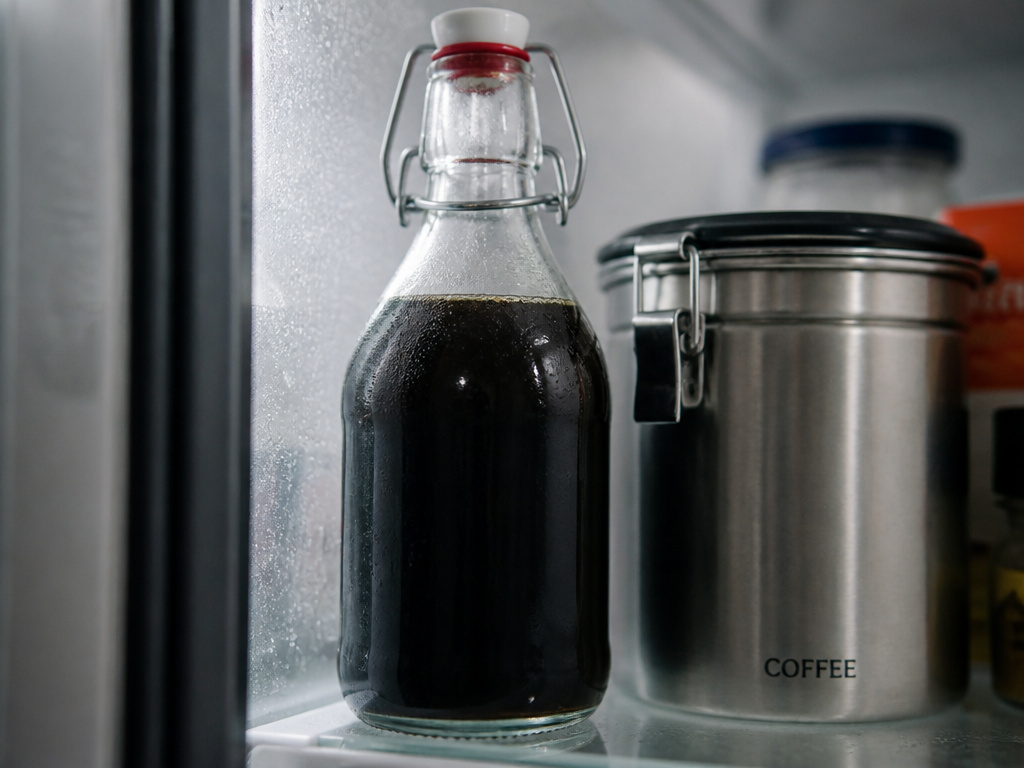
The container you choose decides the battle. For pantry storage, you need a barrier against three enemies: air, light, and moisture. An opaque, airtight canister is non-negotiable. Ceramic or stainless steel with a silicone gasket seal works. Clear glass only works if it’s kept in a dark cupboard.
For refrigerated cold brew, the priority shifts to cleanliness and a true seal. Use a dedicated glass bottle with a swing-top or screw cap that you wash thoroughly between batches. Plastic can absorb odors over time. The goal is to prevent contamination and maintain the seal to avoid absorbing other fridge smells.
This concept of dedicated, sealed storage is a universal food storage principle. It applies to storing bread to prevent drying, to freezing flour to prevent rancidity, and of course, to coffee.
A Quick Test for Your Container’s Seal
Close your empty container with a piece of paper inside. Submerge it in water. If the paper gets wet, the seal is failing. For coffee, that leak means air and moisture are getting in every minute. Upgrade the container before you worry about anything else.
Frequently Asked Questions
Can I refrigerate coffee to make it last longer?
No. Refrigeration introduces moisture and causes staling through temperature fluctuation. Whole beans stored in an airtight container in a cool pantry will stay fresher longer than beans subjected to the humid, variable fridge environment. The only longevity method that works is freezing sealed portions of whole beans.
I’ve seen baristas store coffee in the fridge. Why?
You might see this in a busy cafe where portioned single-dose bags are used within 24 hours. It’s a workflow hack, not a quality choice. The coffee is sealed and won’t absorb much moisture in that short time, but it’s still a compromise. For home use with bags opened over days or weeks, it’s a bad practice.
How long does cold brew actually last in the refrigerator?
According to the official state food safety publication, cold brew classified as a TCS food has a maximum shelf life of seven days when held at 41°F or below. This is a safety standard. Even if it smells okay after eight days, the risk of microbial growth increases. Always label your container with the brew date.
Does freezing coffee beans work?
Yes, for whole beans only. Portion them into airtight bags, squeeze out all excess air, and freeze. Thaw the entire portion at room temperature before opening. Do not refreeze. This pauses the staling process and is effective for storing beans for several months. It is categorically better than refrigeration.
What’s the best place in the kitchen for coffee beans?
Cupboard or pantry that is consistently cool, dark, and dry. Avoid spots near the oven, dishwasher, stove, or a sunlit window. Heat is the second-greatest enemy after moisture. If your kitchen gets very warm, consider a dedicated insulated container or a smaller, more frequent buying schedule.
The Bottom Line
Stop thinking about the refrigerator as a generic preservation box. For coffee, it’s a context-specific tool. Roasted beans and grounds should never see the inside of one, their enemy is humidity, and the fridge is full of it. Your best investment is a solid, opaque, airtight canister for the pantry.
Cold brew is the outlier. Treat it with the same caution as milk or fresh meat. It requires constant refrigeration at 41°F or below and has a firm seven-day expiration for safety reasons. Use a clean, sealed glass bottle and store it in the main compartment’s cold zone.
The rule is simple: beans live outside, brew lives inside. Get the container right for each, and you’ll never have a stale or unsafe cup again.
