Practical Guide: How to Keep Stuff Cold Without a Fridge
This post contains affiliate links. As an Amazon Associate, we earn from qualifying purchases.
You keep stuff cold without a fridge by matching the thermal load to the right passive or active cooling method. For 2–8°C storage over days, a WHO PQS E004-certified cold box with phase-change coolant lasts 10 days on one charge. For sub-zero needs, dry ice at 5–10 pounds per day maintains -78.5°C. For mobile power, a 12/24V compressor cooler like the HyCooler Go holds -20°C.
The 10-day spec isn’t a guess. It’s the verified performance floor for a WHO PQS E004 cold box under controlled cycling temperatures. That changes the math for off-grid food storage, disaster prep, and camping. Your cooler’s rating matters more than its brand.
What follows breaks down the four proven methods: passive ice boxes, dry ice, electric compressor coolers, and evaporation. Each has a specific temperature range, timeline, and failure point. By the end, you’ll match your groceries, medicine, or drinks to the system that actually holds the temperature you need.
Key Takeaways
- A WHO PQS E004-certified passive cold box maintains 0–8°C for 10 days minimum using frozen phase-change material, recharged about monthly.
- Dry ice sublimates at 5–10 pounds per 24 hours in a typical hard cooler; top-load wrapped blocks and never seal the lid airtight.
- Dorm-style refrigerators fail within 1.5 to 4.5 hours during a power outage per a NIST study; they are unreliable for critical storage.
- A 12/24V compressor cooler like the HyCooler Go series can hit -20°C but requires stable power or a dedicated battery pack.
- Evaporative cooling (zeer pots) works in arid climates, dropping internal temps 10–15°C below ambient, but adds humidity.
The WHO Cold Box Standard: 10 Days From One Charge
Passive cooling doesn’t mean weak. The performance specification for a long-term vaccine cold box requires a minimum cold life of 10 days. The box must keep its contents between 0.0°C and +8.0°C through day/night temperature cycles of +43°C/+25°C. It achieves this with phase-change material (PCM) coolant packs, recharged about once a month.
WHO PQS E004/CB04-VP.1 type-testing protocol verifies that qualified vaccine cold boxes maintain a cold life of at least 10 days with one charge of coolant. The internal temperature must remain greater than 0.0°C and less than or equal to +8.0°C under defined hot-zone conditions.
This is the gold standard for off-grid refrigeration. The technology isn’t secret—thick polyurethane insulation, a robust gasket seal, and engineered PCM packs that melt at a precise temperature. For food storage, this means your dairy, produce, and most medicines stay in the safe zone for over a week without electricity. The catch is upfront cost and bulk.
| Box Type | Cold Life | Temperature Range | Coolant Recharge | Best For |
|---|---|---|---|---|
| WHO PQS E004 Certified | 10+ days | 0.0°C to +8.0°C | ~1 month | Medicine, critical food, disaster prep |
| High-End Rotomolded Cooler | 5–7 days | Varies widely | Every 3–5 days | Camping, boating, tailgating |
| Basic Styrofoam Cooler | 12–24 hours | Varies wildly | Every day | Short-term transport, picnic |
You don’t need a medical-grade box for a weekend campout. But if you’re preserving meat without immediate cooking plans or need to keep basil fresh for a week at a cabin, the principle is the same: mass and phase-change material beat plain ice. Ice melts at 0°C and creates a pool of water that accelerates warming. PCM packs plateau at their designed melt point, providing steady cooling.
The short version: For predictable, long-term cold without power, invest in a cooler designed to a verified standard, not just marketing claims.
Dry Ice: The Sub-Zero Workhorse
Dry ice is solid carbon dioxide at -78.5°C (-109.3°F). It doesn’t melt; it sublimates, turning directly into CO₂ gas. This makes it phenomenally effective for deep freezing but introduces a ventilation hazard. You must never seal a cooler containing dry ice airtight.
The rule of thumb is 5–10 pounds of dry ice per 24 hours in a typical hard-sided cooler. Blocks sublimate slower than pellets. Your actual consumption depends on insulation quality, ambient temperature, and how often you open the lid.
Common mistake: Putting dry ice on the bottom for easy access. Cold air sinks. Placing the block on top creates a “cold cap” that showers your entire load with dense, frigid gas, extending hold time by hours.
- Pre-chill the cooler. Run regular ice or frozen gel packs in it for a few hours first. A warm cooler wall steals your dry ice’s cold to cool itself down.
- Wear insulated gloves and eye protection. Dry ice causes frostbite on contact. Handle blocks with thick gloves, not dish towels.
- Load items tightly. Pack frozen goods directly below the dry ice. Place items you only want chilled, or fragile items like lettuce, farther down or separated by a cardboard divider.
- Top-load the wrapped dry ice. Wrap blocks in kraft paper or a towel to slow sublimation and protect packaging. Place them on top of your load.
- Fill side voids with crumpled paper or towels. This reduces air pockets where warm air can circulate.
- Close the lid normally—do not tape or latch it shut. The CO₂ gas must escape. Most quality coolers have a designed vent path when the lid is simply closed.
If you’re traveling, label the cooler “Dry Ice/UN1845” and ensure it’s transported in a ventilated vehicle area. For mixed loads where you’re also preserving tomatoes or storing sun-dried tomatoes that shouldn’t freeze, a divider and buffer layer are non-negotiable.
Electric Compressor Coolers: Mobile But Power-Hungry
A 12/24V compressor cooler plugs into a car’s DC outlet or a battery pack. It’s a true refrigerator, not a thermoelectric cooler, so it can actually freeze. The HyCooler Go series, for example, has a temperature range of -20°C to +20°C and draws 45W.
These units are fantastic for road trips or as a backup freezer in a van. The compressor is variable-speed, so it’s quieter and more efficient than older models. The integrated battery protection prevents you from draining your car’s starter battery.
But they have hard limits. The manual states the device must sit level for 6 hours before first use to settle the compressor oil. If you tip it beyond 5 degrees while running, you risk compressor damage. They also need 50–100mm of ventilation space on all sides during operation.
| Model | Capacity | Power | Min Temp | Noise | Best Use Case |
|---|---|---|---|---|---|
| HyCooler Go 8 | 8.7L | 45W (12/24V) | -20°C | < 45 dB | Passenger seat, short trips |
| HyCooler Go 15 | 13.5L | 45W (12/24V) | -20°C | < 45 dB | Small family road trip |
| HyCooler Go 18 | 18.0L | 45W (12/24V) | -20°C | < 45 dB | Extended van life, backup storage |
Their power draw is the real constraint. A 45W cooler running continuously pulls about 3.75 amps at 12V. Over 10 hours, that’s 37.5 amp-hours. A typical car battery has about 50-70 amp-hours total capacity. You’ll need a deep-cycle auxiliary battery or a dedicated power station like the HyCooler Powerpack for stand-alone operation.
Where this goes sideways: Assuming a compressor cooler will run indefinitely off a car’s cigarette lighter. Without a dual-battery system or a power station, you’ll kill your car battery in under a day.
Why Your Mini-Fridge Is a Liability
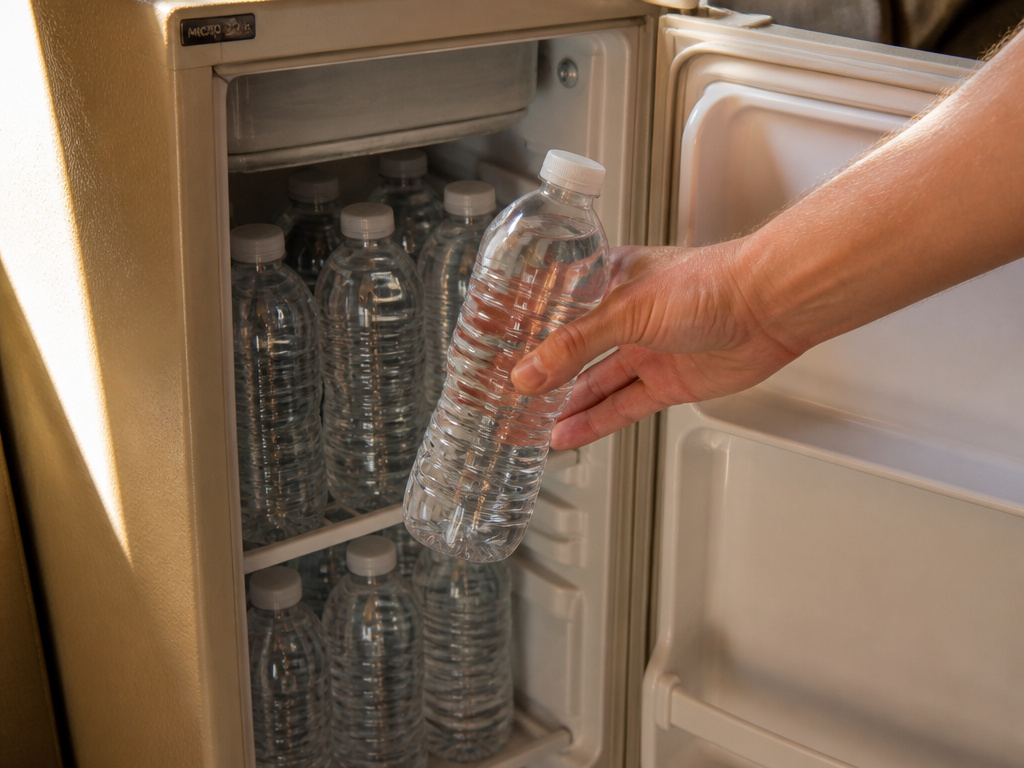
Small dorm-style refrigerators are common in offices and dorm rooms. For critical temperature-sensitive items, they are a documented risk. A NIST thermal analysis found these units cannot reliably maintain the 2°C to 8°C range required for vaccines.
The study recorded a dorm fridge failing after 15 days, with temperatures dropping below the 2°C minimum. More critically, during a power outage simulation, vaccines stored inside exceeded 8°C in 1.5 to 4.5 hours, depending on their location in the box.
The part nobody mentions: For every 1°C increase in room temperature, the internal temperature of a dorm-style refrigerator rises about 0.3°C. A hot server room or sunlit garage pushes it out of safe range fast.
This NIST thermal analysis of refrigeration underscores a principle that applies to food: thermal mass is your friend. The study showed that placing water bottles inside the fridge added ballast. During a door-ajar test, water bottles extended the safe window by 2 to 15 minutes.
If you must use a small fridge for storing coffee beans or preserving lemon zest, keep it full. Use sealed water bottles to occupy empty space. This stabilizes the internal temperature against fluctuations from the compressor cycle and door openings. Never rely on it for long-term storage during a blackout.
Evaporation, Insulation, and Buried Pots
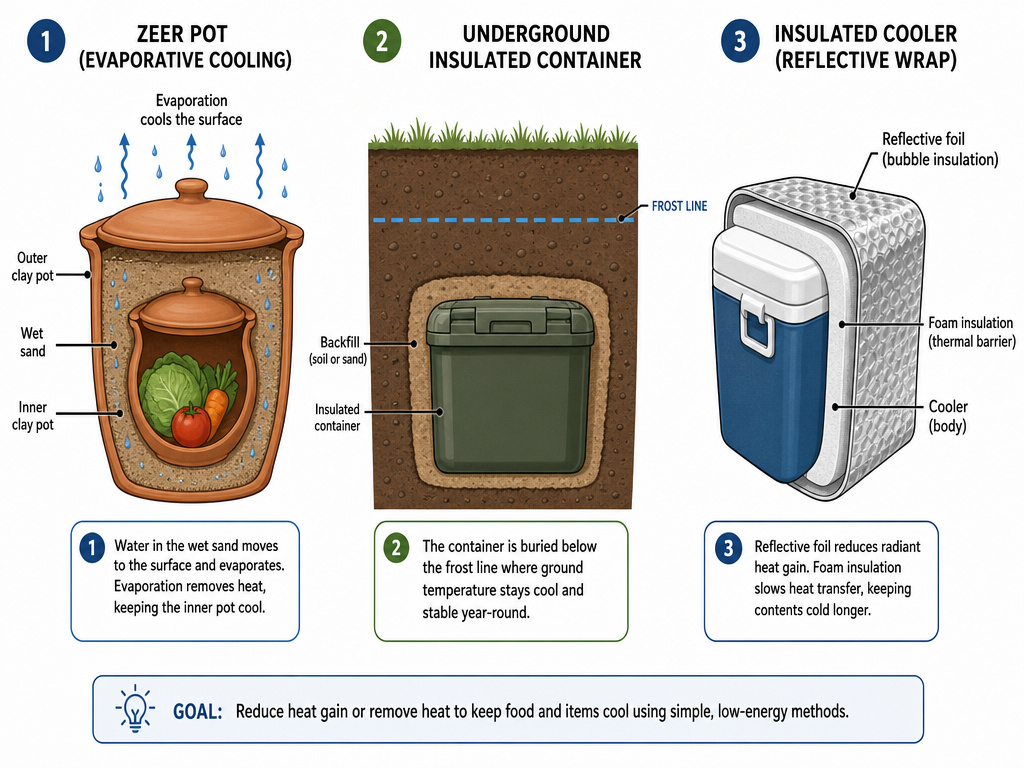
Before compressors, people used physics. These methods still work where electricity doesn’t.
Evaporative Cooling (Zeer Pot): A clay pot sits inside a larger clay pot, with wet sand filling the space between them. As water evaporates from the sand, it pulls heat from the inner pot. In arid climates, this can lower the internal temperature 10–15°C below ambient. It’s excellent for keeping vegetables like onions and tomatoes fresh in a dry, shaded spot. The downside? It adds humidity, which is terrible for crackers or dehydrated fruit.
Root Cellaring / Burying: The ground below the frost line maintains a stable temperature near 10°C year-round. Burying an insulated container, or using a basement corner, creates a natural cold zone. This is the classic method for preserving jalapenos, potatoes, and apples over winter. The key is managing moisture and ventilation to prevent mold.
Super Insulation: Reflectix-style radiant barrier foil bubble wrap is a game-changer for temporary setups. Wrapping a standard cooler in two layers can extend its ice life by 30% or more. It’s cheap, lightweight, and reusable. Combine it with PCM packs for a serious boost.
These are not equivalents to a fridge. They are stable, low-temperature environments. Your food won’t freeze, but it will spoil slower. It’s the difference between salting meat for multi-week preservation and simply keeping fresh meat cold for a few days.
Choosing Your Method: A Decision Matrix
Your goal dictates the tool. This table cuts through the noise.
| Your Goal | Best Method | Key Spec / Action | Realistic Timeline | Watch Out For |
|---|---|---|---|---|
| Keep drinks cool for a day at the beach | High-end rotomolded cooler + block ice | Pre-chill cooler, drain meltwater | 24-36 hours | Waterlogged food from melted ice |
| Transport frozen meat for 48 hours | Hard cooler + dry ice | 10-20 lbs dry ice, top-loaded, vented lid | 48-72 hours at -50°C or below | CO₂ buildup, over-freezing delicate items |
| Off-grid medicine/food storage (2-8°C) | WHO-spec cold box + PCM packs | Verify PQS E004 certification | 10+ days | Monthly coolant recharge in a freezer |
| Mobile freezing in a vehicle | 12/24V compressor cooler (HyCooler Go) | Auxiliary battery system, level placement | Indefinite (with power) | Power consumption, compressor damage from tilting |
| Extend harvest life in a dry climate | Zeer pot (evaporative cooler) | Use in shade, refill water daily | As long as evaporation continues | High humidity inside chamber |
The timeline column is where most plans fail. A generic “5-day cooler” rarely lasts five days with real food in real summer heat. The specs from the WHO cold box standard and the NIST refrigerator study give you numbers you can trust, not marketing optimism.
Frequently Asked Questions
How can I keep something cold for 24 hours without a fridge?
Use a high-quality insulated cooler pre-chilled with ice water for 30 minutes. Pack your items tightly. Use block ice instead of cubes—it melts slower. Fill all air gaps with crumpled paper or towels. If you need below-freezing temps, use dry ice at 5-10 pounds per 24 hours and never seal the lid.
What is the best insulator to keep things cold?
Polyurethane foam is the standard for coolers. For DIY, closed-cell foam sheets or aerogel blankets offer the highest resistance to heat transfer (lowest R-value). Reflectix foil-bubble wrap is excellent for reflecting radiant heat. The best solution is often layers: foam for insulation, foil for reflection, and a waterproof outer shell.
How did they keep food cold in the old days?
They used ice harvested in winter from lakes and stored in insulated ice houses, packed in sawdust. This ice was delivered to home ice boxes—insulated cabinets with a drain pan. For shorter-term cooling, they used evaporative coolers (zeer pots), spring houses (buildings over a cold spring), or root cellars dug into the earth.
Can a cooler stay cold for a week?
Yes, but only with specific technology. A WHO PQS E004-certified cold box with phase-change material coolant is tested to keep 0-8°C for 10 days. A high-end rotomolded cooler like a Yeti or RTIC, when used with refrozen PCM packs (not regular ice) and opened minimally, can often last 5-7 days in moderate climates.
Is it safe to keep food in a cooler instead of a fridge?
For short periods (2-3 days), yes, if you keep the cooler at or below 4°C (40°F). Use a thermometer. The danger zone where bacteria multiply rapidly is between 4°C and 60°C. For longer storage, you must treat it like a fridge: maintain temperature, separate raw meats, and consume perishables like dairy and cooked meat first.
Before You Go
Passive cooling works when you match the method’s physical limits to your actual need. A WHO cold box for medicine, dry ice for frozen goods, a compressor cooler for the car, and a zeer pot for garden vegetables. Each has a verified performance envelope—the 10-day spec, the 5-10 lb/day sublimation rate, the -20°C minimum, the 10-15°C drop.
Your dorm fridge isn’t on that list for a reason. The data shows it’s a temporary convenience, not a reliable storage system. Spend your effort on the method that delivers the cold you need for the duration you need it. Everything else is just hoping the ice lasts.
